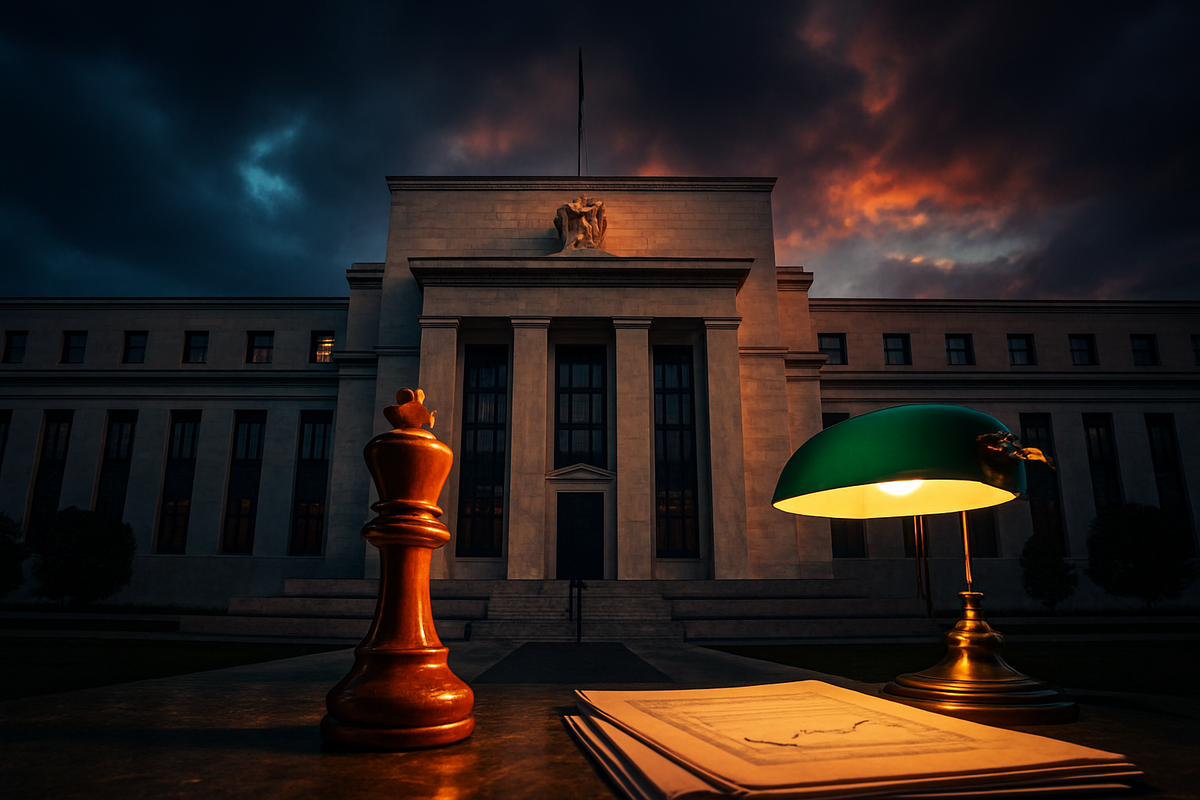
As the Federal Open Market Committee (FOMC) prepares to convene tomorrow, January 27, 2026, the financial world is less focused on the federal funds rate and more on the political storm swirling around the Eccles Building. With the current benchmark rate sitting at a range of 3.50% to 3.75% following a series of aggressive cuts in late 2025, market participants are pricing in a near-certain pause. However, the true drama lies in the imminent end of Jerome Powell’s tenure and the looming announcement of a successor who could redefine the central bank’s independence.
The two-day meeting concludes on Wednesday, and while a "hold" is the consensus, the backdrop is anything but stable. Today, January 26, investors are weighing the impact of a recent Department of Justice investigation into Chair Powell against a resilient but cooling economy. With inflation showing signs of "stickiness" near 2.8% and unemployment nudging up to 4.4%, the Fed finds itself in a delicate balancing act, attempting to sustain a "soft landing" while navigating an increasingly adversarial relationship with the White House.
A Calculated Pause Following the 2025 Pivot
The expected decision to hold rates steady marks a significant shift from the final quarter of 2025. Between September and December of last year, the Fed executed three consecutive 25-basis-point cuts, responding to a softening labor market and a desire to "recalibrate" policy before growth stalled. Those moves successfully lowered the benchmark from its 4.25%–4.50% peak to the current 3.50%–3.75% range. For now, the FOMC appears content to let those cuts work their way through the system, especially as third-quarter GDP surprised on the upside at 4.4%.
However, the meeting is overshadowed by the "Powell Succession" countdown. Jerome Powell’s second term as Chair is set to expire on May 15, 2026. While he could theoretically remain on the Board of Governors until 2028, the atmosphere has turned toxic following the DOJ's mid-January announcement of a criminal probe into a $2.5 billion renovation of the Fed’s headquarters. Powell has termed the investigation a "pretext" for political intimidation, yet the pressure for a new leader is reaching a fever pitch. Stakeholders, from Wall Street trading desks to Capitol Hill, are bracing for President Trump’s "shortlist" announcement, which is rumored to be imminent.
Winners and Losers in the "Neutral" Era
The stabilization of interest rates has created a disparate landscape for public companies, as the era of "easy money" gains is replaced by a focus on fundamental earnings power.
The Financial Giants: Major banks like JPMorgan Chase & Co. (NYSE: JPM) have shown remarkable resilience. In mid-January, JPMorgan raised its 2026 total net interest income (NII) forecast to $103 billion, suggesting that a 3.5% rate environment is a "sweet spot" for lending margins. Conversely, The Goldman Sachs Group, Inc. (NYSE: GS) is viewing the pause as a catalyst for a long-awaited rebound in M&A and IPO activity, as corporate clients finally gain the rate certainty needed to execute large-scale deals. However, State Street Corporation (NYSE: STT) has also emerged as a winner, reporting a 7% rise in NII as deposit costs finally began to stabilize.
Tech and Innovation: The "AI Capex Supercycle" continues to buoy Nvidia Corporation (NASDAQ: NVDA), but the 3.5% floor has introduced new valuation sensitivities. While Nvidia remains a market darling, analysts note that investors are no longer rewarding the stock solely on macro tailwinds; it must now contend with rising competition and geopolitical trade shifts. Apple Inc. (NASDAQ: AAPL), meanwhile, recently faced a downgrade from Oppenheimer to "Perform," with analysts arguing that at 3.5% rates, the "multiple expansion" phase is over. Future gains for the iPhone maker must now come from pure bottom-line growth rather than a lowering discount rate.
The Housing Squeeze: For homebuilders like D.R. Horton, Inc. (NYSE: DHI), the Fed pause is a double-edged sword. While it prevents mortgage rates from climbing higher, it leaves them hovering near 6%. To maintain volume, D.R. Horton has been forced to offer aggressive mortgage rate "buy-downs" as low as 3.99% for first-time buyers. While this strategy boosted orders by 3% in their latest report, it has led to a "margin squeeze," causing the stock to retreat as profitability takes a backseat to market share.
The Battle for Central Bank Independence
The wider significance of this meeting cannot be overstated. We are witnessing a historic stress test of the Federal Reserve's institutional autonomy. Historically, the Fed has operated as a technocratic shield against short-term political whims, but the current conflict—marked by the DOJ probe and public criticism from the executive branch—mirrors the tensions of the early 1980s under Paul Volcker.
This event fits into a broader trend of "fiscal-monetary blurring." President Trump’s recent directive for Fannie Mae and Freddie Mac to purchase $200 billion in mortgage bonds is a prime example of the administration attempting to lower borrowing costs through executive action, bypassing the Fed’s traditional tools. This "shadow" monetary policy complicates the Fed's mission and risks reigniting inflation if the market perceives that the central bank has lost its grip on the money supply.
What Comes Next: The "Shadow Chair" and Market Volatility
In the short term, the market will be hyper-sensitive to the names on the Fed Chair shortlist. The frontrunner, Kevin Warsh, is viewed as a "hawkish traditionalist" who could restore institutional discipline, potentially boosting the US Dollar. However, a "dovish" pick like Kevin Hassett or a market-friendly outsider like BlackRock’s Rick Rieder could signal a more aggressive return to rate cuts, which might fuel an equity rally but spook the long-term bond market.
The ultimate "wild card" is whether Powell chooses to remain as a Governor after his Chairmanship ends. Such a move would create a "Shadow Chair" dynamic, potentially leading to a fractured FOMC where the new Chair faces internal opposition from the old guard. Investors should expect significant volatility in Treasury yields as the transition approaches May, as any sign of a politically "loyalist" Fed could lead to a spike in long-term inflation premiums.
Navigating the Transition
The January 2026 Fed meeting marks the beginning of a transformative era for U.S. monetary policy. The key takeaway for investors is that the era of predictable, macro-driven gains is ending. With rates held in the mid-3% range, the market is shifting toward a "stock-picker's environment" where company-specific margins and capital allocation strategies matter more than the next Fed dot plot.
As we move forward, the market’s focus will shift from what the Fed decides to who is making those decisions. The appointment of the next Chair will be the single most important signal for the future of the dollar and global financial stability. Investors should watch the 10-year Treasury yield closely; if it begins to decouple from the Fed’s steady-state policy, it may indicate that the market is losing faith in the central bank’s ability to remain independent of the political fray.
This content is intended for informational purposes only and is not financial advice.