In the history of artificial intelligence, certain milestones mark the transition from theory to utility. While the 2023 "chatbot era" focused on generating text and images, the late 2024 release of Anthropic’s "Computer Use" capability for Claude 3.5 Sonnet signaled the dawn of the "Agentic Era." By 2026, this technology has matured from a experimental beta into the backbone of modern enterprise productivity, effectively giving AI the "hands" it needed to interact with the digital world exactly as a human would.
The significance of this development cannot be overstated. By allowing Claude to view a screen, move a cursor, click buttons, and type text, Anthropic bypassed the need for custom integrations or brittle back-end APIs. Instead, the model uses a unified interface—the graphical user interface (GUI)—to navigate any software, from legacy accounting programs to modern design suites. This leap from "chatting about work" to "actually doing work" has fundamentally altered the trajectory of the AI industry.
Mastering the GUI: The Technical Triumph of Pixel Counting
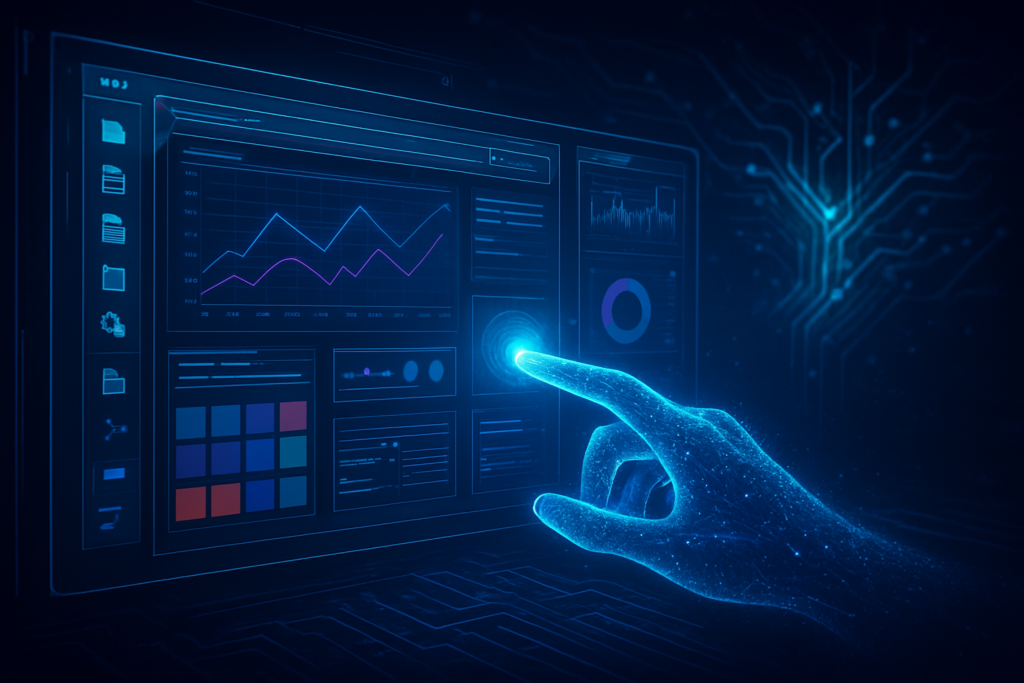
At its core, the Computer Use capability operates on a sophisticated "observation-action" loop. When a user gives Claude a command, the model takes a series of screenshots of the desktop environment. It then analyzes these images to understand the state of the interface, plans a sequence of actions, and executes them using a specialized toolset that includes a virtual mouse and keyboard. Unlike traditional automation, which relies on accessing the underlying code of an application, Claude "sees" the same pixels a human sees, making it uniquely adaptable to any visual environment.
The primary technical hurdle in this development was what Anthropic engineers termed "counting pixels." Large Language Models (LLMs) are natively proficient at processing linear sequences of tokens (text), but spatial reasoning on a two-dimensional plane is notoriously difficult for neural networks. To click a "Submit" button, Claude must not only recognize the button but also calculate its exact (x, y) coordinates on the screen. Anthropic had to undergo a rigorous training process to teach the model how to translate visual intent into precise numerical coordinates, a feat comparable to teaching a model to count the exact number of characters in a long paragraph—a task that previously baffled even the most advanced AI.
This "pixel-perfect" precision allows Claude to navigate complex, multi-window workflows. For instance, it can pull data from a PDF, open a browser to research a specific term, and then input the findings into a proprietary CRM system. This differs from previous "robotic" approaches because Claude possesses semantic understanding; if a button moves or a pop-up appears, the model doesn't break. It simply re-evaluates the new screenshot and adjusts its strategy in real-time.
The Market Shakeup: Big Tech and the Death of Brittle RPA
The introduction of Computer Use sent shockwaves through the tech sector, particularly impacting the Robotic Process Automation (RPA) market. Traditional leaders like UiPath Inc. (NYSE: PATH) built multi-billion dollar businesses on "brittle" automation—scripts that break the moment a UI element changes. Anthropic’s vision-based approach rendered many of these legacy scripts obsolete, forcing a rapid pivot. By early 2026, we have seen a massive consolidation in the space, with RPA firms racing to integrate Claude’s API to create "Agentic Automation" that can handle non-linear, unpredictable tasks.
Strategic partnerships played a crucial role in the technology's rapid adoption. Alphabet Inc. (NASDAQ: GOOGL) and Amazon.com, Inc. (NASDAQ: AMZN), both major investors in Anthropic, were among the first to offer these capabilities through their respective cloud platforms, Vertex AI and AWS Bedrock. Meanwhile, specialized platforms like Replit utilized the feature to create the "Replit Agent," which can autonomously build, test, and debug applications by interacting with a virtual coding environment. Similarly, Canva leveraged the technology to allow users to automate complex design workflows, bridging the gap between spreadsheet data and visual content creation without manual intervention.
The competitive pressure on Microsoft Corporation (NASDAQ: MSFT) and OpenAI has been immense. While Microsoft has integrated similar "agentic" features into its Copilot stack, Anthropic’s decision to focus on a generalized, screen-agnostic "Computer Use" tool gave it a first-mover advantage in the enterprise "Digital Intern" category. This has positioned Anthropic as a primary threat to the established order, particularly in sectors like finance, legal, and software engineering, where cross-application workflows are the norm.
A New Paradigm: From Chatbots to Digital Agents
Looking at the broader AI landscape of 2026, the Computer Use milestone is viewed as the moment AI became truly "agentic." It shifted the focus from the accuracy of the model’s words to the reliability of its actions. This transition has not been without its challenges. The primary concern among researchers and policymakers has been security. A model that can "use a computer" can, in theory, be tricked into performing harmful actions via "prompt injection" through the UI—for example, a malicious website could display text that Claude interprets as a command to delete files or transfer funds.
To combat this, Anthropic implemented rigorous safety protocols, including "human-in-the-loop" requirements for high-stakes actions and specialized classifiers that monitor for unauthorized behavior. Despite these risks, the impact has been overwhelmingly transformative. We have moved away from the "copy-paste" era of AI, where users had to manually move data between the AI and their applications. Today, the AI resides within the OS, acting as a collaborative partner that understands the context of our entire digital workspace.
This evolution mirrors previous breakthroughs like the transition from command-line interfaces (CLI) to graphical user interfaces (GUI) in the 1980s. Just as the GUI made computers accessible to the masses, Computer Use has made complex automation accessible to anyone who can speak or type. The "pixel-counting" breakthrough was the final piece of the puzzle, allowing AI to finally cross the threshold from the digital void into our active workspaces.
The Road Ahead: 2026 and Beyond
As we move further into 2026, the focus has shifted toward "long-horizon" planning and lower latency. While the original Claude 3.5 Sonnet was groundbreaking, it occasionally struggled with tasks requiring hundreds of sequential steps. The latest iterations, such as Claude 4.5, have significantly improved in this regard, boasting success rates on the rigorous OSWorld benchmark that now rival human performance. Experts predict that the next phase will involve "multi-agent" computer use, where multiple AI instances collaborate on a single desktop to complete massive projects, such as migrating an entire company's database or managing a global supply chain.
Another major frontier is the integration of this technology into hardware. We are already seeing the first generation of "AI-native" laptops designed specifically to facilitate Claude’s vision-based navigation, featuring dedicated chips optimized for the constant screenshot-processing cycles required for smooth agentic performance. The challenge remains one of trust and reliability; as AI takes over more of our digital lives, the margin for error shrinks to near zero.
Conclusion: The Era of the Digital Intern
Anthropic’s "Computer Use" capability has fundamentally redefined the relationship between humans and software. By solving the technical riddle of pixel-based navigation, they have created a "digital intern" capable of handling the mundane, repetitive tasks that have bogged down human productivity for decades. The move from text generation to autonomous action represents the most significant shift in AI since the original launch of ChatGPT.
As we look back from the vantage point of January 2026, it is clear that the late 2024 announcement was the catalyst for a total reorganization of the tech economy. Companies like Salesforce, Inc. (NYSE: CRM) and other enterprise giants have had to rethink their entire product suites around the assumption that an AI, not a human, might be the primary user of their software. For businesses and individuals alike, the message is clear: the screen is no longer a barrier for AI—it is a playground.
This content is intended for informational purposes only and represents analysis of current AI developments.
TokenRing AI delivers enterprise-grade solutions for multi-agent AI workflow orchestration, AI-powered development tools, and seamless remote collaboration platforms.
For more information, visit https://www.tokenring.ai/.