Let’s dig into the relative performance of Fiverr (NYSE: FVRR) and its peers as we unravel the now-completed Q4 gig economy earnings season.
The iPhone changed the world, ushering in the era of the “always-on” internet and “on-demand” services - anything someone could want is just a few taps away. Likewise, the gig economy sprang up in a similar fashion, with a proliferation of tech-enabled freelance labor marketplaces, which work hand and hand with many on demand services. Individuals can now work on demand too. What began with tech-enabled platforms that aggregated riders and drivers has expanded over the past decade to include food delivery, groceries, and now even a plumber or graphic designer are all just a few taps away.
The 6 gig economy stocks we track reported a softer Q4. As a group, revenues missed analysts’ consensus estimates by 2.1% while next quarter’s revenue guidance was 0.7% below.
Amidst this news, share prices of the companies have had a rough stretch. On average, they are down 21.6% since the latest earnings results.
Weakest Q4: Fiverr (NYSE: FVRR)
Based in Tel Aviv, Fiverr (NYSE: FVRR) operates a fixed price global freelance marketplace for digital services.
Fiverr reported revenues of $107.2 million, up 3.4% year on year. This print fell short of analysts’ expectations by 1.7%. Overall, it was a disappointing quarter for the company with full-year revenue guidance missing analysts’ expectations significantly and full-year EBITDA guidance missing analysts’ expectations significantly.
“As we close 2025, a year of disciplined execution for us, it is clear that we are living through a significant shift in AI adoption. We are seeing a profound migration on our marketplace where humans are becoming more essential, not less. By moving toward an agentic economy, where AI helps navigate complexity, we are ensuring that we remain the bridge between businesses and the most exceptional human talent. With our expansive global talent network, outcome based hiring model, and depth of proprietary data, Fiverr has a unique right to win in this new age of AI,” said Micha Kaufman, founder and CEO of Fiverr.
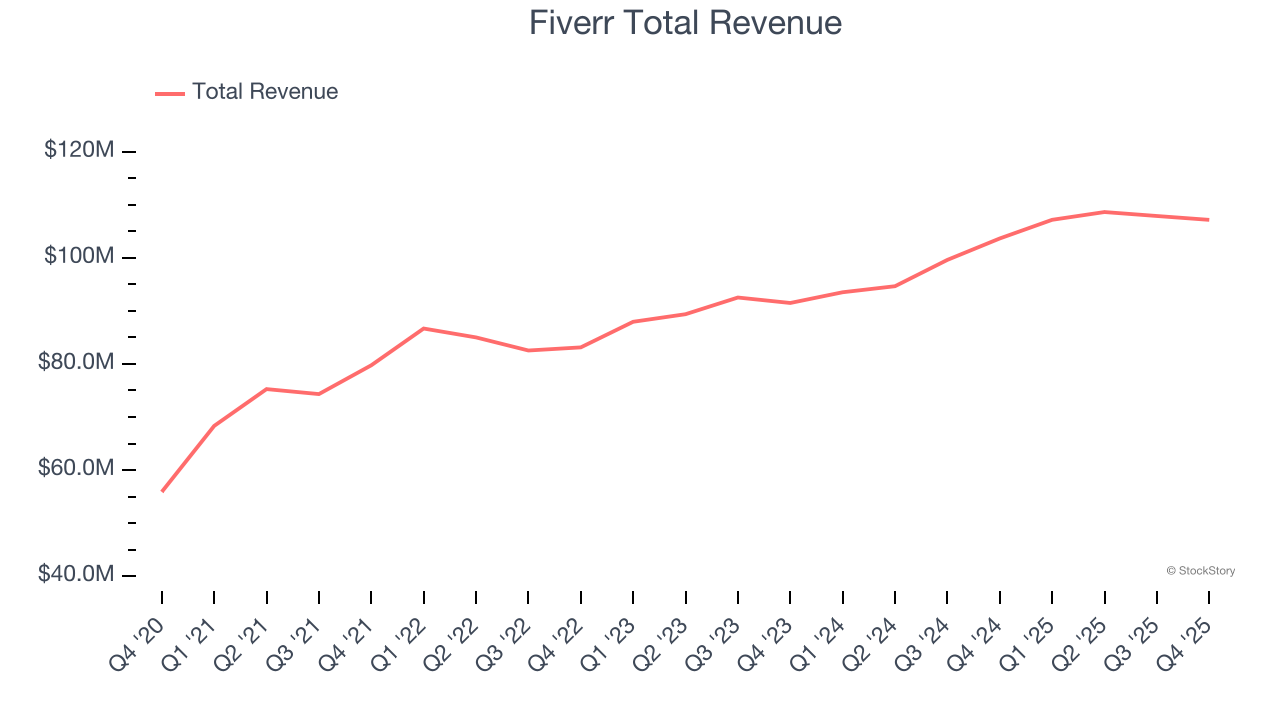
Fiverr delivered the weakest full-year guidance update of the whole group. The company reported 3.1 million active buyers, down 13.9% year on year. Unsurprisingly, the stock is down 20.7% since reporting and currently trades at $10.39.
Read our full report on Fiverr here, it’s free.
Best Q4: Uber (NYSE: UBER)
Notoriously funded with $7.7 billion from the Softbank Vision Fund, Uber (NYSE: UBER) operates a platform of on-demand services such as ride-hailing, food delivery, and freight.
Uber reported revenues of $14.37 billion, up 20.1% year on year, in line with analysts’ expectations. The business performed better than its peers, but it was unfortunately a mixed quarter with strong growth in its users.
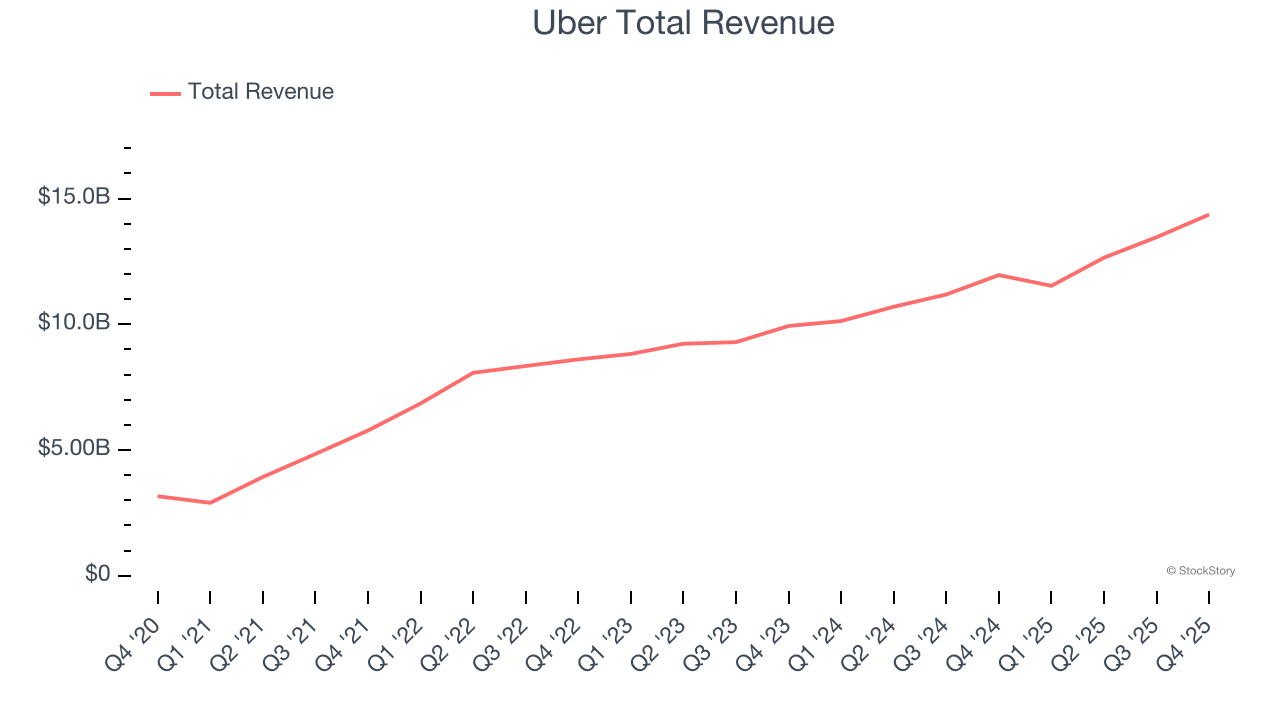
Although it had a fine quarter compared its peers, the market seems unhappy with the results as the stock is down 6.3% since reporting. It currently trades at $73.04.
Is now the time to buy Uber? Access our full analysis of the earnings results here, it’s free.
Angi (NASDAQ: ANGI)
Created by IAC’s mergers of Angie’s List and HomeAdvisor, ANGI (NASDAQ: ANGI) operates the largest online marketplace for home services in the US.
Angi reported revenues of $240.8 million, down 10.1% year on year, falling short of analysts’ expectations by 1.2%. It was a softer quarter as it posted a slight miss of analysts’ revenue estimates and a slight miss of analysts’ EBITDA estimates.
Angi delivered the slowest revenue growth in the group. As expected, the stock is down 36.8% since the results and currently trades at $7.56.
Read our full analysis of Angi’s results here.
Lyft (NASDAQ: LYFT)
Founded by Logan Green and John Zimmer as a long-distance intercity carpooling company Zimride, Lyft (NASDAQ: LYFT) operates a ridesharing network in the US and Canada.
Lyft reported revenues of $1.59 billion, up 2.7% year on year. This print lagged analysts' expectations by 9.1%. It was a softer quarter as it also recorded a significant miss of analysts’ revenue estimates and EBITDA guidance for next quarter missing analysts’ expectations significantly.
Lyft had the weakest performance against analyst estimates among its peers. The company reported 29.2 million users, up 18.2% year on year. The stock is down 23.1% since reporting and currently trades at $12.96.
Read our full, actionable report on Lyft here, it’s free.
DoorDash (NASDAQ: DASH)
Founded by Stanford students with the intent to build “the local, on-demand FedEx", DoorDash (NASDAQ: DASH) operates an on-demand food delivery platform.
DoorDash reported revenues of $3.96 billion, up 37.7% year on year. This result missed analysts’ expectations by 1.1%. Overall, it was a softer quarter as it also logged a slight miss of analysts’ revenue estimates and EBITDA guidance for next quarter missing analysts’ expectations significantly.
DoorDash scored the fastest revenue growth among its peers. The company reported 903 million service requests, up 31.8% year on year. The stock is down 6.3% since reporting and currently trades at $162.51.
Read our full, actionable report on DoorDash here, it’s free.
Want to invest in winners with rock-solid fundamentals? Check out our Top 5 Growth Stocks and add them to your watchlist. These companies are poised for growth regardless of the political or macroeconomic climate.
StockStory’s analyst team — all seasoned professional investors — uses quantitative analysis and automation to deliver market-beating insights faster and with higher quality.