Scientific instrument company Bruker (NASDAQ: BRKR). reported Q4 CY2025 results exceeding the market’s revenue expectations, but sales were flat year on year at $977.2 million. The company’s full-year revenue guidance of $3.59 billion at the midpoint came in 3.1% above analysts’ estimates. Its non-GAAP profit of $0.59 per share was 10.9% below analysts’ consensus estimates.
Is now the time to buy Bruker? Find out by accessing our full research report, it’s free.
Bruker (BRKR) Q4 CY2025 Highlights:
- Revenue: $977.2 million vs analyst estimates of $963.3 million (flat year on year, 1.4% beat)
- Adjusted EPS: $0.59 vs analyst expectations of $0.66 (10.9% miss)
- Adjusted EBITDA: $134.4 million vs analyst estimates of $189.5 million (13.8% margin, 29.1% miss)
- Adjusted EPS guidance for the upcoming financial year 2026 is $2.13 at the midpoint, missing analyst estimates by 0.8%
- Operating Margin: 7.8%, in line with the same quarter last year
- Free Cash Flow Margin: 21.2%, up from 15.6% in the same quarter last year
- Organic Revenue fell 5% year on year (beat)
- Market Capitalization: $6.45 billion
Company Overview
With roots dating back to the pioneering days of nuclear magnetic resonance technology, Bruker (NASDAQ: BRKR) develops and manufactures high-performance scientific instruments that enable researchers and industrial analysts to explore materials at microscopic, molecular, and cellular levels.
Revenue Growth
A company’s long-term performance is an indicator of its overall quality. Any business can experience short-term success, but top-performing ones enjoy sustained growth for years. Luckily, Bruker’s sales grew at a decent 11.6% compounded annual growth rate over the last five years. Its growth was slightly above the average healthcare company and shows its offerings resonate with customers.
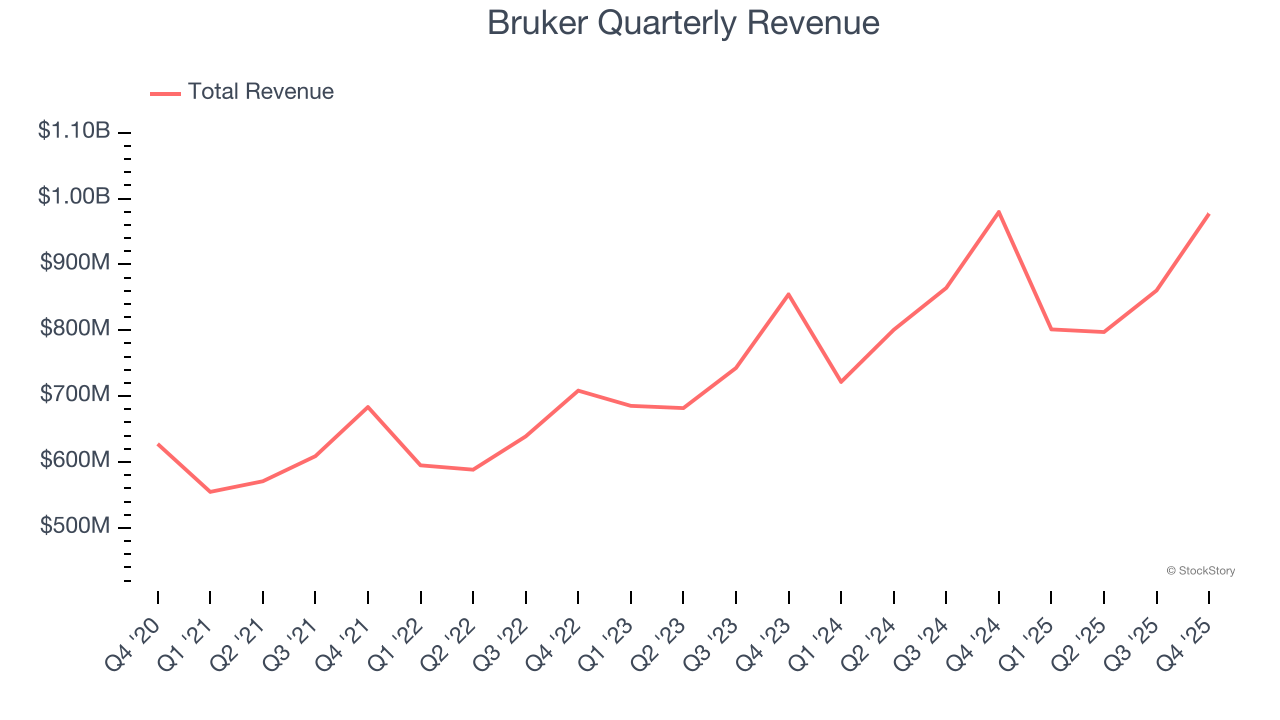
Long-term growth is the most important, but within healthcare, a half-decade historical view may miss new innovations or demand cycles. Bruker’s annualized revenue growth of 7.7% over the last two years is below its five-year trend, but we still think the results were respectable. 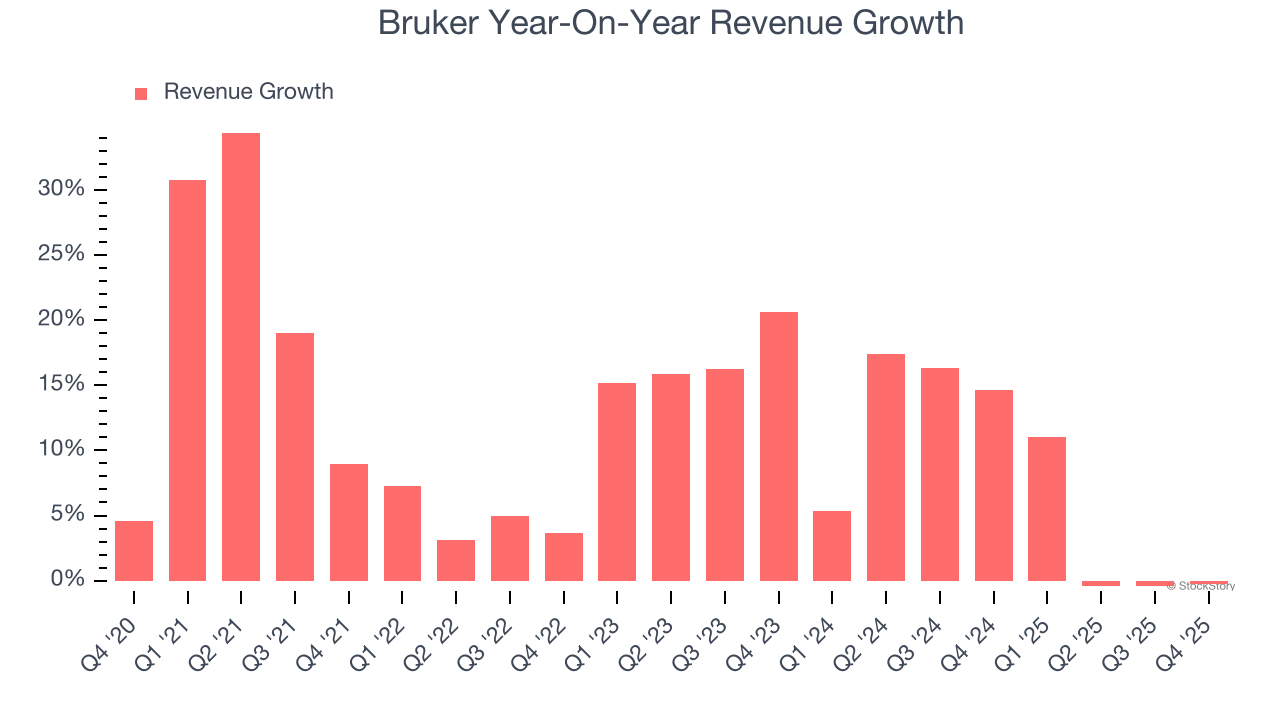
Bruker also reports organic revenue, which strips out one-time events like acquisitions and currency fluctuations that don’t accurately reflect its fundamentals. Over the last two years, Bruker’s organic revenue was flat. Because this number is lower than its two-year revenue growth, we can see that some mixture of acquisitions and foreign exchange rates boosted its headline results. 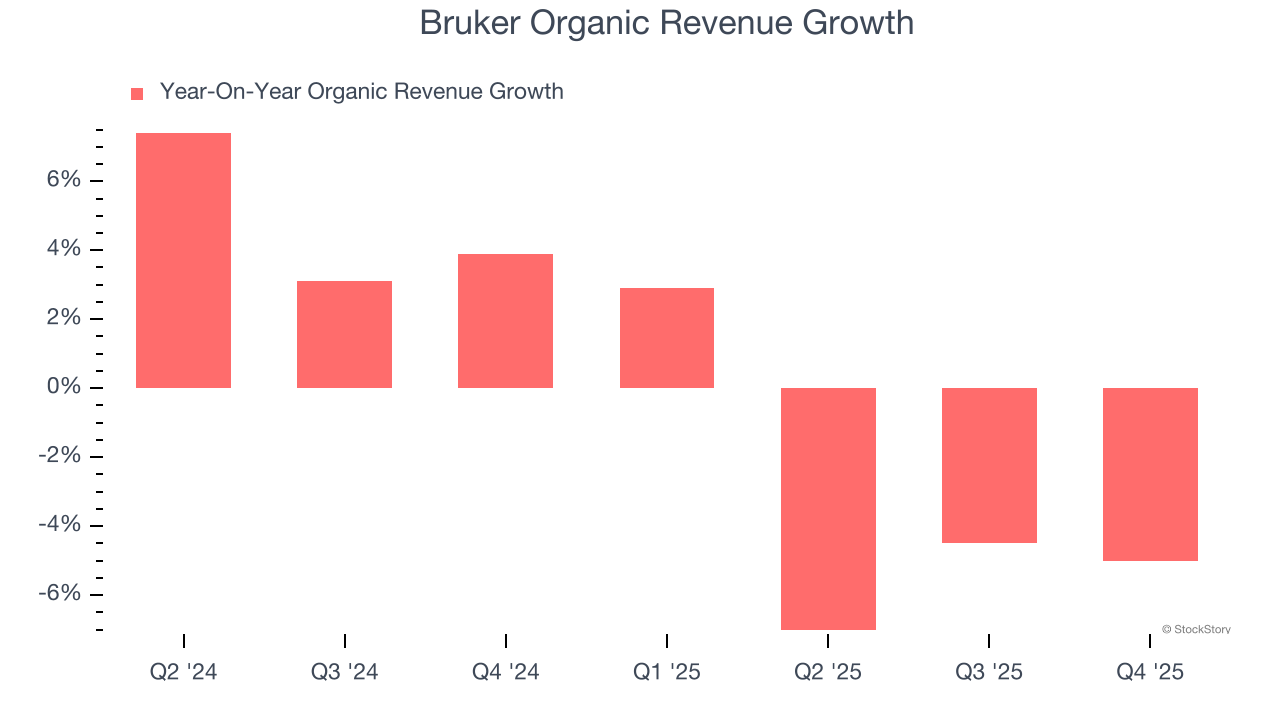
This quarter, Bruker’s $977.2 million of revenue was flat year on year but beat Wall Street’s estimates by 1.4%.
Looking ahead, sell-side analysts expect revenue to grow 1.5% over the next 12 months, a deceleration versus the last two years. This projection doesn't excite us and suggests its products and services will see some demand headwinds.
Software is eating the world and there is virtually no industry left that has been untouched by it. That drives increasing demand for tools helping software developers do their jobs, whether it be monitoring critical cloud infrastructure, integrating audio and video functionality, or ensuring smooth content streaming. Click here to access a free report on our 3 favorite stocks to play this generational megatrend.
Operating Margin
Operating margin is a key measure of profitability. Think of it as net income - the bottom line - excluding the impact of taxes and interest on debt, which are less connected to business fundamentals.
Bruker has done a decent job managing its cost base over the last five years. The company has produced an average operating margin of 10.9%, higher than the broader healthcare sector.
Looking at the trend in its profitability, Bruker’s operating margin decreased by 15.1 percentage points over the last five years. The company’s two-year trajectory also shows it failed to get its profitability back to the peak as its margin fell by 12.8 percentage points. This performance was poor no matter how you look at it - it shows its expenses were rising and it couldn’t pass those costs onto its customers.
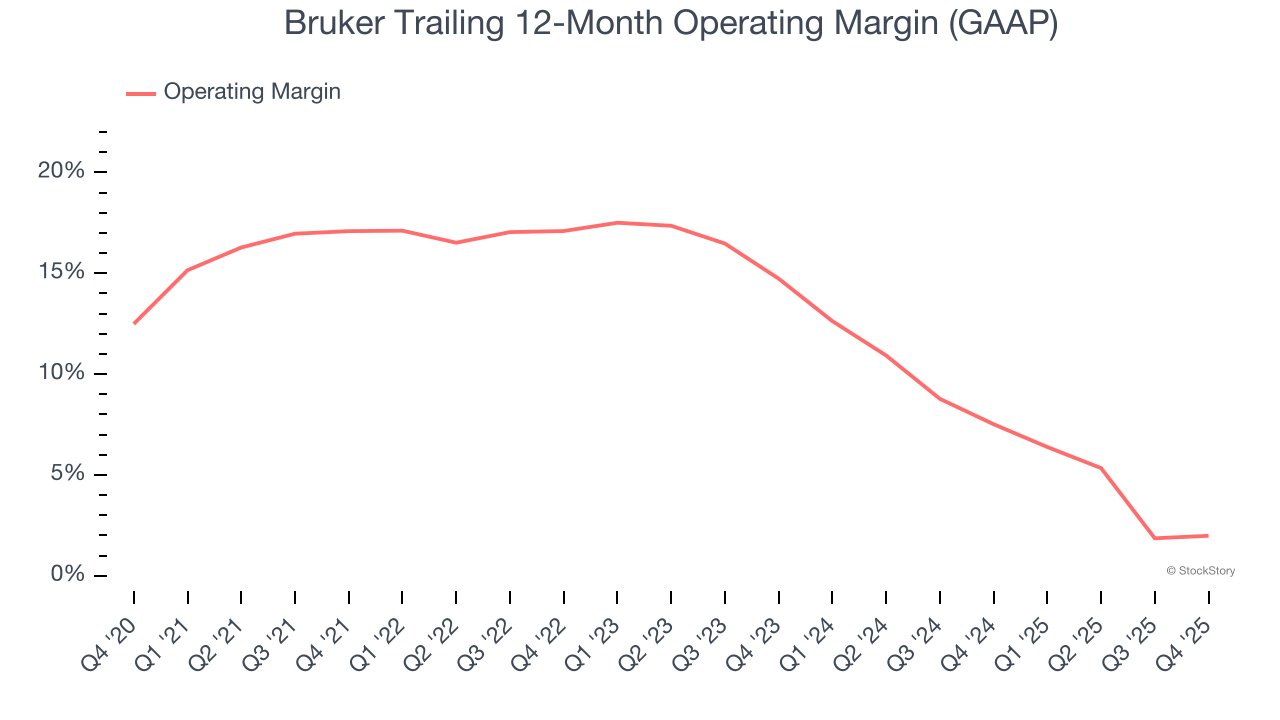
In Q4, Bruker generated an operating margin profit margin of 7.8%, in line with the same quarter last year. This indicates the company’s overall cost structure has been relatively stable.
Earnings Per Share
We track the long-term change in earnings per share (EPS) for the same reason as long-term revenue growth. Compared to revenue, however, EPS highlights whether a company’s growth is profitable.
Bruker’s EPS grew at a decent 6.3% compounded annual growth rate over the last five years. However, this performance was lower than its 11.6% annualized revenue growth, telling us the company became less profitable on a per-share basis as it expanded.
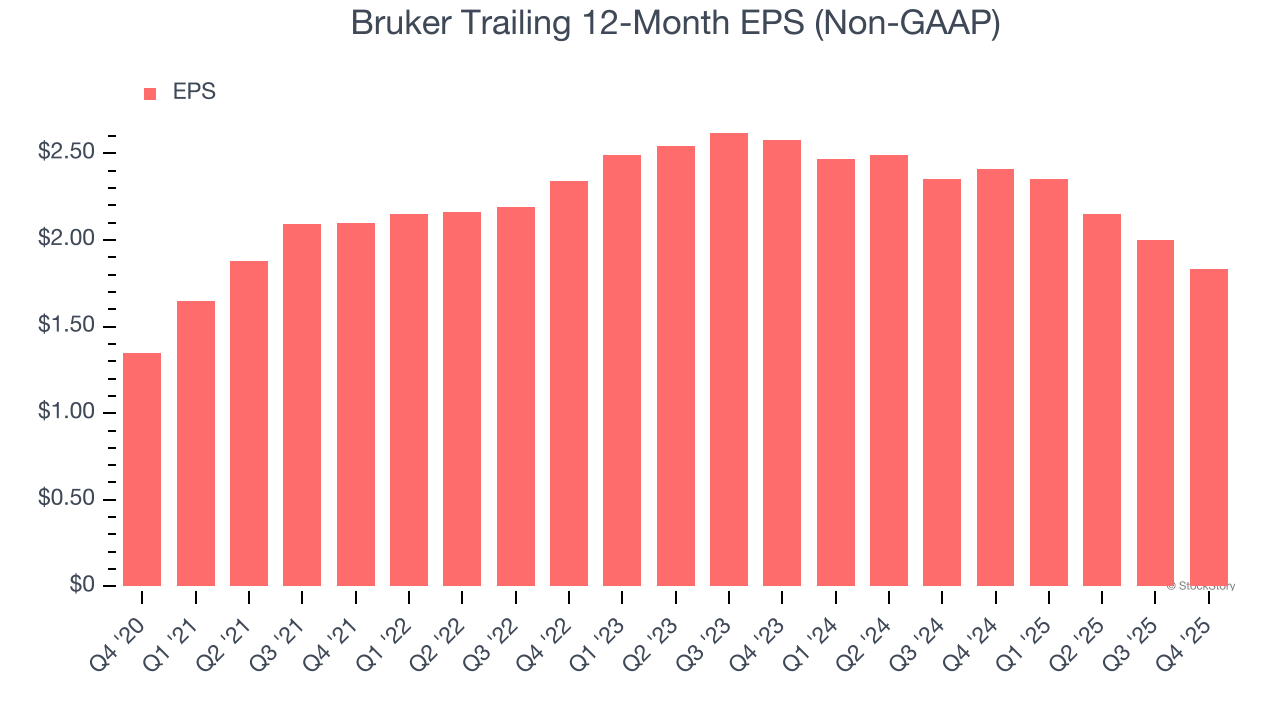
Diving into the nuances of Bruker’s earnings can give us a better understanding of its performance. As we mentioned earlier, Bruker’s operating margin was flat this quarter but declined by 15.1 percentage points over the last five years. This was the most relevant factor (aside from the revenue impact) behind its lower earnings; interest expenses and taxes can also affect EPS but don’t tell us as much about a company’s fundamentals.
In Q4, Bruker reported adjusted EPS of $0.59, down from $0.76 in the same quarter last year. This print missed analysts’ estimates, but we care more about long-term adjusted EPS growth than short-term movements. Over the next 12 months, Wall Street expects Bruker’s full-year EPS of $1.83 to grow 16.7%.
Key Takeaways from Bruker’s Q4 Results
We were impressed by Bruker’s optimistic full-year revenue guidance, which blew past analysts’ expectations. We were also glad its organic revenue outperformed Wall Street’s estimates. On the other hand, its EPS missed and its full-year EPS guidance fell slightly short of Wall Street’s estimates. Overall, this print was mixed, with guidance likely to weigh on shares. The stock remained flat at $42.38 immediately after reporting.
Should you buy the stock or not? When making that decision, it’s important to consider its valuation, business qualities, as well as what has happened in the latest quarter. We cover that in our actionable full research report which you can read here (it’s free).