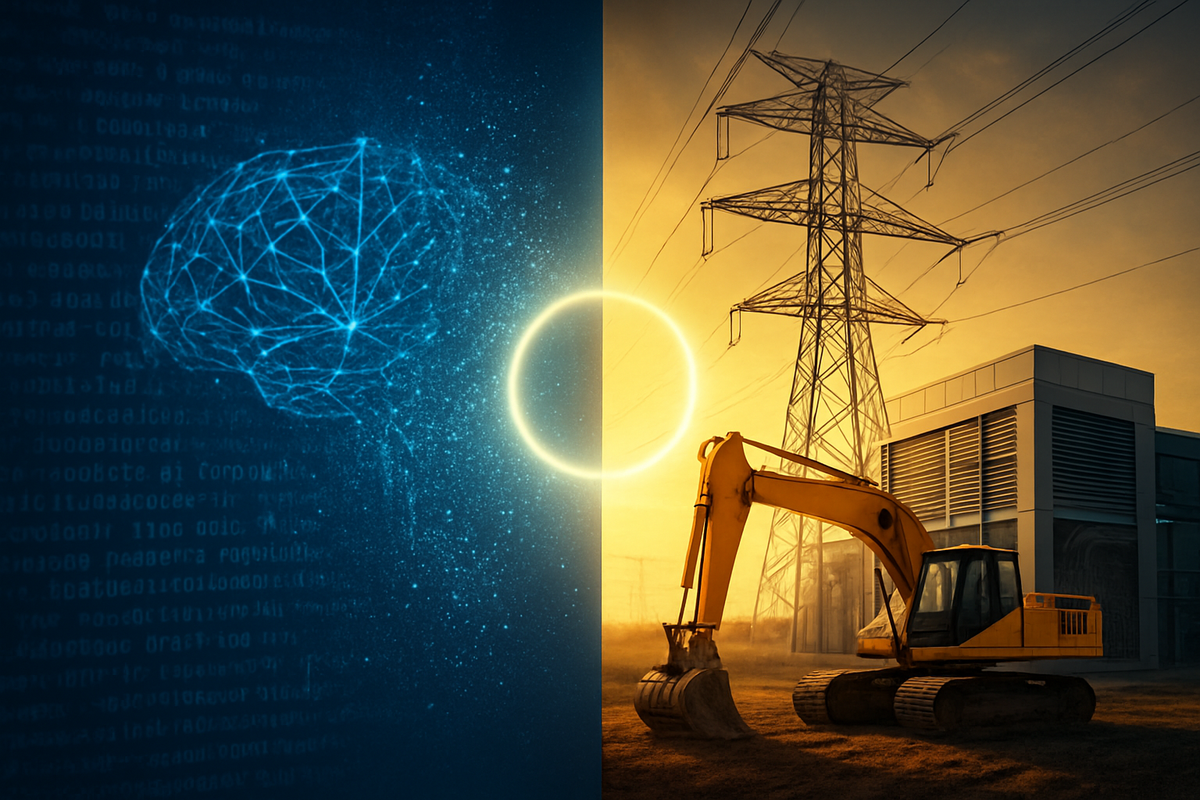
As the first quarter of 2026 draws to a close, a seismic shift in investor sentiment has fundamentally reshaped the landscape of the New York Stock Exchange and the Nasdaq. After three years of relentless enthusiasm for artificial intelligence software and generative models, the market has entered what analysts are calling the "software slaughterhouse." In its place, a new investment philosophy has emerged: the 'HALO' trade. This strategy, which stands for Heavy Assets, Low Obsolescence, marks a strategic retreat from the digital frontier toward the physical foundations of the global economy.
The emergence of the HALO trade comes as a direct response to a massive sell-off in AI-related software stocks that began in early February. Investors, once captivated by the promise of infinite productivity gains, are now grappling with the "paradox of abundance"—the fear that AI will make digital products so cheap and easy to replicate that their profit margins will evaporate. Consequently, capital is fleeing high-multiple tech giants and rotating into companies with massive, tangible infrastructure that AI cannot replicate or "code away."
The "Software Slaughterhouse" and the Birth of a New Acronym
The catalyst for this shift occurred in February 2026, following the release of a series of "agentic" AI tools, most notably Claude Code and Claude Workbench from Anthropic. These tools demonstrated a startling ability to automate entire lifecycles of software engineering and legacy system modernization. While a triumph for technology, it proved a disaster for market valuations. Established players like Salesforce (NYSE: CRM) and IBM (NYSE: IBM) saw double-digit declines as the market began to price in a world where proprietary code no longer serves as a competitive moat.
The term "HALO" was popularized by Josh Brown, CEO of Ritholtz Wealth Management, and quickly adopted by institutional desks at Goldman Sachs and Morgan Stanley. The narrative is simple: in a world where intelligence is a commodity, scarcity moves to the physical realm. "You can't hallucinate a power grid," Brown noted during a widely cited mid-February broadcast. "You can't prompt an oil pipeline into existence. The more digital intelligence we have, the more valuable the physical assets required to house and power it become."
The timeline leading to this moment was paved by the staggering capital expenditure (capex) of the "Big Four" hyperscalers. Between 2023 and the current date of March 5, 2026, Microsoft (NASDAQ: MSFT), Alphabet Inc. (NASDAQ: GOOGL), Amazon (NASDAQ: AMZN), and Meta (NASDAQ: META) have collectively spent an estimated $1.5 trillion on data centers and energy infrastructure. However, as the law of diminishing returns began to hit their own stock prices, investors realized the true winners weren't the ones spending the money, but the "HALO" companies receiving it.
Winners of the Physical Pivot vs. the Hyperscaler Slump
The HALO trade has created a distinct class of winners across two main categories: the AI-Insulated and the AI-Infrastructure providers. In the former camp, "Old Economy" giants have become unlikely safe havens. Walmart (NYSE: WMT) and McDonald’s (NYSE: MCD) have seen their multiples expand as investors prize their massive physical footprints and global supply chains—assets that remain vital regardless of how advanced LLMs become. Similarly, industrial stalwarts like Caterpillar (NYSE: CAT) and John Deere (NYSE: DE) are being revalued as "un-disruptable" entities that own the machinery of the physical world.
The most aggressive growth in the HALO trade, however, is found in the "picks and shovels" of the AI era. Constellation Energy (NASDAQ: CEG) and the uranium producer Cameco (NYSE: CCJ) have reached record highs as the demand for 24/7 nuclear power to feed data centers becomes a national security priority. Infrastructure specialists like Vertiv (NYSE: VRT), which provides liquid cooling systems for high-density chips, and Eaton (NYSE: ETN), a leader in power management, have outperformed the broader tech indices by a wide margin over the last six months.
Conversely, the very companies that built the AI era—Microsoft, Google, Amazon, and Meta—find themselves in a difficult position. While they remain highly profitable, their stocks have stagnated as they face a "capex trap." They are forced to spend hundreds of billions of dollars to stay competitive in the AI race, but the market is no longer rewarding that spending with higher price-to-earnings multiples. Instead, the market is treating them as high-cost utility providers for the very HALO companies that are now leading the indices.
The Scarcity of Atoms in an Age of Infinite Bits
This event fits into a broader historical trend where technological revolutions eventually lead to the commoditization of the technology itself, shifting value to the underlying constraints. Much like the railroad boom of the 19th century eventually shifted value from the train manufacturers to the owners of the land and the coal mines, the AI boom is shifting from the model builders to the providers of electricity and hardware.
The wider significance of the HALO trade lies in the "re-pricing of scarcity." For the last decade, the market prioritized "asset-light" business models—software companies with high margins and low physical costs. The HALO trade flips this on its head. Today, high capital intensity is viewed as a protective moat. If it costs $20 billion to build a modern semiconductor fab or a nuclear-powered data center, that is $20 billion of protection against a startup with a clever algorithm.
Regulatory and policy implications are also emerging. Governments are increasingly viewing HALO assets—specifically energy and domestic manufacturing—as critical infrastructure. This has led to a cooling of the "AI-at-all-costs" mentality, with regulators in the U.S. and EU focusing more on the environmental impact of massive data centers and the stability of the power grid, further increasing the value of existing, permitted energy assets like those owned by NextEra Energy (NYSE: NEE) and ExxonMobil (NYSE: XOM).
What Lies Ahead: The Resilience of the Physical Hedge
In the short term, the market is likely to see a continued "valuation gap" between the high-flying HALO stocks and the depressed software sector. As long as AI continues to demonstrate rapid capabilities in white-collar task automation, the fear of "digital obsolescence" will keep the pressure on software-as-a-service (SaaS) companies. Strategic pivots will be required; software firms must prove they can integrate AI to create truly unique, non-replicable value, or face further devaluation.
Longer-term, the question remains whether the HALO trade will become overcrowded. If every investor piles into "safe" assets like energy and industrials, their yields will compress, and their valuations may become as stretched as the tech stocks they replaced. However, the physical constraints of the real world—the time it takes to build a power plant or mine copper—suggest that the "supply" of HALO assets cannot be increased as quickly as the "supply" of AI tokens, potentially sustaining this trend for years to come.
Market participants should also watch for a potential "re-convergence." If the hyperscalers can successfully turn their massive physical investments into high-margin sovereign AI clouds, they may reclaim their status as market leaders. But for now, the "bits" are in a bear market, and the "atoms" are king.
The Enduring Impact of the HALO Strategy
The emergence of the HALO trade marks a definitive end to the "irrational exuberance" phase of the AI revolution. It represents a maturation of the market, where investors are no longer content with the promise of future efficiency but are demanding the security of tangible assets. The shift from "asset-light" to "Heavy Assets, Low Obsolescence" is not just a temporary hedge; it is a recognition that in an increasingly virtual world, the physical foundations are more precious than ever.
Moving forward, the market will likely be characterized by a "barbell" approach: investors will hold the dominant AI hyperscalers for their sheer scale and cash flow, but will balance those positions with a heavy allocation to HALO stocks to protect against the disruptive volatility of the software they are creating. The "Goldilocks" era of tech, where software had both high growth and high moats, appears to be over.
For the months ahead, investors should keep a close eye on energy prices, data center vacancy rates, and the quarterly capex guidance from the Big Four. Any sign that the physical constraints of AI—power and cooling—are being solved could signal a peak in the HALO trade. Until then, the smart money on Wall Street is betting that the most valuable thing in an AI-driven world is something you can actually touch.
This content is intended for informational purposes only and is not financial advice.