As of March 5, 2026, the technology sector is undergoing a massive "Second Wave" of growth, driven by a fundamental shift from experimental artificial intelligence to the deployment of autonomous "AI Agents." This transition, spearheaded by recent breakthroughs from Meta and Anthropic, has catalyzed a significant market rebound, pushing the NASDAQ-100 index (INDEXNASDAQ: NDX) past the historic 25,000-point milestone earlier this week. The latest advancements in Large Language Models (LLMs) are no longer just about chat interfaces; they are about the "industrialization of intelligence," where AI systems can now navigate complex software environments and execute multi-step business processes with minimal human oversight.
The immediate implications of these developments are profound. Institutional investors, who spent much of 2024 and 2025 questioning the return on investment (ROI) for AI, are now seeing a clear path to profitability as enterprise adoption scales. Meta's open-source dominance with its Llama 4 family and Anthropic’s leadership in agentic reliability with the newly released Claude 4.6 have fundamentally altered the competitive landscape. This "agentic era" is not only driving cloud revenue for hyperscalers but is also fueling a massive infrastructure supercycle that has sustained the broader markets despite geopolitical volatility in the Middle East and fluctuating energy costs.
From Models to Agents: The 2025-2026 AI Roadmap
The current market momentum is the culmination of a strategic pivot that began in early 2025. Meta (NASDAQ: META) disrupted the sector in April 2025 with the release of the Llama 4 family, which introduced a "mixture of experts" (MoE) architecture designed for native multimodality. The family includes three tiers: Scout (17B parameters for edge devices), Maverick (the 400B parameter industry workhorse), and Behemoth, a 2T+ parameter model that became the first open-source system to consistently outperform closed-source peers on complex reasoning benchmarks. Meta's decision to provide a "Llama Stack" in partnership with IBM (NYSE: IBM) and Dell (NYSE: DELL) has allowed Fortune 500 companies to host these powerful models locally, ensuring data sovereignty while cutting costs.
Simultaneously, Anthropic has solidified its position as the premier choice for high-stakes enterprise applications. Following the successful launch of the Claude 4 series in May 2025—which first introduced the revolutionary "computer use" capability—Anthropic released Claude 4.6 in February 2026. This latest iteration has reduced latency by nearly 70% and achieved a record-breaking 82% success rate on the SWE-bench for autonomous coding. Anthropic’s strategic partnerships have been equally pivotal; a $4 billion follow-on investment from Amazon (NASDAQ: AMZN) in late 2024 and an expanded compute deal with Google (NASDAQ: GOOGL) have given the startup the massive TPU-based compute resources needed to challenge OpenAI’s dominance.
The timeline of these events suggests a maturing industry. While 2023 was the year of "hype" and 2024 was the year of "prototyping," 2025 emerged as the year of "infrastructure." Now, in early 2026, we are witnessing the "execution" phase. Market reactions have been overwhelmingly positive, with Meta’s stock rising 22% over the last six months as its AI-driven advertising tools began delivering double-digit conversion improvements for small businesses.
Winners and Losers in the New Intelligence Economy
In this intensified competitive landscape, the clear winners are the "Inference Giants" and the "Infrastructure Enablers." Nvidia (NASDAQ: NVDA) remains the primary beneficiary, recently hitting a staggering $5 trillion valuation. While the focus has shifted from training models to running (inference) them, Nvidia’s Blackwell and upcoming Rubin (R100) architectures continue to be the gold standard for high-performance compute. Furthermore, companies like Palantir (NYSE: PLTR) have seen a surge in demand, as their platforms provide the necessary "operating system" for enterprises to deploy Anthropic’s agentic models within secure, classified, or highly regulated environments.
Cloud service providers are also reaping rewards, though the nature of their growth is changing. Amazon’s AWS and Google Cloud have transitioned from being mere vendors to becoming integrated AI partners. Amazon’s decision to integrate Claude 4.6 deeply into its Bedrock platform has attracted a new wave of enterprise customers who prioritize "agentic reliability" over raw model size. However, the rapid advancement of these autonomous agents has placed traditional Software-as-a-Service (SaaS) providers under immense pressure. Companies that previously charged "per seat" for basic productivity tools are finding their business models disrupted by AI agents that can perform the tasks of five human users for a fraction of the cost.
On the losing side, "AI laggards"—companies that failed to modernize their data stacks during the 2024 window—are facing a widening productivity gap. Mid-sized software firms that relied on simple API wrappers around older models like GPT-4 are seeing their margins evaporate as Meta’s Maverick (Llama 4) provides superior performance for free via open-source channels. Furthermore, hardware companies without a clear path to AI integration are being rotated out of investor portfolios in favor of "AI-ready" industrial and energy stocks.
The Broader Significance: Energy, Geopolitics, and $650B in Capex
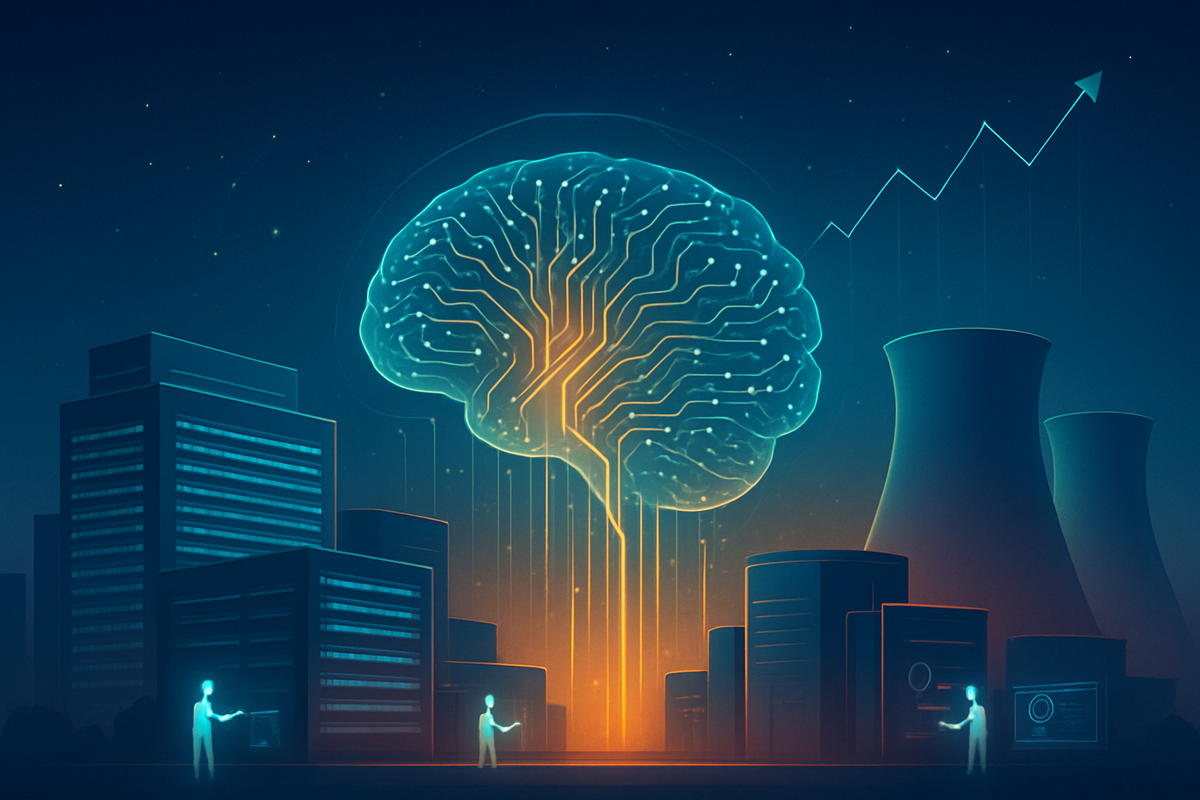
The significance of the Meta and Anthropic advancements extends far beyond Silicon Valley. We are now in a "Physical Substrate" era where tech performance is inextricably linked to energy and geopolitics. The "Big Four" hyperscalers—Meta, Alphabet, Amazon, and Microsoft (NASDAQ: MSFT)—are projected to spend over $650 billion on capital expenditures in 2026. This astronomical spending is not just for chips, but for the power grids and cooling systems required to sustain them. Microsoft’s recent "Stargate" data center milestones and Amazon’s acquisition of nuclear-adjacent land highlight a new trend: tech companies are becoming energy moguls to secure their AI futures.
This shift has created a "halo trade" in the energy sector, particularly in nuclear and renewable utilities, as investors realize that the growth of AI agents is capped by the availability of gigawatts. Historically, this mirrors the industrial revolution, where the shift from steam to electricity fundamentally reorganized the global economy. Today, the transition from "human-in-the-loop" to "human-on-the-loop" AI agents is similarly reorganizing the labor market. While entry-level white-collar roles in law and finance are seeing displacement, the demand for "AI Orchestrators" has grown by 80% year-over-year.
Looking Ahead: The Road to Autonomous Enterprise
In the short term, the market will be laser-focused on the Q1 2026 earnings reports to see if the massive capex spending is translating into "inference-driven" revenue. Strategic pivots are already underway; Microsoft is rumored to be preparing a massive update to its Copilot ecosystem to match the "computer use" capabilities of Claude 4.6, while Meta is expected to further integrate Llama 4 into its upcoming "Orion" augmented reality glasses, blending spatial computing with agentic AI.
The long-term outlook remains bullish but fraught with "bottleneck risks." The upcoming launch of Nvidia’s Rubin architecture in late 2026 will be a critical test of whether the hardware can keep up with the increasing complexity of model architectures. Additionally, the industry must navigate the "data wall"—the point where high-quality human-generated data for training becomes scarce. This will likely lead to a surge in "synthetic data" startups and new partnerships with media conglomerates for proprietary licensing deals.
Summary: A Mature Bull Market in Intelligence
The advancements by Meta and Anthropic in early 2026 mark the definitive end of the "AI hype" phase and the beginning of the "AI utility" phase. Meta’s open-source Llama 4 has commoditized intelligence, making it an accessible utility for the global economy, while Anthropic’s Claude 4.6 has set the gold standard for reliable, autonomous action. Together, these developments have provided the fundamental justification for the tech sector’s record-breaking rebound, even in the face of macro-economic headwinds.
Moving forward, the market will be driven by "execution metrics": inference costs, energy efficiency, and agentic accuracy. Investors should look beyond the headline-grabbing models and pay close attention to the infrastructure that supports them—specifically custom silicon (TPUs/Trainium), high-bandwidth memory (HBM), and energy-independent data centers. The transition to an agent-led economy is no longer a future projection; it is the current reality of March 2026.
This content is intended for informational purposes only and is not financial advice.
Key Public Companies Mentioned:
- Meta Platforms, Inc. (NASDAQ: META)
- Alphabet Inc. (NASDAQ: GOOGL)
- Amazon.com, Inc. (NASDAQ: AMZN)
- NVIDIA Corporation (NASDAQ: NVDA)
- Microsoft Corporation (NASDAQ: MSFT)
- Palantir Technologies Inc. (NYSE: PLTR)
- IBM Corporation (NYSE: IBM)
- Dell Technologies Inc. (NYSE: DELL)
- Micron Technology, Inc. (NASDAQ: MU)