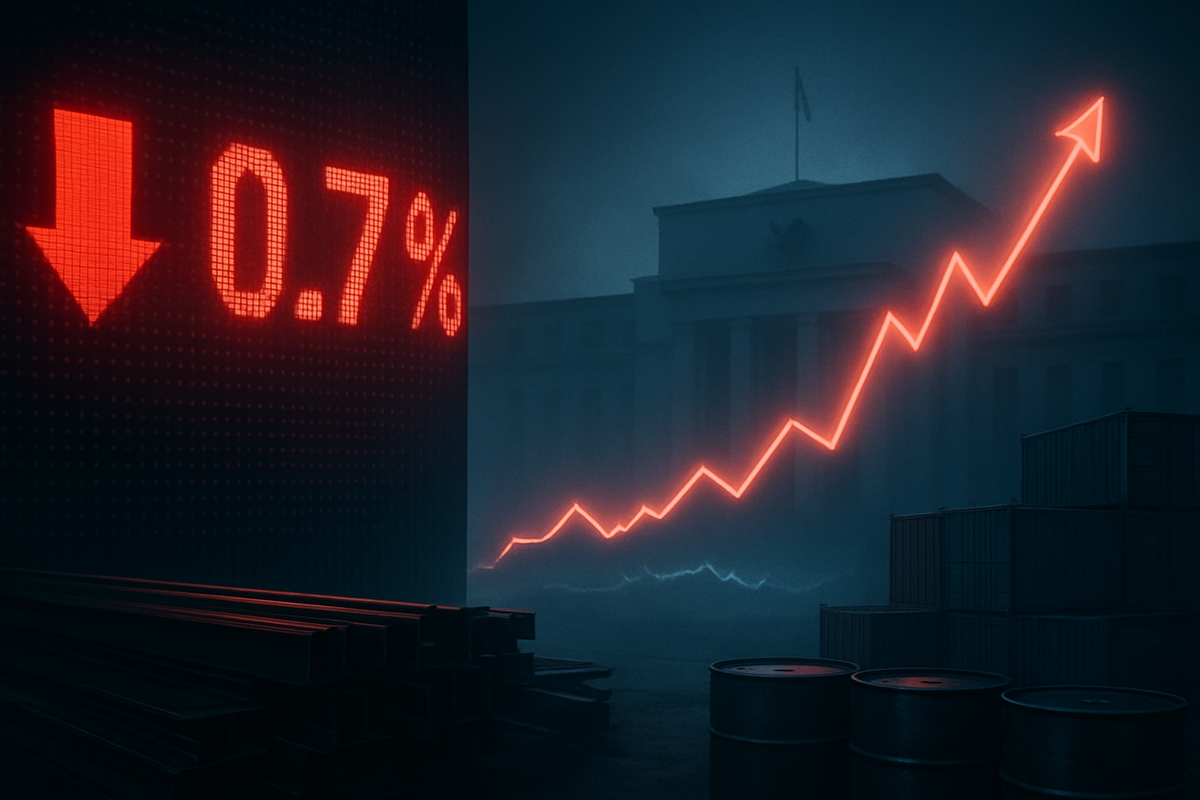
The dream of a “soft landing” for the U.S. economy faced its harshest reality check yet this week as the Bureau of Labor Statistics released Producer Price Index (PPI) data for February 2026. The report revealed a blistering 0.7% monthly increase in wholesale prices—more than double the consensus estimate of 0.3%—sending shockwaves through Wall Street and forcing a radical repricing of interest rate expectations. This surge, the largest single-month jump in over two years, has reignited fears of “sticky” inflation and raised the specter of stagflation as the Federal Reserve struggles to bring the consumer price dragon under control.
The immediate market reaction was one of sharp volatility. As the data hit the wires, the SPDR S&P 500 ETF Trust (NYSEARCA: SPY) and the tech-heavy Invesco QQQ Trust (NASDAQ: QQQ) both slid nearly 1% in pre-market trading before settling into a day of choppy, defensive positioning. Investors, who had spent much of early 2026 betting on a series of mid-year rate cuts, were forced to grapple with the reality that the “last mile” of the inflation fight is proving to be a marathon. The yield on the 10-year U.S. Treasury climbed toward 4.2%, reflecting a market that is now bracing for a “higher-for-longer” monetary policy that could persist well into the latter half of the year.
Wholesale Shock: A Perfect Storm of Energy and Tariffs
The February PPI spike was not the result of a single outlier but rather a “perfect storm” of geopolitical friction and structural cost increases. The headline 0.7% figure was heavily influenced by a dramatic 2.3% rise in energy costs. Much of this can be traced back to the final days of February, when escalating military tensions in the Middle East led to the effective closure of the Strait of Hormuz. With 20% of the world’s oil flow throttled, Brent crude prices surged past $110 per barrel. Wholesale diesel prices alone jumped 13.9% during the month, creating an immediate inflationary pass-through for any company reliant on heavy logistics and shipping.
Beyond energy, the report highlighted a staggering 48.9% increase in the price of fresh and dry vegetables, a volatility spike attributed to severe winter weather and logistical bottlenecks in the Southwest. Furthermore, the industrial sector is still reeling from the delayed effects of the 2025 “Section 232” tariffs, which placed a 50% duty on imported steel and aluminum. In February’s data, construction-related PPI for aluminum and copper mill shapes surged over 30% year-over-year. This combination of raw material inflation and energy shocks has left producers with little choice but to raise prices, ensuring that these costs will soon hit the consumer level in the coming months.
Winners and Losers: Energy Giants Surge While Builders Retreat
In a market defined by "sticky" inflation, the divide between sectors has become a chasm. The clear victors in the current environment are the integrated energy giants. Exxon Mobil (NYSE: XOM) saw its stock price hit fresh record highs following the PPI release, as the company benefits directly from the widening margins of $100+ oil. Similarly, Chevron (NYSE: CVX) has emerged as a safe haven for investors seeking a hedge against the geopolitical "war premium" currently baked into energy markets. These companies are generating massive free cash flow even as the broader market stumbles, fueled by the very wholesale price increases that are hurting the rest of the economy.
On the losing side, the construction and manufacturing sectors are facing a margin squeeze of historic proportions. Caterpillar (NYSE: CAT) and other heavy machinery manufacturers are seeing the cost of their primary inputs—steel and aluminum—soar at the same time that high interest rates are cooling demand for new projects. Retailers like Walmart (NYSE: WMT) and Amazon (NASDAQ: AMZN) are also in a precarious position; while they possess significant pricing power, the 13.9% jump in wholesale diesel costs threatens to erode the razor-thin margins of their massive delivery networks. If these firms choose to pass the "PPI shock" onto consumers, it could trigger a secondary wave of Consumer Price Index (CPI) increases, further complicating the Fed’s mission.
The Stagflation Specter and the Policy Bind
The timing of this PPI data could not be worse for the Federal Reserve. At today’s March 18, 2026, FOMC meeting, Chairman Jerome Powell and the committee opted for a “hawkish hold,” maintaining the federal funds rate at 3.50%–3.75%. The Fed is currently caught in a classic policy bind: the labor market is finally showing signs of cooling, with 92,000 jobs lost in February and unemployment ticking up to 4.4%, yet the 0.7% PPI print makes rate cuts almost impossible to justify. This combination of slowing growth and rising prices is the textbook definition of stagflation, a scenario that haunted the markets in the 1970s and appears to be returning with a modern twist.
Adding to the uncertainty is the political and fiscal landscape. Many economists point to the 2025 "One Big Beautiful Bill Act" (OBBBA) as a primary culprit for the persistent inflation. The act, which provided significant tax adjustments and stimulus, may have over-indexed on demand-side support just as supply-side shocks from the Middle East and new tariffs were taking hold. Furthermore, the leadership transition at the Fed is in a state of paralysis; the nomination of Kevin Warsh to succeed Powell has been stalled in the Senate, leaving a vacuum of long-term policy clarity that has only added to the market’s underlying anxiety.
What’s Next: A Summer of Uncertainty
Looking ahead, the road for investors remains fraught with volatility. The short-term focus will be on the April and May PPI prints to see if the February surge was a one-off "energy blip" or the start of a sustained upward trend. Market-implied odds for a June rate cut, which stood at 70% just a month ago, have now essentially evaporated. If energy prices do not stabilize, there is a growing consensus among analysts that the Fed may not be able to cut rates at all in 2026, a scenario that would require a massive strategic pivot for growth-oriented tech companies that have relied on the promise of cheaper capital.
Furthermore, the geopolitical situation remains the ultimate "wild card." If the Strait of Hormuz remains contested, some analysts warn that oil could test $150 per barrel by the summer, which would likely push PPI into territory not seen in decades. Investors should watch for a "flight to quality," with increased interest in commodities and short-duration fixed income. Companies that can maintain margins through proprietary technology or essential services will likely outperform, while those tethered to raw industrial inputs will face a grueling test of their balance sheets.
The Bottom Line for Investors
The hotter-than-expected February PPI data is a stark reminder that the battle against inflation is far from over. A 0.7% monthly rise is a loud signal that wholesale price pressures are deeply embedded in the supply chain, fueled by energy shocks and trade policy. As the Fed enters a "hawkish hold" phase, the era of easy money remains a distant memory, replaced by a complex environment where stagflation is no longer just a tail risk but a primary concern.
For the months ahead, the key will be watching how companies manage their input costs. Investors should prioritize firms with strong pricing power and low exposure to volatile energy and metal markets. The "sticky" inflation narrative is officially back, and until the geopolitical tensions in the Middle East subside or the Fed finds a way to break the back of wholesale price growth, volatility will remain the only constant in the 2026 market landscape.
This content is intended for informational purposes only and is not financial advice.