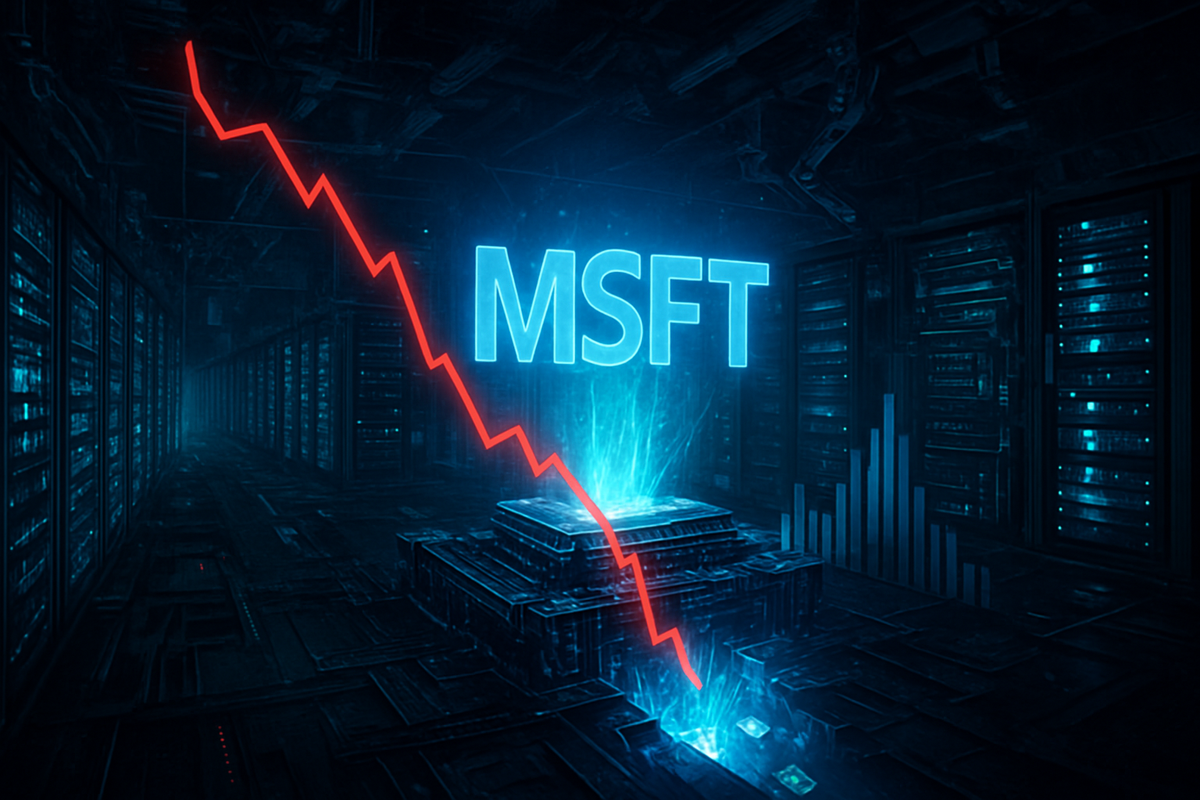
In late January 2026, the artificial intelligence gold rush hit a structural wall of skepticism. Microsoft (Nasdaq: MSFT), the company that kicked off the generative AI era with its investment in OpenAI, reported a set of quarterly earnings that has left Wall Street divided. While the tech giant posted record revenues, its stock plummeted nearly 10% in a single day—wiping out more than $350 billion in market value—as investors fixated on a staggering $37.5 billion quarterly capital expenditure bill.
The core of the concern is a widening "monetization gap." Microsoft is spending at a run rate of roughly $150 billion a year to build what CEO Satya Nadella calls "AI factories," yet the growth of its Azure cloud division is showing signs of moderation. For the first time since the debut of ChatGPT, the narrative has shifted from the infinite potential of AI to a "cautionary tale" of infrastructure costs outpacing actual revenue. As the market digests these numbers, the question is no longer whether AI is the future, but whether Microsoft can afford the price of admission.
The "Token Factory" Reality Check
The Q2 FY2026 earnings report, released on January 28, 2026, was a study in contradictions. On the surface, Microsoft appears invincible: total revenue reached $81.3 billion, up 17% year-over-year, and adjusted earnings per share of $4.14 handily beat analyst estimates. However, the "whisper numbers"—the private expectations held by high-volume traders—focused on Azure. The cloud platform grew by 39%, a robust figure by any historical standard, but a deceleration from the 40% growth seen in the prior quarter. For a stock priced for perfection, this slight miss was a catalyst for a massive sell-off.
The timeline leading to this moment has been defined by a relentless arms race. Over the past 24 months, Microsoft has pivoted its entire corporate strategy toward "Agentic AI" and infrastructure. During the earnings call, Satya Nadella defended the $37.5 billion spend—a 66% increase from the previous year—by describing the company’s new data centers as "factories" producing digital tokens. He pointed to a $625 billion commercial backlog as proof of demand. Yet, analysts from firms like Goldman Sachs (NYSE: GS) and Morgan Stanley (NYSE: MS) were quick to point out that building the factory is only half the battle; filling it with high-margin customers is the real challenge.
Further complicating the narrative is the emergence of the "Power Grid Wall." Microsoft management admitted that despite having the capital to purchase the latest chips from NVIDIA (Nasdaq: NVDA), the physical limits of the electrical grid and liquid-cooling requirements are creating bottlenecks. The company’s "Fairwater" AI super-factory project has faced delays not due to a lack of silicon, but a lack of available wattage. This revelation has spooked investors who worry that the return on investment (ROI) timeline is being pushed further into the late 2020s, while the costs are hitting the balance sheet today.
Initial market reactions have been punishing. Following the report, Barclays (NYSE: BCS) analyst Raimo Lenschow noted that the "Microsoft story will see a slight rethink," as the market moves from rewarding "AI vision" to demanding "profitable scale." The stock’s decline reflects a growing fear that Microsoft is caught in a cycle of "speculative excess," where it must spend billions just to maintain its competitive position, with no guarantee that the software revenue from products like Microsoft 365 Copilot will ever catch up to the cost of the hardware underneath them.
The Ripple Effect: Identifying the Winners and Losers
The fallout from Microsoft’s spending spree has created a clear divide in the technology ecosystem. The most immediate winners remain the "arms dealers"—the companies providing the physical components of the AI revolution. Arista Networks (NYSE: ANET) and Broadcom (Nasdaq: AVGO) have seen their stock prices remain resilient, as they benefit from the massive networking requirements of Microsoft’s 1.6T Ethernet clusters. Similarly, NVIDIA continues to see record demand for its Blackwell systems, though it now faces increasing competition from second-source providers.
Advanced Micro Devices (Nasdaq: AMD) has emerged as a surprising beneficiary of Microsoft’s "cautionary tale." As hyperscalers look to diversify away from NVIDIA’s high-margin ecosystem, AMD’s MI400 series chips have gained significant traction. Microsoft’s need to lower its per-token cost has led it to embrace AMD as a primary partner, helping the chipmaker carve out a "performance-per-dollar" niche that is becoming increasingly attractive to cost-conscious investors. Additionally, the energy sector has found a new growth engine; Constellation Energy (NYSE: CEG) has seen its valuation soar as it signs multi-decade nuclear power deals to fuel Microsoft’s data center expansion.
On the losing side of the ledger are traditional Software-as-a-Service (SaaS) providers and "AI wrappers." Many smaller software companies that promised AI-driven growth have seen their valuations crater as it becomes clear that only the largest hyperscalers can afford the infrastructure required to run high-end models. These companies are being squeezed between Microsoft’s massive CapEx-backed offerings and a customer base that is increasingly skeptical of paying premium "AI surcharges" for marginal productivity gains.
Furthermore, Microsoft’s peers in the "Big Five" are facing a similar credibility test. Alphabet (Nasdaq: GOOGL) and Amazon (Nasdaq: AMZN) both saw their stock prices dragged down in sympathy with Microsoft, as investors questioned whether their combined $700 billion projected 2026 CapEx is sustainable. The only notable exception has been Meta (Nasdaq: META), which successfully demonstrated that its AI spending is directly fueling its core advertising engine, leading to a surge in its stock price even as its peers faltered. This divergence suggests that the market is now discriminating between "AI for infrastructure's sake" and AI that drives immediate, measurable ROI.
A Historical Precedent: Is 2026 the New 1999?
The current AI infrastructure boom is frequently compared to the fiber optic build-out of the late 1990s. During that era, companies like WorldCom spent billions laying "dark fiber," anticipating an explosion in internet traffic that took a decade to actually materialize. The parallels are striking: Microsoft and its rivals are building a vast digital architecture based on the hope that "Agentic AI" will become the next great computing paradigm. If that adoption is slower than expected, the result could be a massive glut of underutilized data centers—the "dark fiber" of the 21st century.
However, there is a critical difference between the 1990s and 2026: capital strength. The dot-com crash was fueled by debt-heavy startups with no path to profitability. In contrast, today’s AI build-out is being funded by the most profitable companies in human history. Microsoft, with its massive cash reserves and diverse revenue streams from Windows, Office, and LinkedIn, can afford to be "wrong" for much longer than the players of the 1990s. This "Hyperscaler Subsidy" means that even if the AI ROI is delayed, Microsoft is unlikely to face the same existential crisis that destroyed the telcos of the early 2000s.
There are also significant regulatory and policy implications to this spending. The sheer scale of Microsoft’s $37.5 billion quarterly budget has drawn the attention of the Federal Trade Commission (FTC) and European regulators, who are investigating whether this level of spending creates an insurmountable barrier to entry for smaller competitors. This "monopoly of infrastructure" could lead to new antitrust challenges, particularly as Microsoft deepens its vertical integration by designing its own custom silicon, such as the Maia AI accelerator chips, to bypass merchant silicon providers.
Finally, the environmental impact of this spending cannot be ignored. The "Power Grid Wall" mentioned in the latest earnings report is a symptom of a larger struggle between AI ambitions and climate goals. As Microsoft buys up nuclear and geothermal capacity, it is coming into direct conflict with public utilities and residential energy needs. This is likely to lead to new policy frameworks governing the "energy-for-intelligence" trade-off, potentially forcing tech giants to become their own power companies in the coming years.
The Path Ahead: Strategic Pivots and Scenarios
In the short term, Microsoft is expected to pivot its communication strategy to focus more on efficiency and less on raw scale. We are likely to see a greater emphasis on "Small Language Models" (SLMs) like the Phi-series, which require significantly less compute power and offer a clearer path to profitability for enterprise customers. By shifting the workload from massive, $100 billion clusters to more efficient, specialized models, Microsoft may be able to slow its CapEx growth without sacrificing its competitive edge in AI services.
The market will also be watching for the success of Microsoft’s custom silicon. If the Maia chips can meaningfully reduce the company's reliance on NVIDIA, it could lead to a significant margin expansion in late 2026 and 2027. This would be a game-changer for the stock, as it would prove that Microsoft can control its own destiny in the AI supply chain. However, if these custom chips fail to match the performance of merchant silicon, Microsoft will remain tethered to NVIDIA’s pricing power, keeping infrastructure costs high.
Long-term, the "cautionary tale" narrative will either be validated as a sign of a bursting bubble or remembered as the "growing pains" of a new industrial revolution. If Azure growth re-accelerates toward 42% or 45% in the second half of 2026, the current $37.5 billion quarterly spend will be viewed as a visionary masterstroke. If growth continues to stagnate or decelerate into the low 30s, Microsoft may be forced to initiate a painful restructuring of its AI investments, potentially leading to a multi-year period of underperformance for the stock.
Final Assessment: What Investors Should Watch
The January 2026 earnings report marked the end of the "blind faith" phase of the AI cycle. Microsoft is now being judged not on its potential, but on its execution. The "cautionary tale" label is a warning that the market is no longer willing to give tech giants a blank check for AI experimentation. Moving forward, the most important metric for investors will be the "Azure AI Contribution Percentage"—the specific portion of cloud growth driven by AI services—and whether that number can grow faster than the capital required to support it.
Investors should also keep a close eye on the "Circular AI Economy." There is growing concern that much of the revenue being reported by Big Tech is coming from AI startups that they themselves have funded. If this "circularity" begins to unravel, the revenue numbers for Azure and its peers could face a significant downward revision. For now, Microsoft remains the bellwether for the entire sector; as its stock goes, so goes the AI trade.
In the coming months, look for announcements regarding new nuclear power partnerships, the deployment of "Agentic" workflows in the enterprise, and the first major benchmarks for the Maia 2 custom silicon. These will be the true indicators of whether Microsoft is leading the world into a new era of productivity or leading itself into a trillion-dollar trap of its own making.
This content is intended for informational purposes only and is not financial advice.