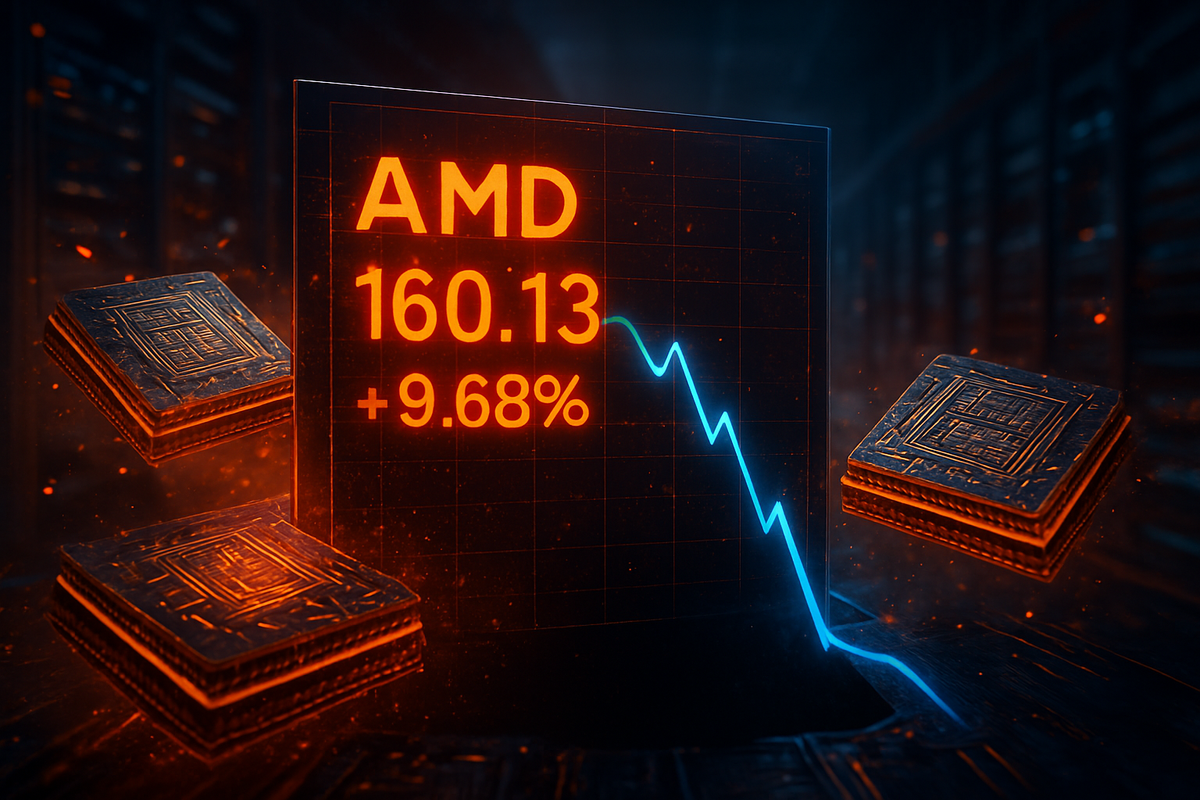
In a stark illustration of the "priced for perfection" era of high-tech investing, Advanced Micro Devices (NASDAQ: AMD) has found itself at the center of a confusing financial whirlwind. On February 3, 2026, the semiconductor giant reported record-breaking fourth-quarter results for 2025, with CEO Dr. Lisa Su describing the demand for the company’s artificial intelligence (AI) chips as being "on fire." Yet, despite a performance that would have been a cause for celebration in any other market cycle, the company’s stock suffered a brutal double-digit sell-off, plummeting nearly 20% in the days following the announcement.
The disconnect highlights a growing tension in the semiconductor sector: while the physical demand for AI infrastructure remains insatiable, the stock market’s appetite for "beats and raises" has reached an almost unattainable threshold. As AMD grapples with a massive valuation correction, the event serves as a warning shot for the broader tech industry, signaling that even "gangbusters" growth may no longer be enough to satisfy a market increasingly focused on the quality of revenue and the immediate return on investment for AI.
The China Cliff and the Guidance Gap
The specifics of AMD’s Q4 2025 earnings report were, on paper, nothing short of spectacular. The company posted record quarterly revenue of $10.27 billion, a 34% increase year-over-year, comfortably beating the analyst consensus of $9.67 billion. Adjusted earnings per share (EPS) hit $1.53, well above the expected $1.32. The primary engine of this growth was the Data Center segment, which raked in $5.4 billion—up 39%—driven by the rapid adoption of the MI325X and early shipments of the next-generation MI350 series AI accelerators. During the earnings call, Dr. Su was remarkably bullish, noting that 2026 would be a "major inflection year" and describing the server CPU and GPU business as "going gangbusters."
However, the euphoria quickly curdled as investors dug into the "under-the-hood" details. Analysts discovered that approximately $390 million of the revenue beat was attributed to a one-time windfall from MI308 chip shipments to China, which were briefly cleared by export licenses that have since tightened. AMD guided that China-bound revenue would drop to just $100 million in Q1 2026, creating what traders dubbed a "China Cliff." Furthermore, while the company’s Q1 revenue guidance of $9.8 billion was technically above consensus, it represented a 5% sequential decline from Q4. For a stock trading at 40 times forward earnings, any hint of a sequential slowdown—even one driven by seasonal weakness in gaming and PC segments—was viewed as a major red flag.
The market reaction was swift and unforgiving. By February 6, 2026, AMD’s market capitalization had shrunk by hundreds of billions of dollars. This was not a reaction to a lack of demand, but rather a realization that the "show-me" story for AI scale still had significant hurdles. While NVIDIA (NASDAQ: NVDA) continues to dominate the "rack-scale" infrastructure market, AMD is still perceived by some as playing a game of catch-up, leading to massive profit-taking from investors who had been riding the AI wave since 2024.
Winners, Losers, and the Flight to Stability
The AMD sell-off triggered a rotation within the semiconductor sector, separating companies with "diversified durability" from those tied strictly to the GPU hype cycle. Taiwan Semiconductor Manufacturing Company (NYSE: TSM) emerged as a relative winner during the volatility. As the sole manufacturer for both AMD and NVIDIA’s advanced 2nm and 3nm designs, TSMC is viewed as the "foundational winner." Investors favored its lower P/E ratio and its diversified customer base, which includes custom silicon orders from Apple (NASDAQ: AAPL) and Google parent Alphabet (NASDAQ: GOOGL).
Broadcom (NASDAQ: AVGO) also solidified its position as an industry leader, largely immune to the AMD-specific drama. Broadcom’s dominance in networking and custom AI silicon (ASICs) positions it to benefit from the shifting composition of hyperscaler capital expenditure, which is increasingly moving toward infrastructure and connectivity rather than just raw compute power. Meanwhile, Micron Technology (NASDAQ: MU) continued to outperform the broader sector, as the extreme demand for High-Bandwidth Memory (HBM3E) required for chips like the MI350 and NVIDIA’s Blackwell series has created a supply-demand imbalance that favors memory producers.
On the losing end, Intel (NASDAQ: INTC) saw its stock fluctuate as it struggled to convince the market that its 1.4nm foundry business and Gaudi accelerators could steal meaningful share from the AMD-NVIDIA duopoly. NVIDIA itself was not immune, seeing a 3-4% dip as the "AI halo effect" dimmed. The narrative of "Decoupling from NVIDIA" has begun to gain traction among major cloud providers like Microsoft (NASDAQ: MSFT) and Meta Platforms (NASDAQ: META), who are aggressively scaling their own internal silicon to reduce the crushing costs of third-party GPUs, a trend that puts pressure on both NVIDIA and AMD’s long-term margins.
The ROI Reckoning: A Shift in the AI Narrative
This event fits into a broader industry trend that analysts are calling "The ROI Reckoning." Throughout 2024 and 2025, the market rewarded any company that could provide the hardware necessary to build AI models. By early 2026, however, the focus shifted from model training to enterprise deployment and monetization. Investors are no longer asking "how many chips can you sell?" but rather "how much money are your customers making from those chips?" This shift has led to valuation fatigue, where even "record results" are met with skepticism if the operating leverage isn't immediately apparent.
Furthermore, the semiconductor sector is hitting physical limits that are complicating the growth story. The bottleneck has moved from a shortage of chips to a shortage of power and cooling. As data center density hits new highs with 500W and 1000W GPUs, companies that provide power management and liquid cooling, such as Vertiv (NYSE: VRT), are becoming the "indirect winners" of the AI boom. AMD’s reliance on the high-wattage MI355X liquid-cooled variants for its 2026 growth underscores this challenge; the success of the chip is now tied to the physical capacity of the power grid.
Historical precedents for this "paradox" can be found in the early 2000s fiber-optic boom, where the physical installation of hardware far outpaced the immediate economic utility, leading to a massive market correction despite high underlying demand. While the AI boom has more tangible revenue streams today, the "priced for perfection" valuations of 2026 have left zero margin for error regarding sequential growth or geopolitical headwinds.
Looking Ahead: The MI350 Ramp and Agentic AI
The short-term outlook for AMD will depend heavily on the volume ramp of the MI350 series throughout the middle of 2026. This chip, built on the 3nm process node, claims a 35-fold increase in AI inference performance over its predecessor. If AMD can prove that the MI350 is a legitimate peer to NVIDIA’s Blackwell architecture in large-scale inference tasks, the stock could see a rapid recovery. Additionally, the industry is moving toward "Agentic AI"—where autonomous agents manage complex workflows—which requires a different kind of compute efficiency that AMD’s CDNA 4 architecture is specifically designed to handle.
In the long term, AMD must navigate the rise of "Edge AI," where models run locally on devices rather than in massive centralized cloud clusters. This transition could shift the center of gravity away from the data center GPUs that currently drive the stock price and toward mobile and PC chipsets. Strategic pivots into unified software ecosystems, like AMD’s ROCm platform, will be critical to ensuring that developers don't remain locked into NVIDIA’s proprietary CUDA software.
The Bottom Line: What Investors Should Watch
The paradox of AMD’s stock performance serves as a reminder that in a hyper-growth sector, the "story" often moves faster than the "stats." The key takeaways from the February sell-off are that non-recurring revenue (like the China windfall) will be punished, and sequential growth is now the primary metric for AI sustainability. The market is maturing, and the "AI halo" that once lifted all boats is being replaced by a rigorous assessment of market share and margin preservation.
Moving forward, investors should keep a close eye on the capital expenditure reports from "Hyperscalers" like Microsoft and Meta in the coming months. If these giants continue to increase their spending despite the high costs, it will signal that the "on fire" demand Lisa Su noted is indeed sustainable. However, if they begin to favor internal silicon over AMD’s offerings, the "brutal sell-off" of early 2026 may be just the beginning of a broader sector recalibration. For now, the semiconductor market remains a high-stakes arena where record-breaking is the baseline, and any deviation from perfection is a catalyst for correction.
This content is intended for informational purposes only and is not financial advice.