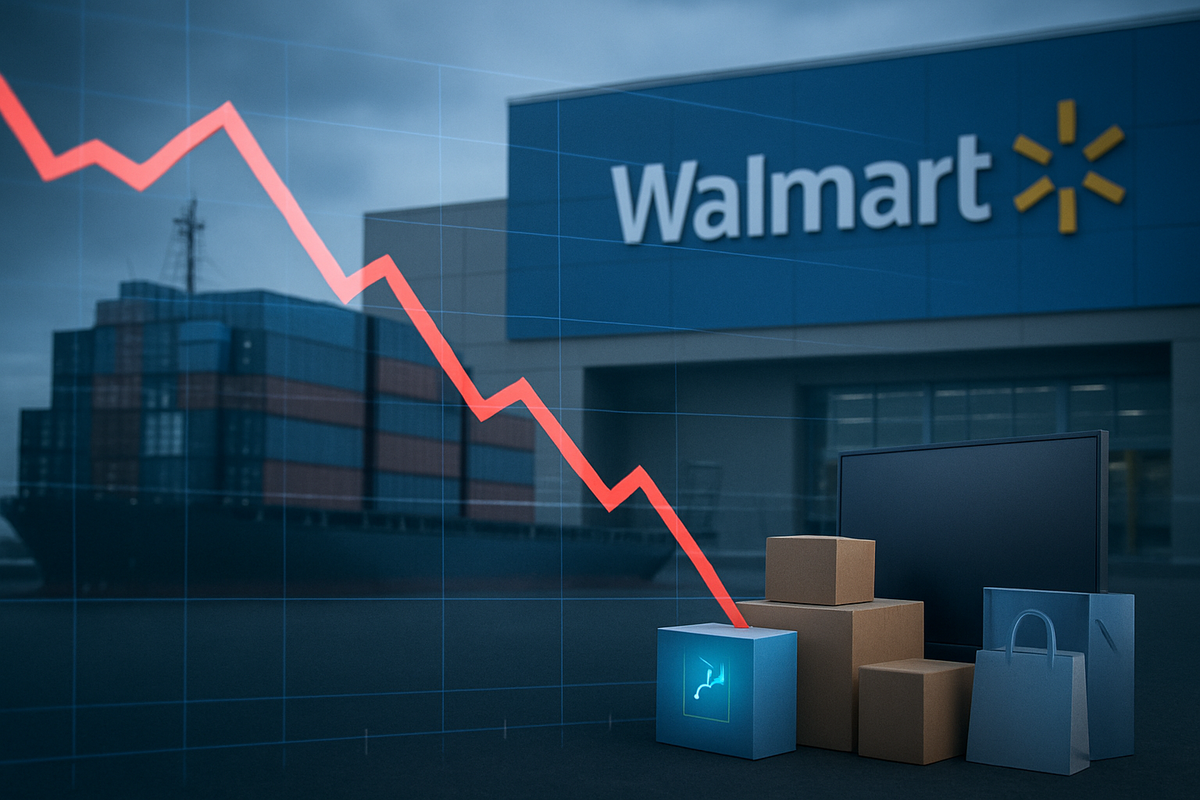
Walmart Inc. (NYSE: WMT), the world's largest retailer and a primary bellwether for the American consumer economy, sent shockwaves through the financial markets this week after issuing a cautious financial outlook for the 2026 calendar year. Citing the volatile impact of "Liberation Day" tariffs and persistent inflation in general merchandise, the company’s conservative guidance led to a sharp reversal in its stock price, which had only recently propelled the retail giant to a historic $1 trillion market capitalization.
The cautious stance from Bentonville underscores a growing anxiety across the retail sector as companies grapple with a shifting trade landscape and a Supreme Court ruling that has thrown federal tariff policies into disarray. While Walmart’s quarterly performance remains robust, the sudden pivot toward fiscal conservatism signals that even the most resilient market leaders are bracing for a period of margin compression and consumer spending volatility.
Conservative Guidance and the "Trillion Dollar" Pullback
On February 19, 2026, Walmart reported its fourth-quarter results for the fiscal year ending January 2026. On the surface, the numbers were impressive: record revenue of $190.7 billion and a 24% surge in global e-commerce. However, the optimism was quickly overshadowed by management’s projections for the upcoming fiscal year. Chief Financial Officer John David Rainey and newly appointed CEO John Furner projected net sales growth of just 3.5% to 4.5%, with an adjusted earnings per share (EPS) range of $2.75 to $2.85. This fell significantly short of Wall Street’s consensus estimate of $2.97, sparking an immediate sell-off.
The timeline leading to this moment was marked by a relentless climb in Walmart’s valuation, fueled by its aggressive integration of AI through its "Sparky" assistant and its success in attracting high-income households. However, the February 19 announcement triggered a nearly 3% slide in pre-market trading, eventually settling roughly 2% lower. This decline effectively stripped Walmart of its recently achieved $1 trillion valuation, reminding investors that even "expensive AI insurance" is not immune to macroeconomic headwinds.
Winners and Losers in a Tariff-Strained Market
The impact of Walmart’s outlook is being felt unevenly across the retail landscape. Walmart (NYSE: WMT) itself remains a long-term "winner" in terms of market share, as its massive scale allows it to negotiate more favorable terms with suppliers and absorb certain costs that would bankrupt smaller competitors. High-income earners—those making over $100,000 annually—continue to flock to the retailer to mitigate the effects of inflation, further solidifying its dominance over mid-tier department stores.
Conversely, Target Corporation (NYSE: TGT) and specialty retailers are facing a more precarious path. Target has already signaled that it is asking Chinese suppliers to absorb half of the tariff costs, a move that has led to supply chain friction and product shortages in key categories like electronics and home goods. Meanwhile, Costco Wholesale Corporation (NASDAQ: COST) has taken a more litigious approach, actively suing the administration over the legality of the import duties. While Costco’s "inventory pull-forward" strategy protected it during the holiday season, the broader retail sector is seeing a deepening "K-shaped" divide where only those with massive automation and private-label capacity can maintain margins.
The "Liberation Day" Crisis and the Supreme Court Pivot
The primary catalyst for Walmart's caution is the "Liberation Day" tariff regime, which imposed a 10% baseline duty on most imports starting in 2025. This policy, designed to encourage domestic manufacturing, has instead become a source of significant general merchandise inflation, currently tracking at over 3%. For Walmart, categories like apparel and consumer electronics—which rely heavily on international sourcing—have become focal points for potential price hikes.
The situation reached a fever pitch on February 20, 2026, when the U.S. Supreme Court issued a landmark 6-3 ruling declaring these tariffs unlawful under the International Emergency Economic Powers Act (IEEPA). While this provides a long-term reprieve, it has created a short-term administrative nightmare. Retailers must now navigate the complex process of reclaiming billions in duties already paid, even as the executive branch continues to pressure companies like Walmart to "eat the tariffs" and avoid passing costs to voters. This regulatory whiplash is the definition of the "unstable" environment cited by Walmart’s leadership.
Strategic Pivots and the Road to Recovery
Looking ahead, the retail sector is entering a phase of rapid adaptation. Walmart is expected to lean even more heavily into its advertising arm, Walmart Connect, which grew by 37% last year, as a high-margin offset to the rising costs in its retail business. The company is also likely to accelerate its shift toward automated distribution centers to reduce labor costs and increase efficiency in its "last-mile" delivery services.
In the short term, the market will be watching to see how quickly the tariff refunds are processed and whether Walmart uses that liquidity to buy back shares or aggressively lower prices to squeeze competitors. A strategic pivot toward more diversified sourcing—moving production out of high-tariff regions like China and into "near-shoring" hubs in Mexico—is already underway, though the infrastructure to support such a shift will take years to fully mature.
Investor Outlook: Navigating the New Retail Reality
The key takeaway from Walmart’s 2026 outlook is that the era of "easy growth" through post-pandemic recovery has officially ended. The retail industry is now defined by its ability to navigate geopolitical risk and regulatory volatility. While Walmart’s stock may have taken a hit, its underlying fundamentals—particularly its e-commerce growth and appeal to affluent demographics—remain strong.
Moving forward, investors should keep a close eye on general merchandise inflation data and any retaliatory trade measures that might follow the Supreme Court's ruling. The next few months will be a test of resilience for the entire sector. While the "trillion-dollar" milestone may have been briefly lost, Walmart’s conservative guidance may ultimately prove to be a masterclass in managing expectations during one of the most unpredictable trade eras in American history.
This content is intended for informational purposes only and is not financial advice.