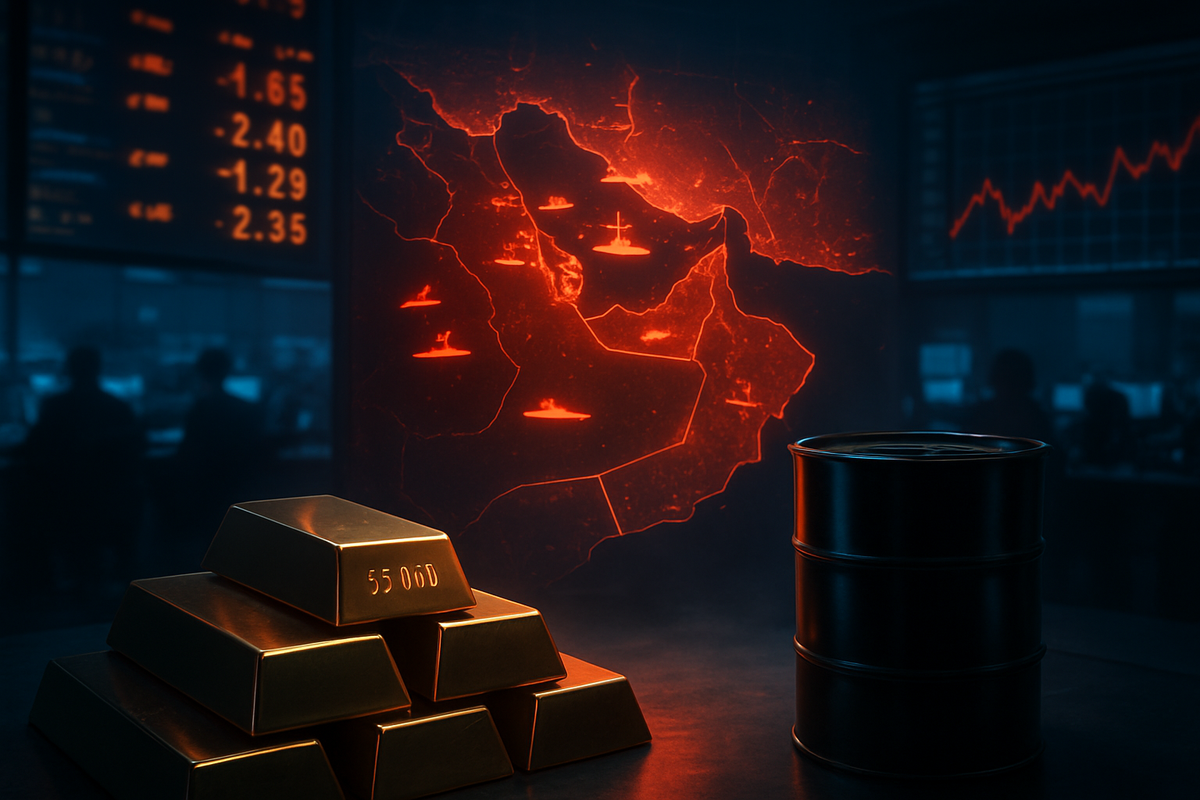
On February 18, 2026, global financial markets are grappling with a dual-shocker: a historic surge in safe-haven assets and a volatile spike in energy costs. Gold prices have shattered all psychological barriers, trading at an unprecedented $5,019.60 per ounce, as investors flee toward security in the wake of escalating military mobilization in the Persian Gulf. Simultaneously, the crude oil market has seen the April WTI contract climb to $64.21, a significant jump that reflects the "fear premium" now baked into energy prices despite a broader global supply surplus.
The immediate implications are profound for both institutional and retail investors. With the Strait of Hormuz—a vital artery for 20% of the world's oil supply—becoming a theater for live-fire naval exercises, the threat of a localized conflict expanding into a regional war is no longer a theoretical "tail risk." The sudden re-pricing of commodities is triggering a massive rotation in equity markets, as energy sector stocks decouple from the broader indices, which are currently under pressure from rising inflationary fears and geopolitical uncertainty.
The Mobilization: A Chokepoint in Crisis
The current crisis reached a boiling point on February 16, 2026, when Iran commenced large-scale naval maneuvers in the Strait of Hormuz. These drills, which included the testing of advanced anti-ship cruise missiles and drone swarms, were strategically timed to coincide with a breakdown in diplomatic negotiations in Geneva. By the morning of February 18, reports confirmed that the United States had accelerated the deployment of the USS Gerald Ford and USS Abraham Lincoln carrier strike groups to the region. This rapid military buildup represents the largest concentration of naval firepower in the Persian Gulf in nearly a decade, signaling a move from deterrence to active readiness.
The timeline leading to this moment has been a steady march toward escalation. Throughout January 2026, internal instability within Iran led to a more aggressive foreign policy posture as the regime sought to divert domestic attention toward external threats. This was met with a hardening stance from Washington, which has increasingly viewed Iranian nuclear advancements as a "red line." According to data from the Eurasia Group, the probability of a direct military strike on Iranian infrastructure by April has now surged to 65%, a factor that is directly fueling the record-breaking run in gold.
Key stakeholders, including the International Energy Agency (IEA) and major OPEC+ members, are currently in emergency consultations. While the market is currently reacting to the threat of supply disruption, the initial reaction has been a "risk-off" stampede. Traders are not just pricing in the loss of Iranian barrels; they are pricing in the potential for a wider conflict that could involve neighboring producers like Saudi Arabia and the United Arab Emirates. The result is a commodity market that is behaving with a level of volatility not seen since the early 1990s.
Energy Giants and Defensive Plays
In the equity markets, the reaction has been swift and polarized. Integrated oil majors such as ExxonMobil (NYSE: XOM) and Chevron (NYSE: CVX) have emerged as the primary beneficiaries of the price spike. ExxonMobil, in particular, has seen its shares rise as its heavy investment in the Permian Basin allows it to capitalize on higher WTI prices without being directly exposed to Middle Eastern physical assets. Investors view these "Atlantic Basin" producers as safer bets, providing a hedge against the very geopolitical instability that is driving prices higher.
Conversely, European majors like BP (NYSE: BP) and Shell (NYSE: SHEL) are facing a more complex outlook. While they benefit from higher commodity prices, their extensive global refining footprints and historical exposure to Middle Eastern partnerships make them more vulnerable to shifts in international maritime insurance rates and logistics costs. During the early trading sessions on February 18, both BP and Shell lagged behind their American counterparts, reflecting concerns over the rising cost of shipping and the potential for a global economic slowdown that could eventually dampen demand.
Defense contractors are also seeing a significant uptick in interest. Lockheed Martin (NYSE: LMT) and other major aerospace firms have seen their stock prices climb as the Pentagon moves toward a state of active mobilization. The market logic is clear: even if a full-scale war is avoided, the "new cold war" posture in the Middle East will necessitate a prolonged and expensive military presence, benefiting those companies that provide the hardware for regional security and deterrence.
The $5,000 Gold Ceiling and the Geopolitical Risk Premium
The ascent of gold to over $5,019.60 is the most striking feature of the 2026 market landscape. This surge is not merely a reaction to the week’s headlines; it is the culmination of a broader trend where central banks, particularly in the Global South, have been aggressively diversifying away from the US dollar. The Iranian crisis has served as the ultimate catalyst, pushing gold into a parabolic move as it re-establishes itself as the world’s premier "crisis currency." This move highlights a significant shift in historical precedents; while gold once moved in small increments, it is now behaving with the volatility of a high-growth tech stock.
Interestingly, the price of crude oil, while rising to $64.21, remains somewhat capped by structural realities that didn't exist in previous decades. A projected global supply surplus of nearly 4 million barrels per day—driven by record production in the US, Brazil, and Guyana—is acting as a fundamental ceiling on energy prices. This "supply glut" is creating a unique market divergence: the geopolitical fear is present, but the physical shortage has yet to manifest. This suggests that while gold is pricing in a "worst-case" systemic collapse, the oil market is still betting that the world’s diversified supply chain can absorb a regional shock.
From a regulatory perspective, this volatility is likely to trigger renewed calls for strategic reserve releases. In the United States, discussions are already underway regarding another drawdown from the Strategic Petroleum Reserve (SPR) to prevent $64 oil from spiraling toward $100. However, the efficacy of such moves is being questioned in a market where the primary driver is no longer just supply and demand, but the looming specter of a major theater war involving nuclear-capable actors.
Escalation or De-escalation: The Road to April
As we look toward the immediate future, the market’s focus is squarely on the month of April, when the current Iranian military contracts and the "strike window" identified by analysts are set to peak. The short-term scenario involves a high-stakes game of "chicken" in the Strait of Hormuz. If Iran chooses to maintain its drills without interfering with commercial shipping, we could see a "relief rally" where gold retreats toward the $4,500 level and oil settles back into the high $50s. However, any kinetic exchange—even a minor skirmish—would likely send gold toward $6,000 and oil into triple digits almost overnight.
Strategic pivots are already being seen among major industrial consumers. Airlines and shipping conglomerates are aggressively hedging their fuel costs for the remainder of 2026, fearing that the current $64 price is merely the base of a much steeper climb. For investors, the challenge is navigating this "fear-driven" market without overextending. The opportunity lies in sectors that are decoupled from Middle Eastern logistics, such as domestic renewable energy and North American resource extraction, which offer a buffer against regional instability.
Long-term, this event may mark the definitive end of the "low volatility" era for commodities. The combination of structural central bank shifts toward gold and the weaponization of energy chokepoints suggests that the "geopolitical risk premium" is becoming a permanent fixture of market valuations. Analysts expect that even if the current tensions subside, the floor for gold and oil has been permanently raised, reflecting a more fragmented and dangerous global order.
Navigating a New Era of Volatility
In summary, the events of February 18, 2026, represent a watershed moment for the global financial system. The breach of $5,000 in gold and the mobilization of US carrier groups against Iranian forces have forced a total reassessment of risk. While the oil market’s current $64 handle reflects a temporary balance between fear and a supply glut, the underlying tension suggests that we are one miscalculation away from a catastrophic energy shock. Investors must recognize that the old "playbook" for geopolitical crises is being rewritten by a world that is more interconnected yet more politically divided than ever before.
Moving forward, the market will be hyper-sensitive to any communication from the White House or Tehran. Watch for shifts in maritime insurance premiums and the movement of commercial tankers in the Persian Gulf as early warning signs of a supply squeeze. Furthermore, the performance of safe-haven assets like gold will continue to serve as a "fear barometer" for the broader economy. If gold maintains its footing above $5,000, it signals that the market believes the geopolitical threat is systemic and long-term.
For the savvy investor, the coming months require a defensive posture characterized by diversification into hard assets and geographically insulated energy stocks. The lasting impact of this crisis will likely be a reinforced focus on energy independence and a permanent shift in how we value security in an increasingly volatile world.
This content is intended for informational purposes only and is not financial advice.