
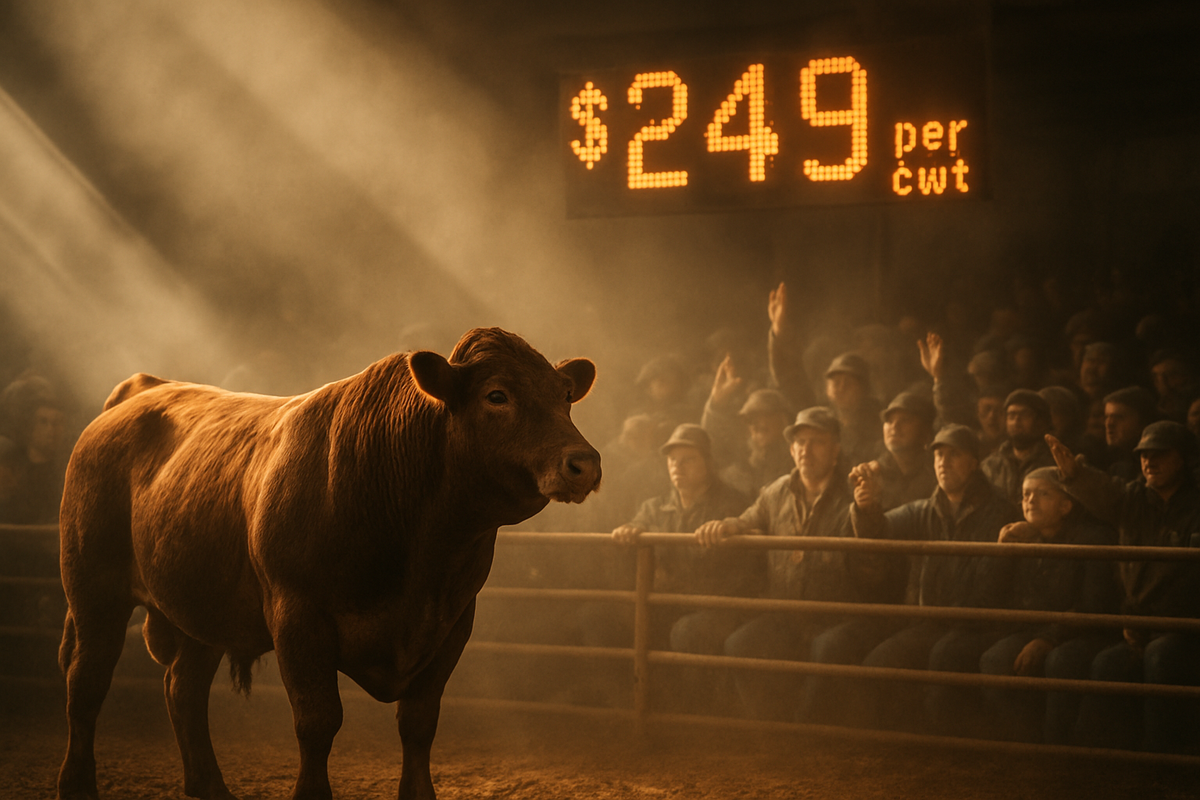
The American cattle market reached a fever pitch this week as cash trade in Kansas skyrocketed to a staggering $249 per hundredweight (cwt), shattering previous all-time nominal records and signaling a paradigm shift in the protein sector. This historic surge, confirmed during the mid-February trading window, comes after weeks of what analysts described as an "eerily quiet" market—a deceptive calm that masked a deeply bullish complex. The sudden breakout from a sideways "chop" near the $243 level has sent shockwaves through the industry, forcing meatpackers and retailers to grapple with a supply reality that has not been seen in over seven decades.
The immediate implications are stark: the "processor squeeze" has tightened significantly, and the price of beef at the retail counter is poised for another leg up. While cattle producers are finally seeing the rewards of a decade-long contraction, the speed of this $249/cwt print has left the "Big Four" meatpackers scrambling to adjust their slaughter schedules. With the United States Department of Agriculture (USDA) confirming that the national herd has shrunk to its lowest level since the Truman administration, the market is no longer just speculating on scarcity—it is now pricing in a fundamental deficit that could last for years.
The Great Cattle Breakout of 2026
The surge to $249 per cwt in Kansas on Friday, February 13, 2026, was the culmination of a tense standoff between cattle feeders and meatpacking giants. Throughout early February, the market remained "eerily quiet," with front-month futures contracts oscillating narrowly. Traders were hesitant, waiting for a catalyst to break the technical resistance. That catalyst arrived in the form of a thinning "showlist" of available cattle and a refusal by feedlots to sell below their breakeven points, which have risen sharply due to the high cost of feeder calves. By Monday, February 16, the $249 mark was solidified as the new floor for high-quality fed cattle in the Southern Plains, with Texas trade following closely at $248 per cwt.
The timeline leading to this moment was defined by a series of compounding supply shocks. In late January 2026, the USDA released its much-anticipated Cattle Inventory Report, which acted as the foundational fuel for this week's fire. The report confirmed a total U.S. cattle herd of just 86.2 million head, the smallest inventory since 1951. Simultaneously, the continued closure of the U.S.-Mexico border due to a New World screwworm outbreak effectively removed 1.2 million head of annual feeder cattle imports from the supply chain, leaving a massive hole in feedlot placements.
Market reactions were swift. As the $249 cash trade was reported, live cattle futures surged, hitting limit-up in some contract months as managed funds piled back into the "bullish complex." Stakeholders across the board, from independent ranchers in the Midwest to corporate procurement officers in Chicago, are now recalibrating for a "higher-for-longer" price environment. The "chop" is over, and the market has entered a discovery phase where the ceiling remains unknown.
A Divided Landscape: Processing Losses vs. Dining Resilience
The record-high cattle prices have created a bifurcated reality for public companies in the food space. The hardest hit are the massive protein processors who must buy live animals at these record rates while struggling to pass the full cost onto consumers through boxed beef prices. Tyson Foods (NYSE: TSN) has emerged as a primary victim of this margin compression, recently reporting a staggering $319 million operating loss in its beef segment for the first quarter of fiscal 2026. The company’s decision to permanently shutter its Lexington, Nebraska facility in January was a harbinger of the pain now being felt across the industry.
Similarly, JBS SA (OTC:JBSAY), the world’s largest meatpacker, reported a $293 million loss in its North American beef operations as the "cost of goods sold" outpaced its ability to raise wholesale prices. For these giants, the $249/cwt price point represents a "red zone" where profitability becomes nearly impossible without a corresponding spike in the "beef cutout" (the wholesale value of the carcass). Investors are closely watching for further capacity reductions or plant "downtime" as these companies attempt to manage their burn rates.
On the other end of the spectrum, the casual dining sector has shown surprising resilience. Despite the rising cost of steak, Texas Roadhouse (NASDAQ: TXRH) and Darden Restaurants (NYSE: DRI), the parent of LongHorn Steakhouse, have managed to maintain traffic by leveraging their scale and brand loyalty. While they face significant "food cost deleverage," the high demand for premium beef experiences among American consumers has allowed these players to outperform the broader market. Meanwhile, retail giants like Walmart (NYSE: WMT) and Kroger (NYSE: KR) are navigating a different challenge: "sticker shock" at the meat case. With ground beef prices averaging $6.69 per pound, these retailers are aggressively pivoting their marketing toward "value proteins" like poultry and pork to maintain grocery basket sizes.
The Invisible Herd: A 75-Year Supply Low
The wider significance of the $249 record lies in the underlying data provided by the USDA’s "Cattle on Feed" and "Inventory" reports. The 86.2 million head count is not just a statistical anomaly; it represents a 12th year of contraction in the current cattle cycle. More concerning for the long term is the heifer retention data. According to the January 23 Cattle on Feed report, heifers made up 38.7% of the cattle currently in feedlots. This indicates that ranchers are still liquidating their female breeding stock to take advantage of high cash prices rather than keeping them to rebuild their herds.
This behavior mirrors the 2014-2015 cycle but with more severe constraints. Unlike a decade ago, today's market is contending with a more fractured global trade environment and more frequent climate-driven disruptions to grazing land. The historical precedent of 1951—the last time the herd was this small—reminds the market that a "rebuild" is not a switch that can be flipped; it is a biological process that takes years.
Furthermore, the federal government has begun to take notice. The Biden administration’s Department of Justice recently launched a new round of antitrust probes into the "Big Four" to ensure that the current price volatility is not being used as a cover for anti-competitive behavior. To provide immediate relief for consumers, the government also signed a proclamation to quadruple the Argentine beef import quota, hoping to flood the market with lean trimmings to lower the price of burger meat—a move that has drawn the ire of domestic producer groups.
The Road to 2028: Is This the Peak?
In the short term, the cattle market is expected to remain volatile but biased toward the upside. With the "eerily quiet" phase broken, the next several months will likely see further attempts to push toward the $255 or $260 mark, especially as the spring grilling season approaches and beef demand historically peaks. However, the risk of "demand destruction" looms large. If the price of a ribeye at the grocery store crosses a certain psychological threshold, consumers may finally trade down to chicken in volumes that force a correction.
Long-term, the industry is entering a mandatory period of adaptation. Ranchers will eventually need to pivot from liquidation to retention, a move that will ironically tighten supplies even further in the short run as females are pulled from the slaughter chain and kept on the ranch. This suggests that the "tight supply" narrative will likely persist through 2027 and into 2028. Investors should expect a consolidation of the processing sector, as smaller, less efficient plants may not survive the prolonged "margin desert" caused by $250+ cattle.
Strategic shifts are already underway. Forward-thinking companies are investing more heavily in "vertical coordination" and direct-to-consumer beef programs to bypass the volatility of the cash market. Additionally, the role of imported beef will likely grow, potentially reshaping the "Product of the USA" landscape as the domestic industry waits for the next generation of calves to reach the market.
Conclusion: The New Era of Protein Scarcity
The record-breaking $249 per cwt trade in Kansas is a landmark event that marks the end of cheap beef in America. It is the result of a perfectly timed collision between a 75-year supply low, a closed Mexican border, and an American consumer whose appetite for steak remains surprisingly inelastic. While the cattle complex was "eerily quiet" just days ago, the breakout has revealed the true depth of the supply crisis facing the industry.
For investors, the coming months will be a test of discernment. The winners will not necessarily be those who produce the most meat, but those who can manage the extreme volatility of the "processor squeeze" and those retailers who can keep customers in the store despite record prices at the checkout. The market is moving into uncharted territory, and the "herd rebuild" remains a distant prospect. Watching for shifts in heifer retention and the status of the Mexican border will be critical for anyone trying to time the eventual peak of this historic bull run.
This content is intended for informational purposes only and is not financial advice.