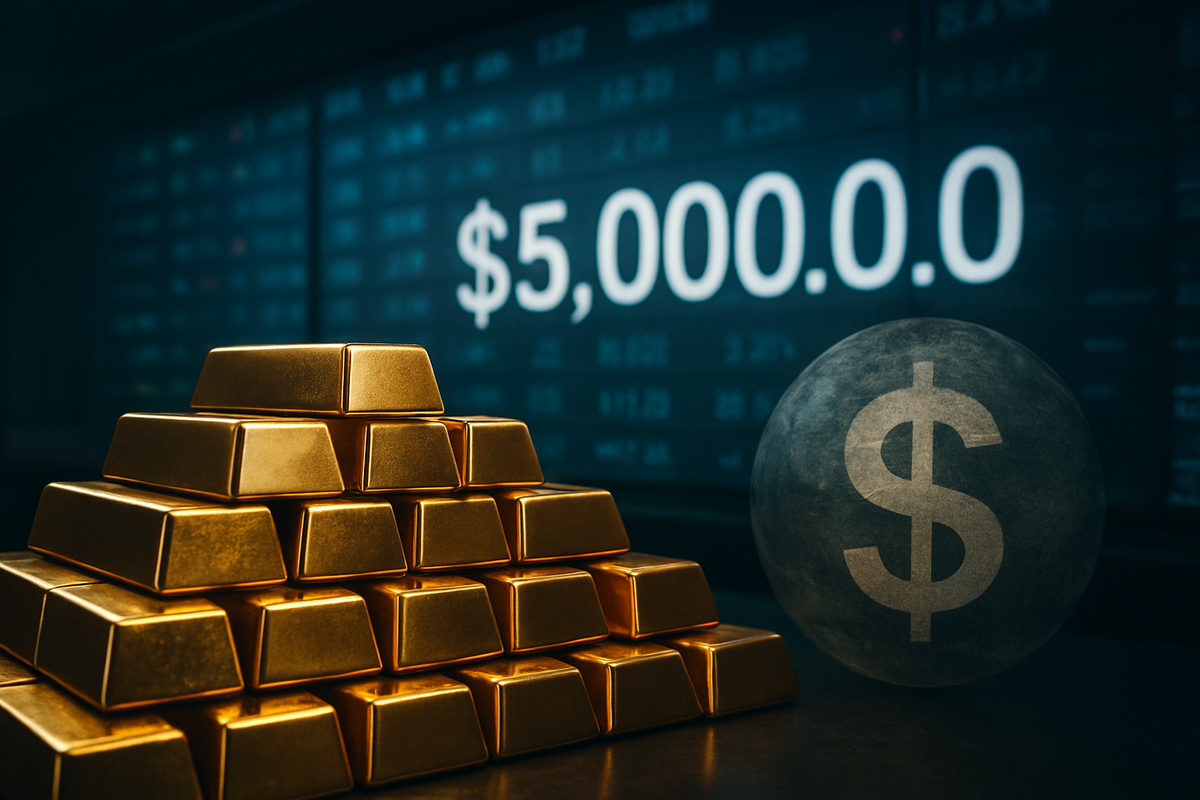
As of February 16, 2026, the global financial landscape has been fundamentally reshaped by a "yellow metal" fever that shows no signs of breaking. Gold has shattered psychological barriers once thought insurmountable, trading near a record $5,000 per ounce. Despite these stratospheric valuations, the People’s Bank of China (PBOC) has just reported its 15th consecutive month of gold accumulation, signaling a profound shift in how the world’s second-largest economy views the stability of the U.S. dollar-led financial system.
This relentless appetite for bullion, even at peak pricing, underscores a growing global conviction in the "debasement trade." Central banks, led by China and other BRICS+ nations, are increasingly treating gold not as a speculative asset, but as an essential hedge against U.S. fiscal dominance and the perceived weaponization of the dollar. As the U.S. debt burden continues to climb, the move toward gold represents an accelerating trend of de-dollarization that is forcing investors and policymakers to rethink the composition of global reserves.
The 15-Month Marathon: Beijing’s Strategic Shift
The People’s Bank of China’s latest data release confirms a methodical and aggressive expansion of its gold reserves, which have now reached approximately 74.19 million troy ounces. This 15-month streak began in late 2024, following a brief tactical pause, and has seen Beijing add roughly 40,000 ounces per month with clockwork precision. While the PBOC has historically been opaque about its buying patterns, the consistency of this 2025-2026 spree suggests a long-term strategic pivot away from "credit-based assets"—primarily U.S. Treasuries—toward "neutral" assets that carry no counterparty risk or sanctions vulnerability.
The timeline leading to this $5,000-per-ounce milestone was paved by a "perfect storm" of geopolitical and economic triggers. Throughout 2025, the U.S. faced mounting pressure from rising interest costs on its $36 trillion debt, leading to fears of "fiscal dominance"—a scenario where the Federal Reserve is forced to prioritize government solvency over inflation control. Market participants reacted by rotating into hard assets, driving gold from the $2,500 range in early 2024 to its current historic highs. Initial market reactions to the PBOC’s continued buying at these levels have been a mix of awe and anxiety, as the "gold floor" continues to rise regardless of traditional valuation metrics.
Miners and Markets: Who Wins in the $5,000 Era?
The primary beneficiaries of this gold super-cycle are the major producers who have seen their profit margins explode. Newmont Corporation (NYSE: NEM), the world’s largest gold miner, has emerged as a powerhouse in this environment. With its Ahafo North project in Ghana reaching full production in early 2026, Newmont is realizing average gold prices that have nearly doubled in two years, while its operational costs have stabilized following the energy shocks of the early 2020s. Similarly, Barrick Gold (NYSE: GOLD) has leveraged its "Tier One" assets and copper-gold synergies to provide massive returns to shareholders, particularly through its expansion of the Lumwana Super Pit.
On the investment side, the SPDR Gold Shares (NYSEARCA: GLD) has become the definitive vehicle for institutional "debasement" plays. As of February 2026, the ETF’s assets under management (AUM) have hit a record $160 billion, as pension funds and sovereign wealth funds seek liquid exposure to the metal without the operational risks of mining. Conversely, the "losers" in this shift include traditional 60/40 portfolios that remained over-weighted in U.S. Treasuries. As central banks reduce their holdings of dollar-denominated debt, the downward pressure on Treasury prices has created a "trap" for conservative investors who failed to diversify into hard assets.
De-dollarization and the New Reserve Reality
The broader significance of the PBOC’s buying streak lies in the accelerating erosion of the U.S. dollar’s dominance. By early 2026, the USD’s share of global foreign exchange reserves has slipped to roughly 56%, its lowest level in three decades. This is not merely a Chinese phenomenon; the National Bank of Poland, the Reserve Bank of India, and Turkey have all joined the gold-buying vanguard. This trend fits into a wider industry movement toward a "multipolar" reserve system where gold serves as the "third pillar" alongside the Dollar and the Euro, providing a neutral ground for international trade settlement.
Historical precedents for such a move are rare, with many analysts drawing parallels to the 1979 bull run during the last major era of high inflation and geopolitical instability. However, the current "debasement trade" is unique because it is driven by structural fiscal issues in the West rather than just cyclical inflation. Regulatory implications are also emerging, as more countries consider bilateral trade agreements that bypass the SWIFT system, further reducing the systemic need for large dollar balances and fueling the rotation into gold.
What Comes Next: Scenarios for a $5,000+ World
Looking ahead to the remainder of 2026, the short-term possibility of a parabolic move toward $5,400 per ounce is increasingly discussed by analysts at firms like J.P. Morgan and Bank of America. If even a small fraction of the trillions held in foreign U.S. assets continues to rotate into gold, the demand surge could easily overwhelm current mining supply. Strategic pivots will be required from global corporations, which may begin holding gold on their balance sheets—a trend already started by several tech giants in 2025 to protect against currency volatility.
The long-term challenge will be the potential for a "gold-standard" sentiment to return to international policy discussions. While a formal return to the gold standard remains unlikely, the metal's role as a "fiscal anchor" is firmly re-established. Investors should watch for any signs of "financial repression" from Western governments—such as caps on interest rates or increased capital controls—as these measures would likely provide the next catalyst for gold’s ascent.
Wrap-up: The Lasting Impact of the 15-Month Streak
The persistence of the PBOC’s gold accumulation at $5,000 per ounce marks a turning point in financial history. It signals that the world’s largest holders of capital no longer view the U.S. dollar as a risk-free asset, but rather as a credit-based instrument subject to the whims of domestic fiscal policy. The "debasement trade" has evolved from a fringe theory to the cornerstone of sovereign reserve management.
As we move forward in 2026, the market must adjust to a reality where gold is no longer just a "crisis asset," but the primary yardstick for value in an era of fiscal dominance. Investors should keep a close eye on central bank reserve reports and U.S. Treasury auction demand in the coming months. The message from Beijing is clear: in a world of unlimited debt, the only true security is the one that cannot be printed.
This content is intended for informational purposes only and is not financial advice