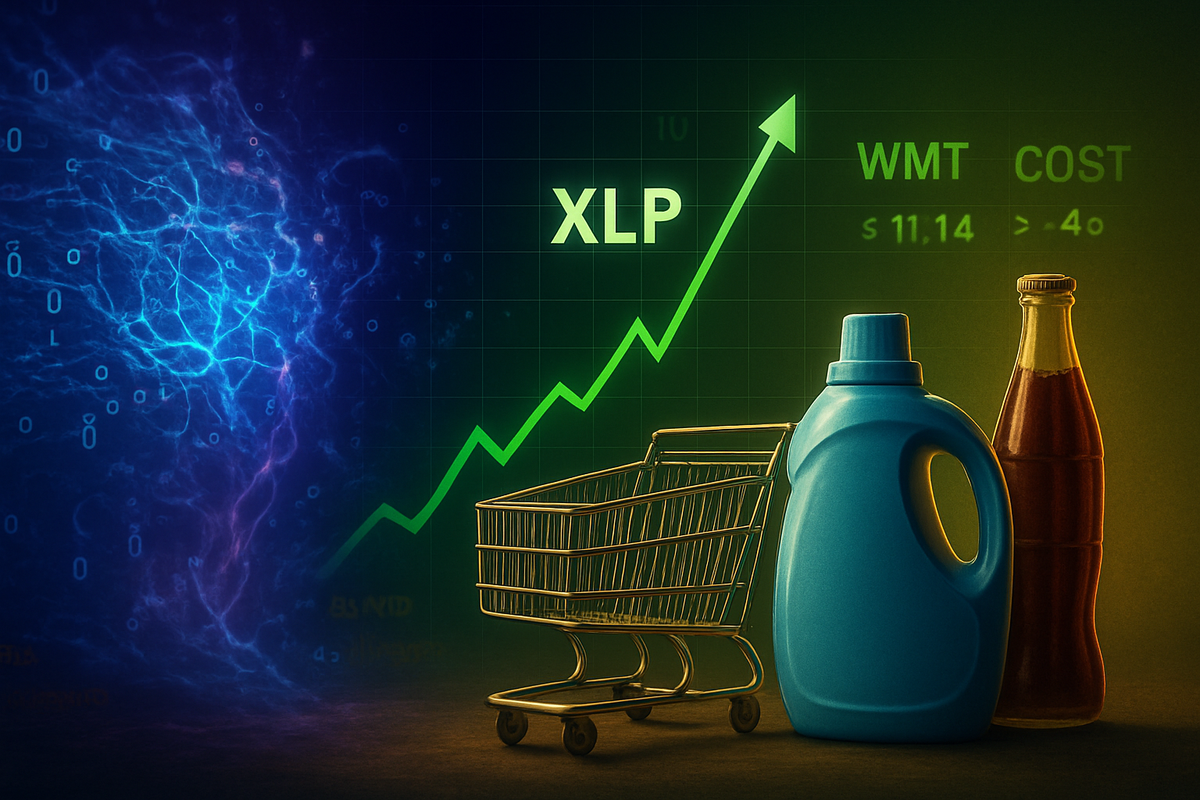
As of February 16, 2026, the narrative on Wall Street has undergone a startling transformation. The "growth-at-any-price" mentality that defined the early 2020s has been replaced by a resolute flight to quality, as investors abandon the high-octane technology sector in favor of the unglamorous but reliable world of household goods. The Consumer Staples Select Sector SPDR Fund (NYSEARCA: XLP) has surged 13.2% year-to-date, hitting all-time highs and significantly outperforming the broader market.
This rotation marks a rare "decoupling" in market dynamics. While the technology sector has slipped into negative territory for the year, the staples sector is enjoying its strongest start in decades. The catalyst for this shift is a growing skepticism toward the massive capital expenditures required to sustain the Artificial Intelligence (AI) revolution, paired with a renewed appreciation for companies with "pricing power"—the ability to pass on costs to consumers regardless of the economic climate.
The End of 'AI Euphoria' and the Rise of the Defensive Pivot
The current rotation began in earnest during the final week of January 2026, following a series of lukewarm earnings reports from technology giants. For two years, investors cheered as "hyperscalers" poured hundreds of billions into AI infrastructure. However, by early 2026, Wall Street’s patience ran thin. Total AI capital expenditure is projected to exceed $600 billion this year, yet the revenue generated from these investments has failed to keep pace with the massive depreciation and operational costs hitting balance sheets. This "CapEx fatigue" was exacerbated by the emergence of new autonomous AI agents that threatened to disrupt the traditional Software-as-a-Service (SaaS) business model, leading to what traders are calling "Software-mageddon."
In response, institutional capital has poured into the XLP at record rates. Leading firms like BlackRock and Vanguard have been observed reallocating billions out of growth-oriented ETFs and into defensive havens. The shift is not merely a hedge against a potential recession but a strategic bet on stability. While the Technology Select Sector SPDR Fund (NYSEARCA: XLK) has slumped approximately 4% since the year began, the XLP has become the primary destination for "safety-seeking" capital, offering an attractive dividend yield between 2.4% and 2.7%—a stark contrast to the low or non-existent yields in the tech sector.
Retail Giants and Dividend Kings: The Big Winners
The primary beneficiaries of this rotation are the heavyweights of the XLP index. Walmart Inc. (NYSE: WMT) has led the charge, with its stock up 14.89% year-to-date. The retail giant has successfully positioned itself as a "value leader" during a time when middle- and lower-income consumers are tightening their belts. Similarly, Costco Wholesale Corporation (NASDAQ: COST) has seen its shares rise 13.45%, fueled by its membership-based model and high renewal rates, which provide a level of predictable cash flow that AI-startups can only dream of.
On the manufacturing side, The Procter & Gamble Company (NYSE: PG) has gained 9.46%, acting as a defensive anchor for many portfolios. Investors are gravitating toward its portfolio of essential brands, recognizing that consumers will continue to buy Tide and Gillette products even if they cancel their high-priced enterprise software subscriptions. Other notable performers include The Coca-Cola Company (NYSE: KO), which recently broke through long-term technical resistance above $75 to post a 10.64% gain for the year. Conversely, the "losers" of this cycle are the tech behemoths like Microsoft Corp. (NASDAQ: MSFT), Alphabet Inc. (NASDAQ: GOOGL), and Amazon.com, Inc. (NASDAQ: AMZN), all of which have seen their market caps trimmed as investors demand more tangible evidence of AI-driven profitability.
A Historical Echo: Comparing 2026 to the Dot-Com Era
The current market behavior is drawing uncomfortable comparisons to the year 2000. Analysts at Bank of America have noted that the divergence between the staples and technology sectors is the widest it has been since the peak of the dot-com bubble. Much like the early 2000s, the market is moving from a phase of speculative excitement over a transformative technology—then the internet, now AI—to a sober realization of the time and capital required to monetize that technology. This "valuation reset" suggests that the broader market is finally pricing in the risks of the AI hype cycle.
Beyond historical comparisons, the rotation into staples reflects a fundamental shift in the macroeconomic environment. Inflation, while cooling from its 2022-2023 peaks, remains a persistent concern for many. Staples companies are uniquely positioned to navigate this environment because their products are non-discretionary. This "pricing power" allows them to maintain margins even as input costs fluctuate. Furthermore, as the Conference Board recently noted, 75% of S&P 500 companies now list AI as a "material risk" in their filings—a significant increase from just a year ago—underscoring the widespread anxiety that is driving the current flight to safety.
What Comes Next: Is the Rotation Sustainable?
In the short term, the momentum behind the XLP seems likely to continue as long as the tech sector remains in a "show me the money" phase. If upcoming earnings reports for the first quarter of 2026 do not show a significant uptick in AI-related revenue, the rotation could intensify. This may force technology companies to undergo significant strategic pivots, moving away from "growth-at-any-cost" and toward more disciplined spending and stock buybacks to regain investor trust.
However, the long-term outlook remains a point of debate among market strategists. Some argue that this is a temporary consolidation before the next leg of the AI bull market, while others believe we are witnessing a structural, multi-year shift toward value and dividends. If the Federal Reserve begins to lower interest rates in the face of a cooling economy, the dividend yields of staples like P&G and Coca-Cola will become even more attractive to income-hungry investors, potentially extending the XLP's record-breaking run.
Assessing the New Market Reality
The 13% surge in the Consumer Staples sector during the first six weeks of 2026 is a loud signal from the market: the era of blind faith in AI is over. Investors are no longer willing to ignore bloated balance sheets and excessive capital expenditure in hopes of future breakthroughs. Instead, they are prioritizing balance sheet resilience, predictable earnings, and tangible shareholder returns.
Moving forward, the key indicators to watch will be the "Big Tech" earnings reports in April and any shifts in consumer spending patterns. If staples continue to hit record highs while tech founders and CEOs struggle to explain their ROI, the defensive rotation of 2026 may be remembered as the moment when the market finally grounded itself in reality. For now, the XLP stands as a bastion of stability in an increasingly volatile financial landscape.
This content is intended for informational purposes only and is not financial advice.