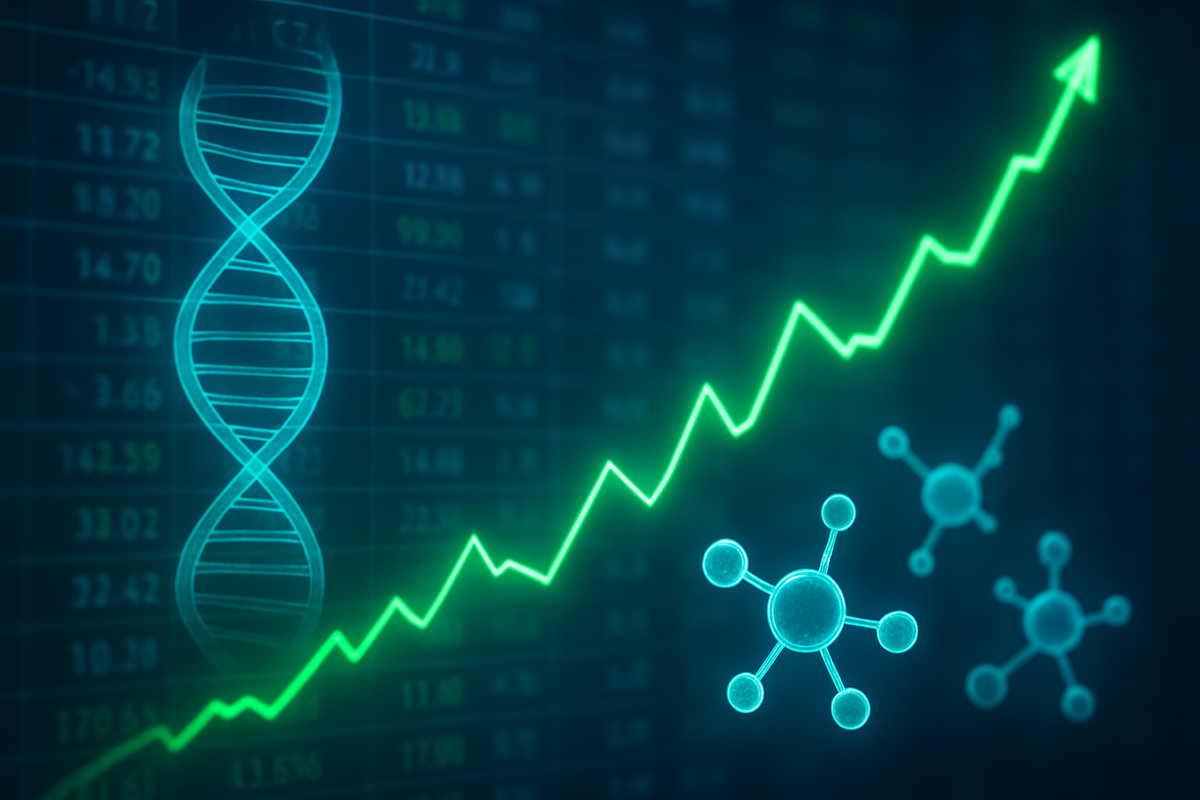
As of February 13, 2026, the financial markets are witnessing a historic "Great Rotation," where institutional capital is flowing out of overextended technology valuations and into the defensive, high-yield corridors of the healthcare sector. At the center of this movement is Gilead Sciences (Nasdaq: GILD), which has defied its decade-long reputation as a stagnant value play to become one of the top performers in the S&P 500 over the past year.
The stock, which recently touched all-time highs near $152.50, is benefiting from a "perfect storm" of fundamental success and macro-economic shifts. Following a robust 2025 where shares surged over 40%, Gilead has successfully transitioned from a legacy virology firm into a diversified powerhouse with high-growth engines in oncology and long-acting therapeutics. While a conservative 2026 guidance caused a minor 3% post-earnings dip earlier this week, the broader narrative remains one of structural re-rating as investors prize Gilead’s 3.2% dividend yield and its newly "de-risked" regulatory profile.
The Road to $150: A Timeline of Transformation
The transformation of Gilead Sciences (Nasdaq: GILD) began in earnest during the second half of 2025, driven by the explosive clinical and commercial success of its long-acting HIV pipeline. The pivotal moment arrived with the mid-2025 launch of Yeztugo (lenacapavir), the industry’s first twice-yearly injection for HIV prevention. By the end of 2025, Yeztugo had already exceeded $150 million in sales, with analysts projecting it to be a multi-billion-dollar franchise by 2027. This success signaled to the market that Gilead could defend its dominant HIV market share—anchored by Biktarvy—well into the 2030s.
In December 2025, a critical political catalyst emerged when Gilead reached a landmark "Most Favored Nation" pricing agreement with the Trump administration. This deal provided a predictable, five-year roadmap for drug pricing, effectively removing the "regulatory overhang" that had depressed biotech multiples for years. By the time Gilead reported its Q4 2025 earnings on February 10, 2026, it was clear the company had found its footing. It posted an adjusted EPS of $1.86 on $7.9 billion in revenue, beating analyst expectations across the board, even as it issued a cautious 2026 outlook to account for shifting insurance landscapes.
Winners and Losers in the Healthcare Pivot
Gilead’s ascent has been a tide that lifts many boats, but it has also highlighted a growing divide in the biotech sector. Amgen (Nasdaq: AMGN) and AbbVie (NYSE: ABBV) have both seen significant inflows as part of the value-to-healthcare rotation, gaining roughly 23% and 30% respectively over the last year. These companies, like Gilead, offer the "defensive growth" profile that fund managers are currently craving: high cash flows, sustainable dividends, and insulation from the volatility of the AI-driven tech sector.
However, the "losers" in this scenario are the high-burn, early-stage biotech firms that have failed to secure partnerships or clear clinical data. While the SPDR S&P Biotech ETF (NYSEARCA: XBI) has rallied nearly 80% from its 2025 lows, the gains are increasingly concentrated in "quality" names. On the pharmaceutical side, companies with heavy exposure to the expiring Affordable Care Act (ACA) tax credits—which lapsed at the end of 2025—face a more difficult 2026 as they navigate a changing insurance mix. Gilead has mitigated this risk through its diverse oncology portfolio, while more specialized players like Vertex Pharmaceuticals (Nasdaq: VRTX) continue to trade at premium "growth" multiples (P/E of 32x) due to their unique positions in gene therapy.
Broader Significance: The End of the AI Monopoly?
The rally in Gilead and the wider biotech sector signals a fundamental shift in market psychology. For much of 2024 and early 2025, the "Magnificent Seven" and AI-centric stocks dominated the S&P 500, often at the expense of traditional value sectors. The current healthcare surge indicates that the "AI Monopoly" on investor attention is ending. As interest rates stabilized in early 2026, the cost of capital for capital-intensive industries like biotech became more predictable, sparking a wave of M&A and a thawing of the IPO market.
Furthermore, the policy clarity achieved in late 2025 has created a "safe harbor" for healthcare investors. Historically, election cycles and administrative shifts brought threats of radical drug pricing reform. The current administration’s preference for negotiated, predictable pricing frameworks—exemplified by Gilead’s December deal—has allowed biotech valuations to recover toward historical norms. This "de-risking" is a significant precedent that could lead to a multi-year period of outperformance for the sector, reminiscent of the biotech boom of the mid-2010s.
The 2026 Outlook: Strategic Pivots and New Frontiers
Looking ahead, the next six months will be a test of Gilead’s ability to execute on its diversified strategy. A major milestone for 2026 is the anticipated launch of Anito-cel, a CAR-T therapy for multiple myeloma, expected in the second half of the year. This launch will be a litmus test for Gilead’s Kite Pharma division and its ability to maintain leadership in the increasingly competitive cell therapy space. Additionally, investors are closely watching for a potential FDA expansion of Trodelvy into first-line metastatic triple-negative breast cancer, which would significantly broaden the drug’s addressable market.
The challenge for Gilead in the short term remains its conservative 2026 guidance, which accounts for a 2% revenue headwind from pricing adjustments and the expiration of pandemic-era healthcare subsidies. Strategically, the company may need to lean more heavily on mid-sized acquisitions to bolster its early-stage pipeline as its legacy products face gradual generic pressure toward the end of the decade. Scenarios for late 2026 range from a continued "steady climb" as Yeztugo gains traction, to a "volatility spike" if insurance coverage shifts more drastically than anticipated under new federal policies.
Market Outlook and Final Thoughts
Gilead Sciences has successfully shed its "value trap" label, proving that a combination of clinical innovation and strategic policy engagement can revitalized even the most stagnant of blue-chip stocks. The key takeaway for investors is that the 2026 biotech rally is not a speculative bubble, but a disciplined rotation into quality and cash flow. Gilead’s role as an anchor in this rally suggests that the market is prioritizing "total return" over "growth at any cost."
Moving forward, the market will remain sensitive to the progress of long-acting therapeutics and the integration of oncology assets. While the 2025 breakout year was defined by a recovery in valuation, 2026 will be defined by operational excellence. Investors should keep a close eye on the Yeztugo uptake rates and the regulatory decisions surrounding the oncology pipeline. If Gilead can maintain its momentum, it won't just be a top performer in the S&P 500—it will be the blueprint for the modern, diversified biopharmaceutical giant.
This content is intended for informational purposes only and is not financial advice.