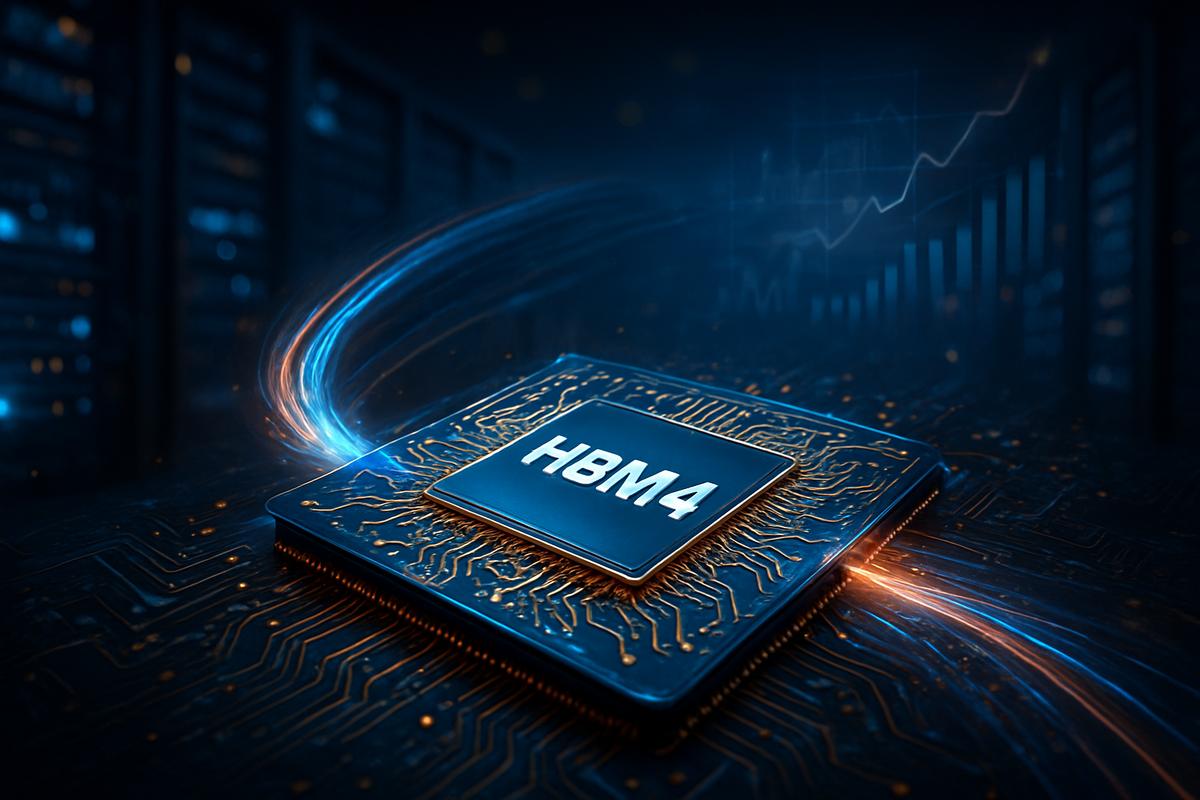
In a dramatic reversal of fortune that underscored the insatiable appetite for artificial intelligence infrastructure, shares of Micron Technology, Inc. (Nasdaq: MU) surged nearly 10% on February 11, 2026. The rally, which propelled the stock to a record closing high of $410.34, was ignited by a series of high-stakes announcements from CFO Mark Murphy. Speaking at a major industry conference, Murphy silenced recent market anxieties by confirming that Micron has officially entered volume production for its next-generation HBM4 memory chips, effectively cementing the company’s role as a linchpin in the global AI supply chain.
The immediate implications of this surge extend far beyond a single day’s trading. By reporting that its entire production capacity for High-Bandwidth Memory (HBM) for the 2026 calendar year is already sold out, Micron has signaled that the "AI infrastructure supercycle" is not just continuing, but accelerating. For investors and industry analysts, the news provides a definitive rebuttal to concerns that the memory market might be cooling. Instead, the data suggests a structural shortage of the specialized silicon required to power the world's most advanced large language models and inference engines.
The Rebuttal and the Rollout: Inside Murphy’s Milestone Announcement
The surge followed a period of intense speculation and a brief bearish dip triggered by reports suggesting Micron might be struggling to meet the rigorous technical standards required for NVIDIA’s (Nasdaq: NVDA) upcoming "Vera Rubin" GPU architecture. Industry rumors had whispered that Micron’s chips were failing to meet the 11Gbps pin-speed requirements, threatening its status as a primary supplier. CFO Mark Murphy took the stage at the Wolfe Research Autos/Semis Conference to put those rumors to rest, stating unequivocally that Micron’s HBM4 solution not only meets but exceeds those mandates, describing the previous reports as "simply inaccurate."
More importantly, Murphy revealed that Micron has accelerated its internal timelines. The company commenced volume shipments of HBM4 in the first quarter of 2026, a full quarter ahead of the guidance provided during the December 2025 earnings call. This operational agility is critical in an industry where being first to market translates directly into billions in revenue. The confirmation that 2026 supply is 100% committed underscores a massive supply-demand imbalance, with Murphy noting that demand is currently outstripping the industry's ability to produce by a "substantial margin."
The timeline of this breakthrough is the culmination of years of capital expenditure and engineering pivots. Since the launch of the HBM3E generation, Micron has been playing a high-stakes game of catch-up with its Korean rivals. By successfully launching HBM4 ahead of schedule and securing long-term contracts with "tier-one" AI customers, Micron has demonstrated that it can compete at the bleeding edge of semiconductor physics.
Winners and Losers in the Memory Arms Race
The primary winner of this event is, of course, Micron Technology itself. The 10% stock jump reflects a "relief rally" as the market recalibrates its valuation based on guaranteed revenue through 2026. Micron’s aggressive expansion of its manufacturing footprint in New York and Singapore is now viewed not as a risky gamble, but as a necessary scale-up to meet a locked-in order book.
However, the ripple effects extend to other industry giants. NVIDIA (Nasdaq: NVDA) stands as a major beneficiary; with Micron proving its ability to deliver high-performance HBM4, NVIDIA’s Rubin platform remains on track for a blockbuster launch. The competition among memory providers ensures that NVIDIA has a diversified supply chain, reducing its reliance on any single manufacturer.
On the other side of the ledger, the news creates a complex landscape for SK Hynix (KRX: 000660) and Samsung Electronics (KRX: 005930). SK Hynix, which held an estimated 60-70% share of the HBM market entering 2026, now faces a much more aggressive and technically capable Micron. While the "expanding pie" of the AI market means SK Hynix is still seeing record demand, the loss of near-monopoly pricing power may eventually impact margins. Samsung, meanwhile, is in the midst of its own HBM4 comeback, aiming for a 25-30% market share by the end of the year. Micron’s early volume shipments put additional pressure on Samsung to execute its 1c DRAM and 4nm foundry process flawlessly to avoid falling into the third-place spot.
The AI Infrastructure Supercycle and the Shift to Inference
The significance of Micron's sold-out status cannot be overstated within the context of the broader "Memory Supercycle." By early 2026, the semiconductor industry has shifted its focus from the initial training of AI models to the massive scale of AI inference—the stage where models are actually used by billions of end-users. Inference requires vast amounts of high-speed memory, leading to projections that AI data centers will consume nearly 70% of all high-end DRAM by the end of 2026.
This event mirrors historical precedents such as the mobile internet boom of the late 2000s, but at a vastly more capital-intensive scale. Unlike previous memory cycles, which were often plagued by oversupply and price crashes, the current era is defined by Cloud Service Providers (CSPs) like Microsoft (Nasdaq: MSFT) and Meta (Nasdaq: META) prioritizing "supply security" over price. This fundamental change in buyer behavior allows companies like Micron to maintain record-high margins and predictable cash flows, a rarity in the historically volatile memory sector.
Furthermore, the HBM market is on a trajectory to reach a $100 billion valuation by 2028, a milestone that analysts now believe could be reached even sooner. The regulatory environment remains relatively supportive of this expansion, as governments in the U.S. and Asia view semiconductor self-sufficiency as a matter of national security, providing subsidies and tax breaks for the very facilities Micron is currently using to produce these chips.
Looking Ahead: Scaling for the Unknown
As we move deeper into 2026, the primary challenge for Micron will be execution on its massive capital expenditure projects. Short-term, the focus will be on the ramp-up of the Singapore facility and the groundbreaking of new phases in the New York mega-fab. The company must navigate potential supply chain bottlenecks in specialized manufacturing equipment, particularly the advanced lithography tools required for HBM4.
Long-term, the industry is already looking toward HBM5 and the integration of memory directly onto logic dies. Micron’s ability to stay ahead of the curve will depend on its continued R&D investment, which is expected to remain at record levels. A potential strategic pivot may involve deeper partnerships with foundries like TSMC (NYSE: TSM) to co-develop custom HBM solutions tailored for specific AI chipsets, moving away from "commodity" memory toward high-margin, bespoke hardware.
The market must also weigh the possibility of a "digestion period" where CSPs eventually slow their frantic buying. However, with 2026 already fully booked, any such slowdown remains a distant concern for the next several quarters.
Conclusion: A New Era for Micron and the Market
Micron’s 10% surge on February 11, 2026, represents more than just a good day for the stock; it is a validation of the company’s long-term strategy and a bellwether for the entire technology sector. By confirming volume shipments of HBM4 and a completely sold-out 2026 inventory, Mark Murphy has signaled that Micron is no longer just a participant in the AI race—it is a leader.
Moving forward, the market will transition from questioning Micron’s technical capabilities to monitoring its production yields and expansion timelines. For investors, the takeaway is clear: the AI boom is entering a phase of sustained industrial scaling. The "sold out" sign hanging on Micron’s door is perhaps the strongest evidence yet that the digital transformation of the global economy still has significant room to run. In the coming months, watch for updates on the Singapore facility's output and any further expansion of the NVIDIA partnership, as these will be the key drivers of Micron's next leg of growth.
This content is intended for informational purposes only and is not financial advice.