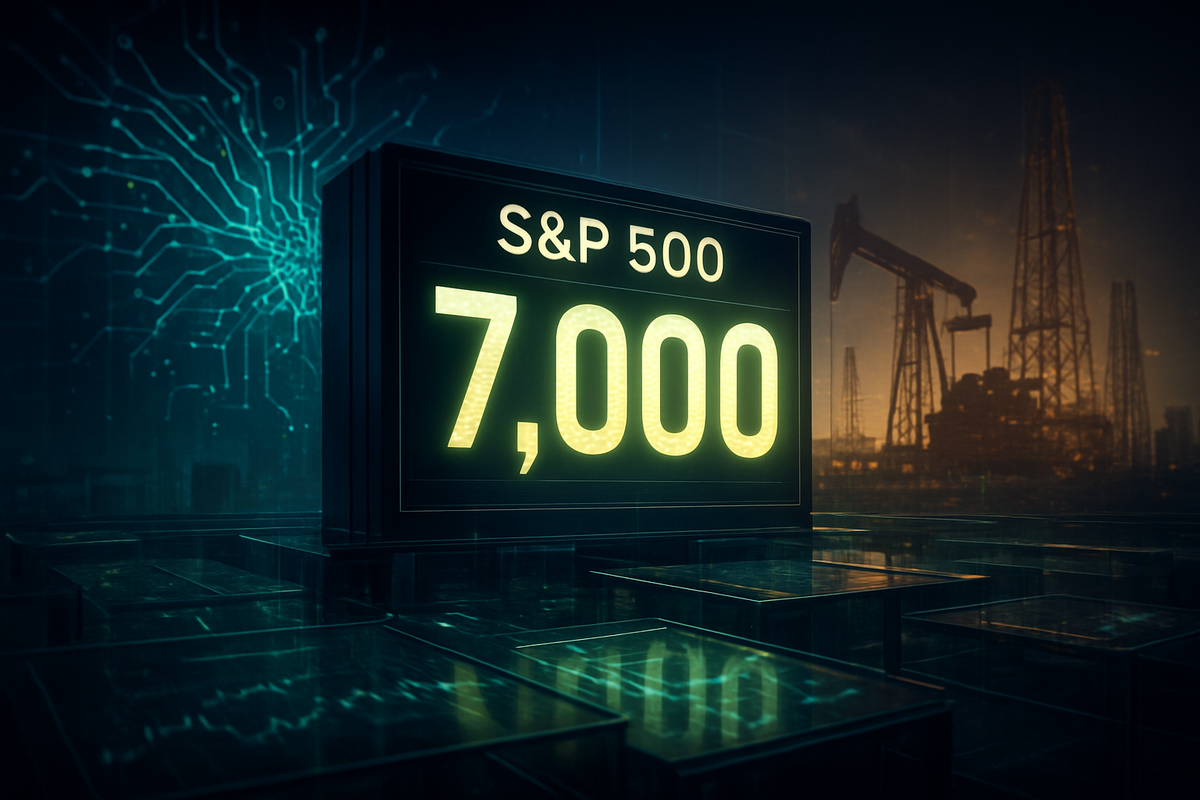
The S&P 500 has spent the early weeks of 2026 dancing on the edge of history, repeatedly testing the psychological and technical barrier of the 7,000 mark. After a relentless climb throughout 2025, the world’s most-watched equity index briefly eclipsed the milestone on January 28, 2026, hitting an intraday high of 7,002.28. While it has yet to sustain a daily close above that level, the index’s proximity to 7,000 marks a staggering 40% rise from its late-2023 lows, signaling a new era of market valuation driven by an intricate mix of artificial intelligence productivity and a resurgence in traditional industrial power.
The current atmosphere on the floor of the New York Stock Exchange is one of cautious optimism, characterized by a "Gamma Wall"—a zone of heavy options positioning—that has kept the index range-bound between 6,940 and 6,980 as of mid-February. Investors are currently weighing the "SaaSpocalypse" correction in the software sector against the raw earnings power of energy and materials. This tension has transformed the 7,000 level into more than just a number; it is a battleground where the "new" and "old" economies are fighting to define the next leg of the bull market.
The Long Road to 7,000: A Timeline of Resilience
The march to 7,000 began in earnest during the final quarter of 2025, bolstered by a series of 25-basis-point rate cuts by the Federal Reserve. These cuts provided the liquidity necessary for the "Magnificent Seven" to maintain their momentum, even as concerns about valuation began to surface. The rally accelerated in early January 2026, fueled by a surge in "non-inflationary productivity" data, which many analysts attributed to the first wave of enterprise-wide AI implementation. By mid-January, the index was gaining an average of 1.5% per week, culminating in the historic, albeit brief, breach of 7,000 in late January.
However, the rally’s composition shifted dramatically in the first six weeks of 2026. The initial market reaction to the 7,000 level was a wave of profit-taking in the tech sector, specifically in companies that failed to show an immediate return on their massive 2025 capital expenditures. This "Capex fatigue" coincided with a geopolitical shock: a military intervention in Venezuela on January 3, 2026, which sent shockwaves through energy markets and redirected capital into the "Old Economy." Key stakeholders, including institutional heavyweights like Goldman Sachs and State Street, have noted that while the 7,000 level remains the target, the drivers have rotated from growth-at-any-price to value-plus-productivity.
Winners and Losers in the Race to the Top
In this high-stakes environment, the leaderboard of the S&P 500 is undergoing a profound reshuffle. Alphabet Inc. (NASDAQ: GOOGL) has emerged as a rare tech winner, hitting new all-time highs as its integrated AI search tools prove more resilient than skeptics predicted. Similarly, Oracle Corporation (NYSE: ORCL) has seen sustained gains, benefiting from its strategic cloud-AI partnerships that have shielded it from the broader software sell-off. The real surprise, however, has been the energy sector, led by Chevron Corporation (NYSE: CVX), which has surged over 20% year-to-date as global supply concerns and domestic infrastructure rebuilding take center stage.
Conversely, the "SaaSpocalypse" has claimed several high-profile victims. Salesforce, Inc. (NYSE: CRM) has faced a brutal 26% decline in early 2026, as investors fear that native AI "coworkers" are reducing the need for traditional enterprise software seats. Microsoft Corporation (NASDAQ: MSFT), while still a titan, entered a technical correction in February after its massive $600 billion AI capital expenditure plan sparked concerns about long-term return on invested capital. Other notable laggards include Adobe Inc. (NASDAQ: ADBE) and Palantir Technologies Inc. (NYSE: PLTR), both of which have struggled to justify their high multiples in a market that is increasingly demanding tangible "Old Economy" results alongside AI efficiency. Even Nvidia Corporation (NASDAQ: NVDA), the poster child of the 2024 rally, is currently trading 15% below its 2025 peak as the market waits for the next generation of hardware catalysts.
The Wider Significance: AI, Geopolitics, and the Fed
The S&P 500's struggle at 7,000 is emblematic of a broader transition in the global economy. This isn't just a stock market rally; it's a reflection of a fundamental shift in how productivity is measured. Unlike the dot-com bubble of 1999, the current rally is backed by substantial earnings growth—estimated at 13% to 15% for 2026. However, the move toward 7,000 is also being shaped by significant policy shifts. The nomination of Kevin Warsh to succeed Jerome Powell as Federal Reserve Chair has introduced a new variable: a "hawkish dove" who may lower rates to support productivity while simultaneously shrinking the Fed's $7.3 trillion balance sheet.
This event also highlights the "tangible economy" resurgence. The ripple effects of data center construction and the energy needs of AI have revitalized materials and industrial sectors. Historically, when the S&P 500 hits major thousand-point milestones, it often undergoes a period of "digestion." The 1999-2000 period saw the index struggle with the 1,500 level, and 2021 saw a similar hesitation around 4,000. The current 7,000 hurdle is complicated by a more fractured geopolitical landscape, including NATO tensions and the aforementioned shifts in South American energy production, making this milestone more volatile than its predecessors.
What Comes Next: The Path to 8,000 or a Retreat?
In the short term, the S&P 500 is likely to remain in a tug-of-war between the 6,900 and 7,100 levels. The market requires a "clearing event"—potentially the first quarter earnings reports in April—to provide the evidence of AI-driven ROI that investors are currently missing. If Microsoft (NASDAQ: MSFT) and its peers can demonstrate that their massive Capex spend is translating into bottom-line growth, a sustained close above 7,000 is all but certain. If not, the index could see a deeper correction toward the 6,500 support level as the SaaS sector continues its painful recalibration.
Longer-term, the outlook remains bullish for many analysts. Michael Arone of State Street has provocatively forecasted a move to 8,000 by year-end 2026, predicated on the idea that the "Old Economy" will adopt AI at a pace that offsets any slowdown in the tech sector itself. Strategic pivots will be required for investors; the "buy-the-dip" strategy that worked for tech for a decade may now be more effective in energy, materials, and industrials. The market is evolving from a narrow, tech-led sprint into a broad-based marathon.
Summary and Investor Outlook
The S&P 500's flirtation with 7,000 is a watershed moment for Wall Street. The key takeaways are clear: while AI remains the primary structural driver of the market, the "easy money" phase of the rally is over. The emergence of the "SaaSpocalypse" and the rotation into energy and materials suggest a market that is becoming more discerning, valuing tangible assets and immediate productivity over distant growth projections.
Moving forward, the market is likely to reward "AI-enabled" companies—those that use the technology to improve margins—rather than just "AI-providers." Investors should keep a close watch on Federal Reserve communications regarding the balance sheet and watch for any stabilization in the software sector. The climb to 7,000 has been historic, but the real test will be whether the index can turn this psychological ceiling into a new floor for the years to come.
This content is intended for informational purposes only and is not financial advice.