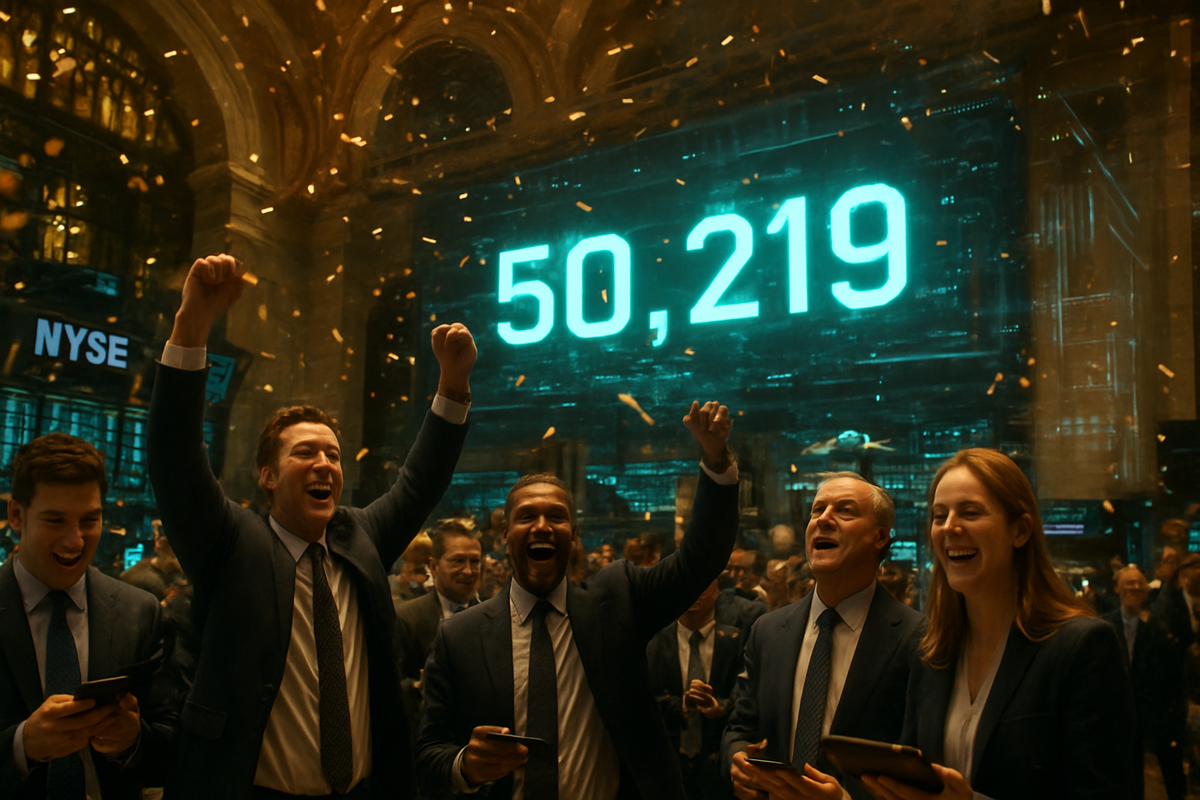
On February 9, 2026, the Dow Jones Industrial Average (DJIA) carved its name into the history books, closing at a record high of 50,219.00. This historic milestone marks a monumental achievement for the blue-chip index, which has navigated a turbulent start to the year characterized by massive sector rotations and a fundamental "re-rating" of the technology landscape. The surge past the 50,000-point psychological barrier signals a resilient market sentiment, even as investors grapple with the rapid integration of advanced artificial intelligence into the global economy.
However, the euphoria of Monday’s close was met with a sober reality on the morning of February 10. Stock futures showed a slight dip as investors paused to digest the implications of the 50k level and prepared for a "triple-threat" of upcoming economic data. While the Dow’s achievement is a testament to the strength of its modern components, the cooling of futures suggests that the road to 60,000 will be paved with caution and renewed scrutiny of corporate earnings and consumer health.
The Path to 50,219: A Blue-Chip Renaissance
The Dow’s journey to 50,219 was anything but linear. The index first grazed the 50,000-point ceiling on Friday, February 6, before solidifying its position with a 103-point gain on Monday. This 21-month ascent from the 40,000 mark—first reached in May 2024—was propelled by a unique blend of traditional industrial strength and high-octane growth from the index's newest technology additions. The rally was particularly impressive given that it followed a "violent" sell-off in the software sector earlier in the month, a period some analysts have dubbed the "SaaSpocalypse."
The volatility began in early February when breakthrough releases from AI startups sparked fears of "AI substitution," where autonomous agents began to threaten traditional software-as-a-service (SaaS) business models. This triggered a swift $300 billion wipeout in market value across the software space. However, the Dow proved its resilience as investors pivoted from "software" to "infrastructure." By the time the markets opened on February 9, the narrative had shifted; the massive capital expenditure plans from tech giants were no longer viewed as a burden, but as a guaranteed revenue stream for the hardware and industrial giants that anchor the Dow 30.
Key stakeholders, including institutional asset managers and retail investors, watched closely as the "Blue-Chip Renaissance" took hold. The index’s price-weighted construction meant that high-priced shares in the financial and industrial sectors provided the necessary ballast to stabilize the index during tech's more volatile swings. This convergence of "Old Economy" reliability and "New Economy" growth potential created the perfect conditions for the record-breaking close.
Winners and Losers: The AI Vanguard vs. The SaaS Struggle
The primary engine behind the Dow’s historic climb was Nvidia (NASDAQ: NVDA), which has become the index’s most watched growth driver since joining the average in late 2024. In the days leading up to the 50,219 close, Nvidia surged nearly 8%, contributing significantly to the index's upward momentum. Microsoft (NASDAQ: MSFT) also played a pivotal role, with its shares jumping 3% on the back of strong cloud performance, reinforcing its status as a cornerstone of the modern Dow.
Beyond the "Magnificent" tech names, other winners emerged from the shift toward AI infrastructure. Oracle (NYSE: ORCL) saw its shares climb nearly 10% after announcing a massive $50 billion AI infrastructure fund, while Advanced Micro Devices (NASDAQ: AMD) benefited from the insatiable demand for high-performance chips. Even the "Old Economy" stalwarts showed teeth; Goldman Sachs (NYSE: GS) and Caterpillar (NYSE: CAT) both reached all-time highs during the rally, benefiting from a broader market rotation into financials and industrials.
Conversely, the software sector felt the sting of the "SaaSpocalypse." Salesforce (NYSE: CRM), a prominent Dow component, faced headwinds as investors worried about the long-term defensibility of its core platform against autonomous AI agents. Other industry leaders like Adobe (NASDAQ: ADBE), Intuit (NASDAQ: INTU), and LegalZoom (NASDAQ: LZ) suffered double-digit losses earlier in the month as the market recalibrated expectations for software growth. On the morning of February 10, even consumer staples faced pressure; Coca-Cola (NYSE: KO) saw its shares fall approximately 4% in premarket trading after a revenue miss, highlighting a growing price sensitivity among consumers that could threaten the broader market's momentum.
Wider Significance: Breaking the Psychological Anchor
The psychological significance of the Dow hitting 50,000 cannot be overstated. In the world of behavioral finance, round numbers often act as "anchors" that can either serve as a launchpad for further gains or a ceiling for profit-taking. For many institutional traders, the 50,000 level represents a point of "institutional exhaustion," where the perceived expensiveness of the market leads to a natural pause. This event mirrors historical precedents, such as the Dow hitting 10,000 in 1999 or 30,000 in 2020, moments that were followed by periods of intense consolidation as the market searched for its next catalyst.
This milestone also highlights a broader industry trend: the transition from AI experimentation to AI infrastructure. The market is currently rewarding companies that provide the "picks and shovels" for the AI era—chips, data centers, and power—while punishing those whose business models rely on traditional human-mediated software. The Dow's ability to reach 50,000 despite the software sell-off suggests that the index is successfully evolving to reflect the 2026 economy, where hardware and heavy industry are once again the bedrock of growth.
Furthermore, the rally occurred against a backdrop of a "good news is bad news" paradox. While the economy remains resilient, this very strength has complicated the Federal Reserve's path toward interest rate cuts. The Dow's rise to 50,219 indicates that, for now, investors are more focused on corporate earnings and technological transformation than they are on the central bank's next move. However, this sentiment remains fragile and highly dependent on the "Capex narrative" holding steady.
The Morning After: What Comes Next?
As the sun rose on February 10, 2026, the initial "50k" celebration was replaced by a more cautious tone. Futures for the Dow and the S&P 500 slipped as investors looked toward a "triple-threat" of economic data scheduled for the remainder of the week. The primary concern in the short term is the January Consumer Price Index (CPI) and the upcoming Non-Farm Payrolls report. If these figures suggest that inflation is re-accelerating or the labor market is overheating, the Dow could see a swift retreat back toward the 48,000 level as the Fed's "higher for longer" stance is reinforced.
In the long term, the market's focus will likely shift from AI infrastructure to AI ROI (Return on Investment). Companies like Amazon (NASDAQ: AMZN) and Alphabet (NASDAQ: GOOGL), which are spending hundreds of billions on capital expenditures, will eventually need to prove that these investments are translating into bottom-line growth. If the productivity gains promised by AI fail to materialize by late 2026, the current rally could be viewed in hindsight as a period of irrational exuberance.
Strategic adaptations are already underway. Software companies are racing to integrate "AI agents" to stave off obsolescence, while industrial firms are leveraging AI to optimize supply chains in an environment of persistent inflation. For investors, the challenge will be distinguishing between the companies that are genuinely transforming their operations and those that are merely riding the coattails of the 50,000-point hype.
Market Outlook and Final Thoughts
The Dow Jones Industrial Average hitting 50,219 is a landmark event that reflects the enduring power of the American economy and its ability to reinvent itself through technological cycles. The key takeaway for investors is that while the 50,000 milestone is a cause for celebration, it also marks the beginning of a new, more demanding phase of the market cycle. The easy gains from the initial AI hype have likely been realized; the next leg of the journey will require rigorous fundamental analysis and a keen eye for consumer health.
Moving forward, the market will be defined by its ability to digest the massive capital investments of the last two years. Investors should watch for the upcoming CPI data and the performance of consumer staples like Coca-Cola, which serve as a "canary in the coal mine" for consumer spending power. If the consumer remains resilient and the AI infrastructure build-out continues unabated, the 50,219 mark may soon be viewed as just another stepping stone on the path to even greater heights.
Ultimately, the Dow's achievement serves as a reminder that the market is a "climb up a wall of worry." Even amidst sectoral sell-offs and macroeconomic uncertainty, the blend of innovation and industrial might continues to push the boundaries of what is possible in the financial markets. For now, the 50,000 frontier has been crossed, and the world is watching to see how far this tech-led rally can go.
This content is intended for informational purposes only and is not financial advice.