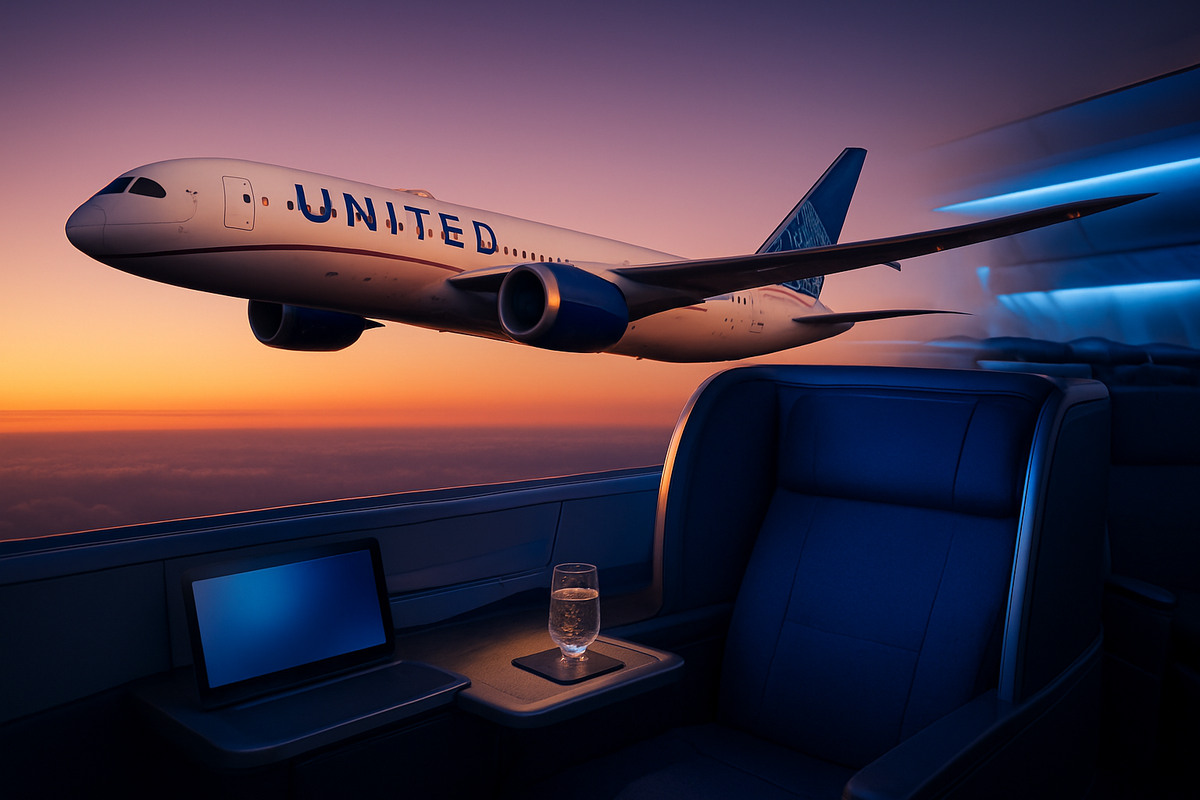
The Chicago-based carrier, United Airlines Holdings Inc. (NASDAQ: UAL), reported record-breaking fourth-quarter and full-year 2025 financial results this week, signaling a permanent shift in the airline industry’s business model. On January 20, 2026, the company revealed that while its total revenue reached a historic $15.4 billion for the quarter, the real story lies in the "K-shaped" demand profile of the modern traveler. High-margin premium cabins are now doing the heavy lifting for the airline's bottom line, effectively subsidizing a standard economy segment that has seen stagnant growth and increased competition.
The results, which surpassed Wall Street's expectations for the 14th consecutive quarter, suggest that United's gamble on luxury is paying off. With adjusted earnings per share (EPS) of $3.10 beating the $2.98 consensus, the market reacted with cautious optimism. However, the report also highlighted a growing rift in the cabin: premium revenue surged by 12% year-over-year, while revenue from standard main-cabin seats grew by a meager 1%. This bifurcation is forcing United—and the industry at large—to reconsider the very nature of mass-market air travel in an era of rising costs and affluent consumer resilience.
A Tale of Two Cabins: The Q4 Breakdown
The earnings call, led by CEO Scott Kirby and Chief Commercial Officer Andrew Nocella, painted a picture of an airline that has successfully "inoculated" itself against the volatility of the budget travel market. The $15.4 billion revenue mark was achieved despite significant headwinds, including the residual effects of a U.S. government shutdown in late 2025 that cost the carrier an estimated $250 million. The standout metric was the performance of United’s premium offerings—Polaris, Premium Plus, and First Class—which saw double-digit revenue growth on only a 7% increase in capacity. This indicates massive "yield" power, as travelers are increasingly willing to pay a premium for "space and grace."
This strategic pivot is part of the "United Next" initiative, a multi-year overhaul focused on larger aircraft and upscale interiors. Throughout 2025, United accelerated the rollout of its signature interiors, featuring larger overhead bins and seatback entertainment at every seat. The airline also began the fleet-wide implementation of Starlink high-speed Wi-Fi, a move that executives claim has been a primary driver for corporate contract wins. Conversely, the "Standard Economy" segment lagged significantly, failing to keep pace with its own 6% capacity growth. Interestingly, "Basic Economy" saw a 7% revenue jump, as United used the low-fare tier as a defensive weapon to squeeze out ultra-low-cost competitors like Spirit Airlines, which re-entered Chapter 11 bankruptcy late last year.
Winners and Losers in the Premium Arms Race
United is not alone in this strategy, but it is currently winning the execution battle alongside Delta Air Lines (NYSE: DAL). Delta recently reported that for the first time in its history, premium revenue actually exceeded main cabin revenue, accounting for nearly 60% of its total intake. Together, United and Delta have formed a duopoly at the top of the market, leveraging their massive international networks and luxury lounges to capture the highest-spending 20% of the traveling public. For investors, UAL remains a "winner" in terms of growth potential, with the company issuing a stunning 2026 EPS guidance of $12.00 to $14.00, far above analyst forecasts.
The "loser" in this current environment appears to be American Airlines (NASDAQ: AAL), which is scheduled to report its results on January 27. American has focused heavily on a "connectivity-first" model, using its domestic hubs to offer the most frequent flights. However, this strategy has left it vulnerable to rising labor costs without the high-margin cushion that United’s international premium cabins provide. In a pointed jab during the earnings call, CEO Scott Kirby predicted that American would lose upwards of $1 billion at Chicago’s O'Hare International Airport in 2026 as United continues to dominate the high-yield corporate market in that hub. Meanwhile, ultra-low-cost carriers (ULCCs) are facing an existential crisis; even Southwest Airlines (NYSE: LUV) has been forced to abandon its famous open-seating policy in early 2026 to introduce assigned premium seating in a desperate bid to capture some of this high-end demand.
The Industry-Wide "K-Shaped" Reality
The 2026 travel landscape is a reflection of a broader macroeconomic trend where high-income consumers remain largely insulated from inflationary pressures. This "K-shaped" recovery has fundamentally changed airline economics. Historically, airlines relied on filling every seat to break even; today, a flight can be profitable even with a half-empty economy cabin, provided the business class and premium economy sections are sold out at high yields. This shift has also been aided by a regulatory pivot. In early 2026, the Department of Transportation (DOT) began rolling back some of the more aggressive passenger protection rules introduced in 2024, such as mandatory cash refunds for minor delays. This has reduced the "disruption liability" for legacy carriers, further protecting their margins.
However, the industry is not without its systemic risks. A persistent pilot shortage, projected to reach a shortfall of 24,000 aviators by the end of 2026, continues to limit capacity and drive up wages. Furthermore, United is currently grappling with a significant labor dispute. Its 28,000 flight attendants have been without a contract for five years, and the union recently rejected a 40% pay increase proposal, citing poor scheduling conditions. As United leans further into "premium service," the disconnect between its high-end brand promise and its disgruntled frontline workforce remains a volatile variable that could disrupt its upward trajectory.
Looking Ahead: The 2026 Roadmap
In the short term, United plans to double down on its fleet modernization, expecting delivery of over 100 narrowbody and 20 widebody aircraft in 2026. Each of these planes will feature the "United Next" interior, which the company views as its primary competitive advantage. The airline is also expanding its "Digital ID" biometric systems to over 70% of its network, aiming to create a "frictionless" experience for its Polaris customers. The goal is clear: make the travel experience so seamless for the affluent traveler that price becomes a secondary consideration to convenience and comfort.
The long-term challenge will be the sustainability of this premium-heavy model. If the broader economy cools, the corporate travel budgets that currently support United’s $14.00 EPS target could be the first to be slashed. Additionally, the airline must find a way to stabilize its "Main Cabin" revenue. Relying on Basic Economy to fight off budget carriers is a low-margin game that could eventually dilute the premium brand. United’s management seems aware of this, suggesting that future configurations may see even fewer economy seats in favor of expanded Premium Plus sections, effectively shrinking the "bus" and expanding the "limousine" sections of the aircraft.
Investment Summary and Final Thoughts
United Airlines has entered 2026 as a formidable powerhouse, successfully pivoting from a traditional legacy carrier to a luxury-focused service provider. The key takeaway for investors is the company’s ability to generate record revenue even as its largest segment—standard economy—underperforms. This suggests that United’s "United Next" strategy is not just a marketing slogan but a fundamental restructuring of its revenue streams. The market's positive reaction to the $12-$14 EPS guidance reflects a belief that this premium demand is structural rather than cyclical.
Moving forward, investors should keep a close eye on the flight attendant contract negotiations and the potential for labor unrest, which remains the single biggest threat to United's operational reliability. Furthermore, the competitive battle at major hubs like O'Hare will serve as a bellwether for whether United can truly squeeze out its rivals through superior service and hub economics. For now, United is flying high on the wings of the affluent traveler, proving that in the 2026 airline industry, the view from the front of the plane has never been better—or more profitable.
This content is intended for informational purposes only and is not financial advice.