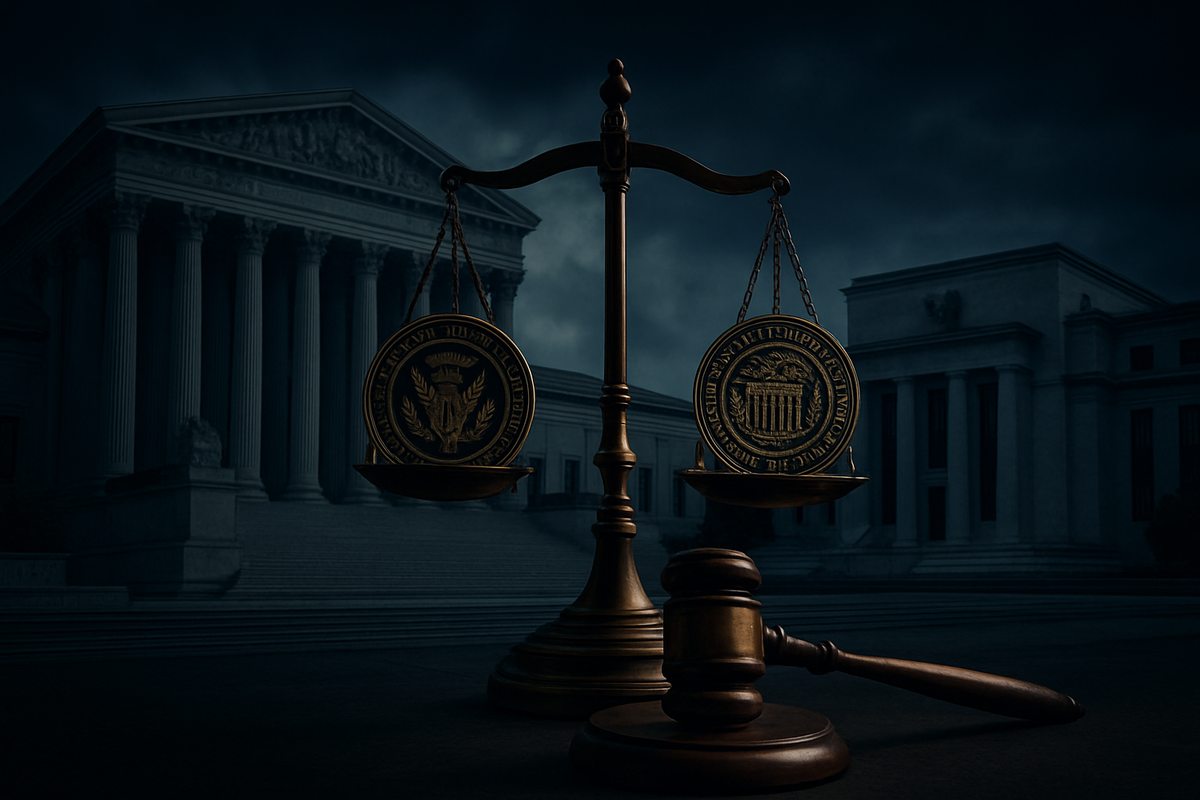
The pillars of the global financial system trembled this week as the U.S. Supreme Court (SCOTUS) took up the case of Trump v. Cook, a high-stakes legal battle that could redefine the executive branch’s authority over the Federal Reserve. At the heart of the dispute is President Donald Trump’s attempt to remove Governor Lisa Cook from the Federal Reserve Board of Governors, a move that critics argue threatens the century-old independence of the nation’s central bank. As oral arguments concluded on January 21, 2026, the case has become a litmus test for the "for cause" protections that historically shielded Fed officials from political interference.
The immediate implications are profound: a ruling in favor of the President would effectively grant the White House the power to fire Fed governors over policy disagreements, potentially turning monetary policy into an extension of the executive’s political agenda. Conversely, a ruling for Cook would solidify the Fed’s autonomy, reassuring global markets that interest rate decisions remain insulated from electoral cycles.
A Battle for the Soul of the Central Bank
The conflict ignited in August 2025, when President Trump announced via social media his intention to terminate Governor Lisa Cook. The administration cited "cause" for the removal, alleging that Cook had engaged in mortgage fraud related to a personal home purchase in 2022—years before she joined the Board of Governors. Cook immediately challenged the dismissal in federal court, asserting that the Federal Reserve Act only allows for removal for "inefficiency, neglect of duty, or malfeasance in office," and that the unproven, pre-tenure allegations did not meet this legal bar.
The timeline leading to the Supreme Court has been swift. In September 2025, a District Court judge issued a preliminary injunction, allowing Cook to remain in her post while the legal process unfolded. The D.C. Circuit Court of Appeals upheld that stay, prompting the administration to petition the Supreme Court for an expedited hearing. During the two-hour oral argument on January 21, Solicitor General D. John Sauer argued that the President possesses "near-limitless authority" to determine what constitutes "cause" and that the judiciary has no role in reviewing the President’s factual findings.
However, the justices appeared skeptical of this expansive view of executive power. Justice Brett Kavanaugh, a pivotal conservative voice, warned that allowing unreviewable removals would "weaken, if not shatter, the independence of the Federal Reserve." Justice Amy Coney Barrett questioned the lack of a formal hearing for Cook, while Justice Ketanji Brown Jackson pointed out the absence of a factual basis for the fraud claims. These exchanges suggest the Court may be reluctant to overturn the long-standing precedent set in Humphrey’s Executor v. United States (1935), which protects independent agency heads from at-will firing.
Markets Breathe a Sigh of Relief as Judicial Skepticism Mounts
The financial markets, which had been in a defensive crouch leading up to the hearing, staged a significant "relief rally" as the skeptical tone of the justices became clear. The SPDR S&P 500 ETF Trust (NYSE Arca: SPY) rose 1.16% to close at $685.39 on January 21, recovering more than half of its losses from a sharp selloff earlier in the week. Investors interpreted the judicial pushback as a sign that the Fed’s institutional integrity would likely remain intact, preventing a "loyalist takeover" that might result in politically motivated, inflationary rate cuts.
Major financial institutions saw a notable bounce back. Goldman Sachs (NYSE: GS) shares surged 2.28% to close at $964.89, while JPMorgan Chase (NYSE: JPM) rose to $302.04. These banking giants are particularly sensitive to Fed stability, as a politicized central bank would introduce immense uncertainty into lending, capital requirements, and interest rate hedging. Citigroup (NYSE: C) also gained ground, closing at $113.86. The bond market reflected this easing of political risk, with the 10-year Treasury yield retreating from a peak of 4.31% to approximately 4.25%.
Conversely, sectors that thrive on high volatility or "safe haven" demand, such as gold, saw their momentum stall. The iShares 20+ Year Treasury Bond ETF (NASDAQ: TLT) stabilized after a period of intense pressure, as the "political risk premium" that had been priced into long-dated debt began to evaporate. Analysts at major firms noted that if the Court had shown more sympathy for the administration’s arguments, we would likely have seen a "flight to quality" and a spike in the VIX, which instead dropped from 20.69 to 16.90 following the hearing.
The Fragile Shield of 'For Cause' Protections
This case fits into a broader trend of "unitary executive" legal challenges aimed at dismantling the administrative state. In recent years, the Supreme Court ruled in Seila Law LLC v. CFPB and Collins v. Yellen that single-headed agencies like the Consumer Financial Protection Bureau cannot have "for cause" protections. However, the Federal Reserve’s multi-member board has historically been viewed as a different category. The Trump v. Cook case forces the Court to decide if the Fed’s unique role in the global economy justifies its continued insulation from direct presidential control.
If the Court were to side with the President, it would represent a radical departure from the historical precedent that has governed the U.S. central bank since 1913. A "toothless" removal standard would effectively mean that any President could manufacture a reason to fire a Governor who refuses to lower interest rates during an election year. This would likely have a ripple effect on other independent bodies, such as the Securities and Exchange Commission and the Federal Trade Commission, potentially leading to a wholesale politicization of federal regulation.
The regulatory implications are also significant. A Fed dominated by the executive branch could see a rollback of "Basel III Endgame" capital requirements or a shift in focus from price stability to industrial policy. This prospect has caused concern among international central bankers, who view the U.S. Federal Reserve as the "gold standard" of independent monetary authority. Any perceived erosion of that independence could weaken the U.S. dollar’s status as the world’s primary reserve currency.
The Summer Verdict: Scenarios and Strategic Pivots
As the market looks ahead to the final ruling expected by June 2026, several scenarios are on the table. The most likely outcome, based on the oral arguments, is a narrow ruling that upholds the "for cause" standard and requires the President to provide clear, reviewable evidence of malfeasance. Such a ruling would be a victory for institutional stability and would likely lead to a sustained rally in financial stocks and long-term bonds.
However, a more disruptive scenario involves the Court clarifying what "cause" means in a way that gives the President more leverage, even if it doesn't grant at-will removal. This could lead to "strategic pivots" by the Fed itself, where Governors might become more cautious or prone to self-censorship to avoid the "malfeasance" label. Market participants may need to adapt to a "new normal" where every Fed vacancy or internal debate is viewed through a hyper-partisan lens, potentially increasing the frequency of market-moving "headline risk."
In the long term, if the administration successfully creates a path to remove Governors, we may see a shift in investment strategies toward inflation-protected securities and assets that are less sensitive to interest rate volatility. Hedge funds and institutional investors are already reportedly stress-testing portfolios for a "post-independence" Fed environment, where fiscal and monetary policy are permanently coordinated—a move that historically leads to higher structural inflation.
A Precarious Balance for Investors
The Trump v. Cook hearing has laid bare the fragility of the institutions that underpin the American economy. While the immediate reaction from the Supreme Court provided a much-needed reprieve for the markets, the fundamental question of who controls the levers of monetary policy remains in the balance. The skepticism displayed by the justices suggests that a total overhaul of the Fed’s structure is unlikely this term, but the mere fact that the case reached the nation's highest court indicates that the era of "unquestioned" Fed independence may be ending.
Moving forward, the market will remain sensitive to any further attempts by the executive branch to influence the Fed's Board of Governors. Investors should keep a close eye on upcoming Fed vacancies and any legislative attempts to reform the Federal Reserve Act in Congress. The summer ruling will be a watershed moment; it will either reaffirm the Fed’s status as an independent technocratic body or mark the beginning of its transition into a political arm of the White House.
For now, the "relief rally" indicates that the market still bets on the rule of law and institutional precedent. However, the path to June will likely be marked by heightened sensitivity to political rhetoric. Investors should watch for the Court's final opinion with an eye toward the specific language used regarding "judicial review" of executive actions, as this will determine how much "cause" a President truly needs to disrupt the status quo.
This content is intended for informational purposes only and is not financial advice.