As the calendar turns to January 2, 2026, the global semiconductor sector is riding an unprecedented wave of momentum, fueled by a transformative shift from experimental generative models to "Physical AI." Following a historic rally in the final quarter of 2025, the industry has entered the new year on a trajectory to surpass $975 billion in annual revenue. This surge is no longer merely a speculative bet on the future of chatbots; it is a fundamental re-architecting of global infrastructure, as autonomous agents, humanoid robotics, and sovereign AI projects create an insatiable demand for next-generation silicon.
The immediate implications of this rally are profound, with the PHLX Semiconductor Index (SOX) hitting record highs in the first trading sessions of 2026. The market has moved past the "valuation digestion" phase seen in mid-2025, as massive capital expenditure from hyperscalers and national governments provides clear visibility into a multi-year growth cycle. For investors, the narrative has shifted from "if" AI will generate revenue to "how fast" companies can deploy the hardware required to run the autonomous systems now managing global supply chains and industrial floors.
The Q4 Surge: From Blackwell to Helios
The current rally traces its roots to a pivotal shift in September 2025, when a series of stronger-than-expected earnings reports from major cloud providers triggered a massive re-rating of the sector. While the summer of 2025 was plagued by rumors of thermal management issues in high-density server racks, the successful high-volume rollout of the Blackwell Ultra (B300) platform by NVIDIA (NASDAQ: NVDA) in October 2025 silenced skeptics. By late October, Nvidia became the first company in history to achieve a $5 trillion market capitalization, a milestone that signaled the semiconductor industry’s dominance over the broader tech landscape.
The timeline of this rally was further accelerated by the late 2025 announcement of the MI450 "Helios" architecture from Advanced Micro Devices (NASDAQ: AMD). AMD’s strategic pivot to focus on "Inference-First" silicon allowed it to capture a significant share of the burgeoning market for autonomous AI agents. The industry reaction was immediate: as Oracle (NYSE: ORCL) announced the deployment of a 50,000-GPU "Helios" supercluster in late 2025, the competitive landscape shifted from a monopoly to a high-stakes duopoly, driving innovation and capital inflow across the entire supply chain.
Titans of the New Silicon Age
NVIDIA (NASDAQ: NVDA) remains the gravitational center of the semiconductor universe. With its Blackwell Ultra platform now fully integrated into global data centers and the highly anticipated Rubin (R100) architecture slated for the second half of 2026, the company has secured revenue visibility through the end of the decade. Nvidia’s transition into a full-stack infrastructure provider—offering everything from chips to liquid-cooling solutions—has solidified its "moat" even as competitors race to catch up.
However, Advanced Micro Devices (NASDAQ: AMD) has emerged as the rally’s biggest surprise, with its stock surging approximately 80% over the course of 2025. By securing marquee partnerships with OpenAI and Microsoft (NASDAQ: MSFT) for its MI350 and MI450 series, AMD has proven it can compete at the highest levels of performance. Meanwhile, Taiwan Semiconductor Manufacturing Company (NYSE: TSM) continues to be the indispensable foundation of the rally, as its 2nm and 3nm nodes are currently booked to capacity through 2027. On the flip side, traditional legacy players who failed to pivot toward high-bandwidth memory (HBM) and AI logic have found themselves sidelined, struggling to maintain relevance in a market that now prioritizes "AI-first" architectures.
The Dawn of Sovereign and Physical AI
The wider significance of this rally lies in the diversification of demand. In 2025, the industry moved beyond the "Giga-cluster" race between Big Tech firms to the era of "Sovereign AI." Nations like Saudi Arabia and the United Kingdom have launched multi-billion dollar initiatives, such as "Project Transcendence," to build independent AI infrastructure. This geopolitical race for silicon sovereignty has created a floor for chip prices, as governments prioritize national security and strategic autonomy over short-term market fluctuations.
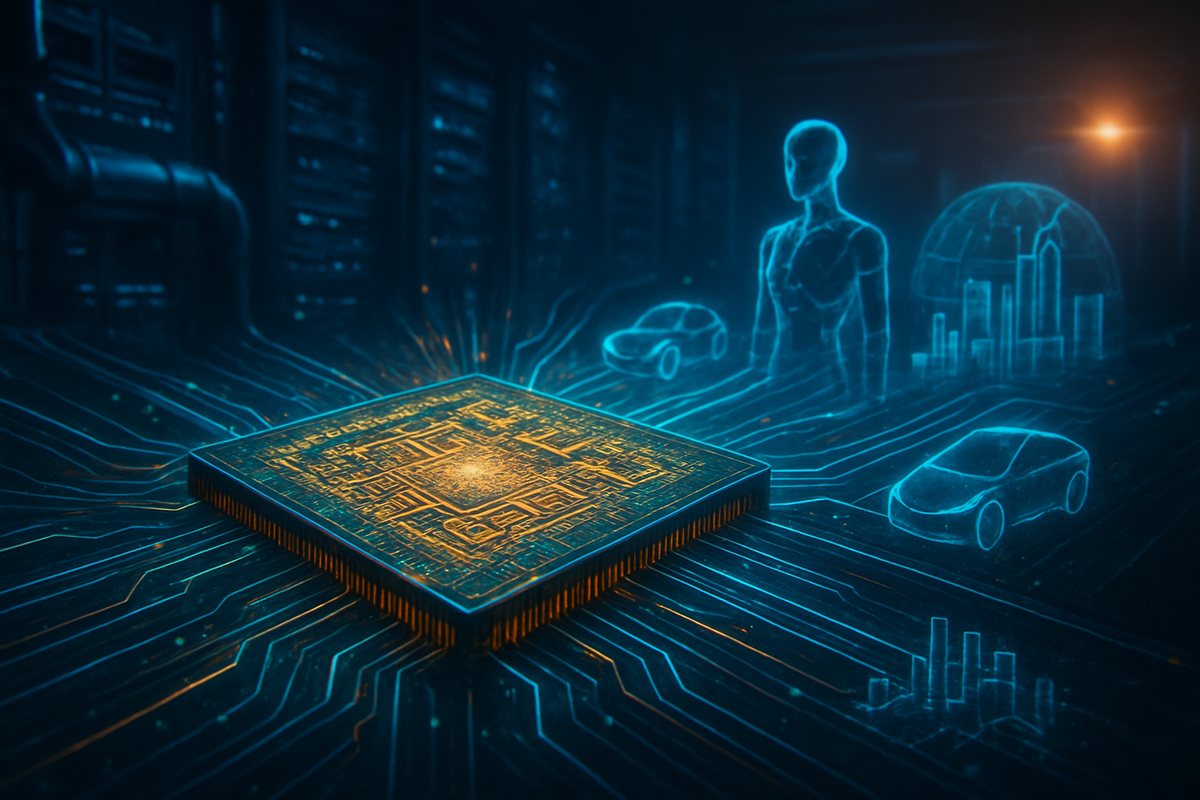
Furthermore, the breakthrough in "Physical AI"—the integration of AI into humanoid robotics and autonomous vehicles—has opened a massive new frontier. The limited industrial deployment of humanoid prototypes like Tesla (NASDAQ: TSLA) Optimus Gen 2.5 in late 2025 has created a secondary market for "Edge AI" chips. These processors must deliver high performance within strict power envelopes, benefiting specialized designers like Broadcom (NASDAQ: AVGO) and Marvell Technology (NASDAQ: MRVL), who excel in custom silicon and high-speed networking. This shift is also driving a revolution in power infrastructure, with data centers increasingly being co-located with Small Modular Reactors (SMRs) to meet the staggering electricity demands of the new AI age.
The Road to the Trillion-Dollar Milestone
Looking ahead, the short-term focus for the market will be the transition to HBM4 memory and the deployment of the first 2nm-based chips in late 2026. The industry is currently preparing for a strategic pivot toward "Agentic Infrastructure," where silicon is optimized not just for processing data, but for enabling AI agents to make real-time decisions in physical environments. While challenges remain—most notably the ongoing constraints in global power grids and the complexity of liquid-cooling transitions—the roadmap for the next 24 months appears robust.
The market may face volatility as it navigates the high expectations set by 2025’s performance, but the long-term trajectory remains upward. Investors should watch for the "Rubin" launch from Nvidia and the initial performance benchmarks of AMD’s Helios systems. If these platforms deliver the promised 50x improvements in inference efficiency, the semiconductor sector could reach the $1 trillion annual revenue milestone sooner than even the most optimistic analysts predicted a year ago.
A Final Assessment of the Silicon Supercycle
The semiconductor rally of 2025-2026 represents more than just a cyclical upturn; it is the definitive "Silicon Supercycle." The convergence of Sovereign AI, humanoid robotics, and agentic software has turned semiconductors into the world's most critical commodity, surpassing oil in strategic importance. As we move further into 2026, the distinction between "tech companies" and "chip companies" continues to blur, as every major enterprise becomes, at its core, a consumer of advanced logic and memory.
For the months ahead, investors should keep a close eye on two critical bottlenecks: the availability of high-bandwidth memory and the speed of power grid upgrades. While the demand for chips like those from NVIDIA (NASDAQ: NVDA) and AMD (NASDAQ: AMD) is essentially infinite in the current environment, the ability to actually plug these systems in and cool them will be the true arbiter of growth. The semiconductor sector has officially entered its "Operational Era," and the winners will be those who can provide the physical infrastructure to match the digital ambition.
This content is intended for informational purposes only and is not financial advice.