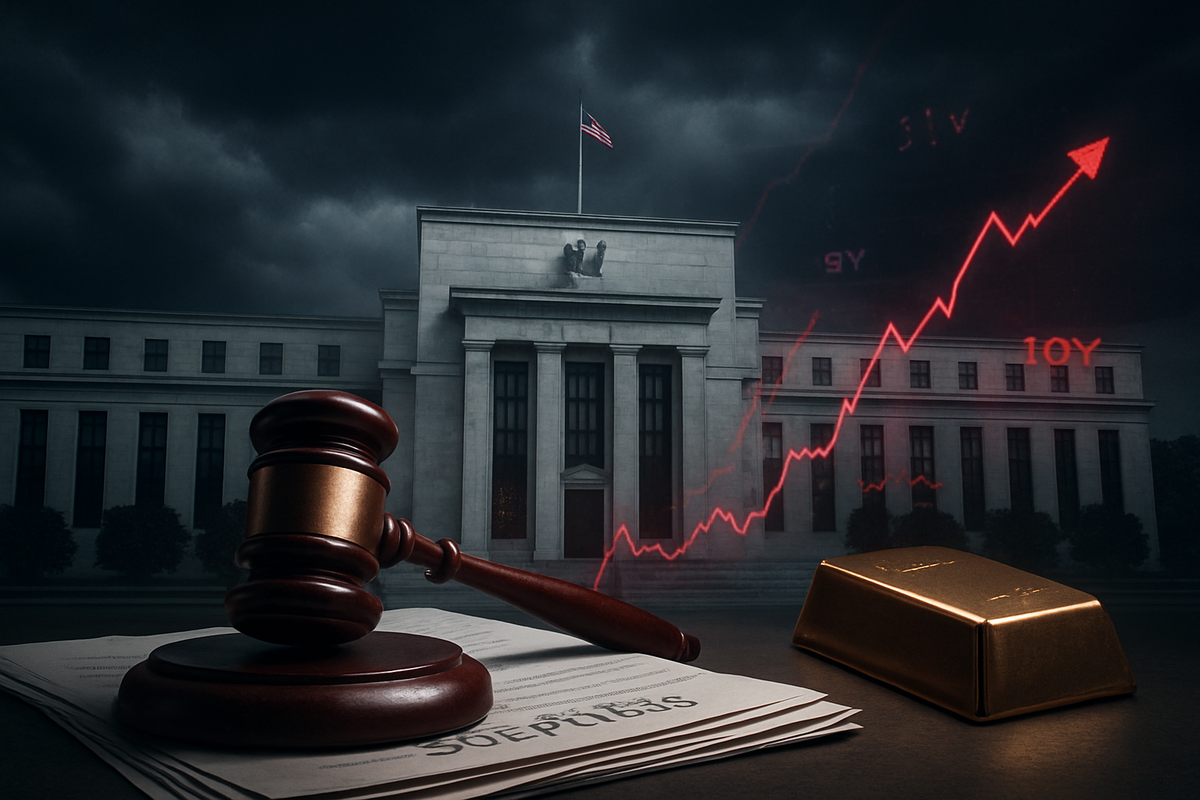
The foundations of American institutional stability are currently facing their sternest test in decades as the Department of Justice (DOJ) moves forward with an unprecedented criminal investigation into Federal Reserve Chair Jerome Powell. As of today, January 19, 2026, the global financial community is grappling with the fallout from the news that the nation’s top central banker has been served with grand jury subpoenas, marking the first time in the Federal Reserve's 113-year history that its leader has faced a criminal probe while in office. The investigation has sent shockwaves through the bond markets and triggered a "Sell America" trade that highlights deep-seated fears regarding the erosion of central bank independence.
The immediate implications of this probe have been nothing short of volatile. While equity markets have shown some technical resilience, the underlying stress in the Treasury market and the record-shattering surge in precious metals suggest that investors are pricing in a significant "political risk premium" for the United States. With Attorney General Pam Bondi and U.S. Attorney Jeanine Pirro leading the charge, the narrative has shifted from monetary policy to a high-stakes constitutional showdown that pits the executive branch against the autonomy of the Federal Reserve Board.
A Timeline of Allegations and Institutional Friction
The crisis escalated rapidly following the first weekend of the year. On Sunday, January 11, 2026, Jerome Powell broke tradition by releasing a direct video statement confirming that the Federal Reserve had been served with grand jury subpoenas just two days prior, on January 9. The investigation centers on allegations of perjury related to Powell’s June 2025 testimony before the Senate Banking Committee. At the heart of the dispute is a $2.5 billion renovation project for the Federal Reserve’s headquarters, the Marriner S. Eccles Building. Prosecutors are investigating whether Powell knowingly misled Congress regarding the inclusion of "lavish" amenities—such as specialized marble, private elevators, and VIP dining facilities—which the Trump administration’s Office of Management and Budget (OMB) claims were part of the internal planning documents.
The political backdrop of this investigation is inescapable. For months, President Donald Trump has publicly lambasted Powell for the Fed’s refusal to implement aggressive interest rate cuts in the face of cooling economic data. By authorizing AG Pam Bondi to pursue these charges, the administration has framed the issue as a matter of transparency and fiscal responsibility. Powell, however, has characterized the probe as a "pretext" for political retaliation, maintaining that the renovation was a necessary modernization of an aging, asbestos-filled facility. He has flatly denied the existence of the alleged "ostentatious" features, stating that the modernization stayed within the bounds of standard federal infrastructure upgrades.
Market reactions were swift and severe. In the initial hours of trading following the January 11 announcement, the Dow Jones Industrial Average plunged over 500 points. However, the most profound movement occurred in the bond market, where the 10-year Treasury yield spiked to 4.23%, its highest level in months. This surge reflects a growing concern among international creditors that the Federal Reserve may lose its ability to manage inflation without political interference. Gold prices reacted by soaring to an all-time high of $4,640 per ounce, as investors sought refuge in hard assets amid the institutional uncertainty in Washington.
Corporate Winners and Losers in the "Sell America" Trade
The fallout from the investigation has created a sharp divergence in the performance of public companies. Major financial institutions have been among the hardest hit as the threat to Federal Reserve independence looms over the banking sector. JPMorgan Chase & Co. (NYSE: JPM) saw its shares lag significantly, dropping as part of a broader decline in the S&P 500 Financials Sector. CEO Jamie Dimon has been a vocal defender of Powell, warning that the DOJ’s actions could backfire by undermining global confidence in the U.S. dollar. Similarly, Goldman Sachs Group Inc. (NYSE: GS) felt the pressure, with its leadership expressing deep concern that a "politically captured" Fed would lead to erratic monetary policy and higher long-term borrowing costs for the private sector.
Conversely, the "flight to safety" has minted clear winners in the precious metals space. Newmont Corporation (NYSE: NEM), the world’s largest gold miner, saw its stock surge to record highs between $112 and $114 per share, benefiting directly from the gold rally. Barrick Gold Corp (NYSE: GOLD) also posted impressive gains, with its shares rising nearly 3% as institutional investors rotated out of the dollar and into commodity-linked equities. These companies are being viewed as essential hedges for a scenario where the U.S. central bank is no longer seen as a neutral arbiter of the economy.
Interestingly, the technology sector has remained largely decoupled from the drama. Apple Inc. (NASDAQ: AAPL) and Nvidia Corp (NASDAQ: NVDA) have shown remarkable resilience, driven by their own industry-specific catalysts. Apple’s stock actually rose slightly following news of a strategic AI partnership, while Nvidia remained steady as investors prioritized its dominance in the AI chip market over the political storm in D.C. This suggests that while the "macro" environment is under stress, the "micro" fundamentals of high-growth tech continue to provide a floor for the broader equity indices.
The Battle for Federal Reserve Independence
The wider significance of this event cannot be overstated; it represents a potential paradigm shift in the relationship between the White House and the Federal Reserve. Historically, the Fed has operated with a high degree of autonomy to ensure that monetary policy remains insulated from short-term political cycles. This investigation is widely seen by legal scholars as an attempt to establish "cause" for the removal of a Fed official. Under current law, the President can only fire a Fed governor "for cause," typically interpreted as legal or ethical misconduct. By pursuing criminal perjury charges, the DOJ may be attempting to create the legal pathway necessary to oust Powell before his term as Chair expires in May 2026.
This maneuver has triggered a rare unified front among the financial elite. All living former Federal Reserve Chairs—including Janet Yellen, Ben Bernanke, and Alan Greenspan—issued a joint statement condemning the investigation as a threat to the stability of the global financial system. They argue that if the Fed Chair can be targeted by the DOJ for policy disagreements disguised as administrative disputes, no future central banker will be able to make the difficult decisions required to curb inflation or manage a crisis without fear of prosecution.
The situation is further complicated by a looming Supreme Court battle scheduled for oral arguments on January 21, 2026. The Court will decide on the President’s authority to fire Fed Governor Lisa Cook, a case that could redefine the executive branch’s power over independent agencies. This "two-pronged" attack—the DOJ investigation of Powell and the SCOTUS challenge to Cook—suggests a coordinated effort to reshape the Fed’s leadership into a more compliant body. This mirrors historical tensions seen during the Nixon administration, though the current use of criminal subpoenas represents a significant escalation beyond past executive pressure.
Scenarios for the Coming Months
In the short term, the market will be hyper-focused on the legal proceedings. If the grand jury moves toward an actual indictment, the pressure on Powell to resign will become immense, even as he maintains his innocence. A leadership vacuum at the Federal Reserve during a period of 4%+ Treasury yields could trigger a deeper correction in the bond market and potentially stall the "soft landing" the economy has been attempting to navigate. Conversely, if the Senate—led by bipartisan concerns from figures like Senator Thom Tillis (R-NC)—manages to provide a legislative shield for the Fed, we could see a relief rally in the banking sector.
Long-term, the strategic pivot for investors may involve a permanent shift toward diversification outside of U.S. dollar-denominated assets. If the Federal Reserve is perceived as having lost its independence, the "exorbitant privilege" of the dollar as the global reserve currency could be further eroded. This would likely sustain the bull market in commodities and potentially accelerate the adoption of alternative assets. Strategic adaptations by companies like Goldman Sachs and JPMorgan may involve increasing their international exposure to hedge against domestic institutional instability.
The most likely scenario involves a protracted legal battle that lasts until the end of Powell's term in May 2026. During this "lame duck" period, the Fed may find its policy-making capabilities paralyzed, as every interest rate decision will be viewed through the lens of the DOJ investigation. Market opportunities may emerge in "anti-fragile" sectors like cybersecurity and defense, which often benefit from periods of high geopolitical and domestic tension.
Summary and Investor Outlook
The DOJ investigation into Jerome Powell is more than a legal hurdle; it is a fundamental challenge to the post-war economic order. The key takeaway for investors is that political risk is no longer an "emerging market" concern—it has arrived at the doorstep of the Eccles Building. The initial market reaction has established a clear pattern: stress in bonds and banks, resilience in tech, and a boom in precious metals.
As we move forward, the "political risk premium" will likely remain embedded in U.S. assets. Investors should watch the January 21 Supreme Court arguments and any further leaks from the grand jury process as primary market movers. The ability of the Federal Reserve to maintain its credibility in the face of these attacks will determine whether the current market volatility is a temporary shock or the beginning of a long-term structural shift in the American financial landscape. For now, the "Sell America" trade remains a potent force, signaling that the market's trust in institutional autonomy is currently on trial.
This content is intended for informational purposes only and is not financial advice.