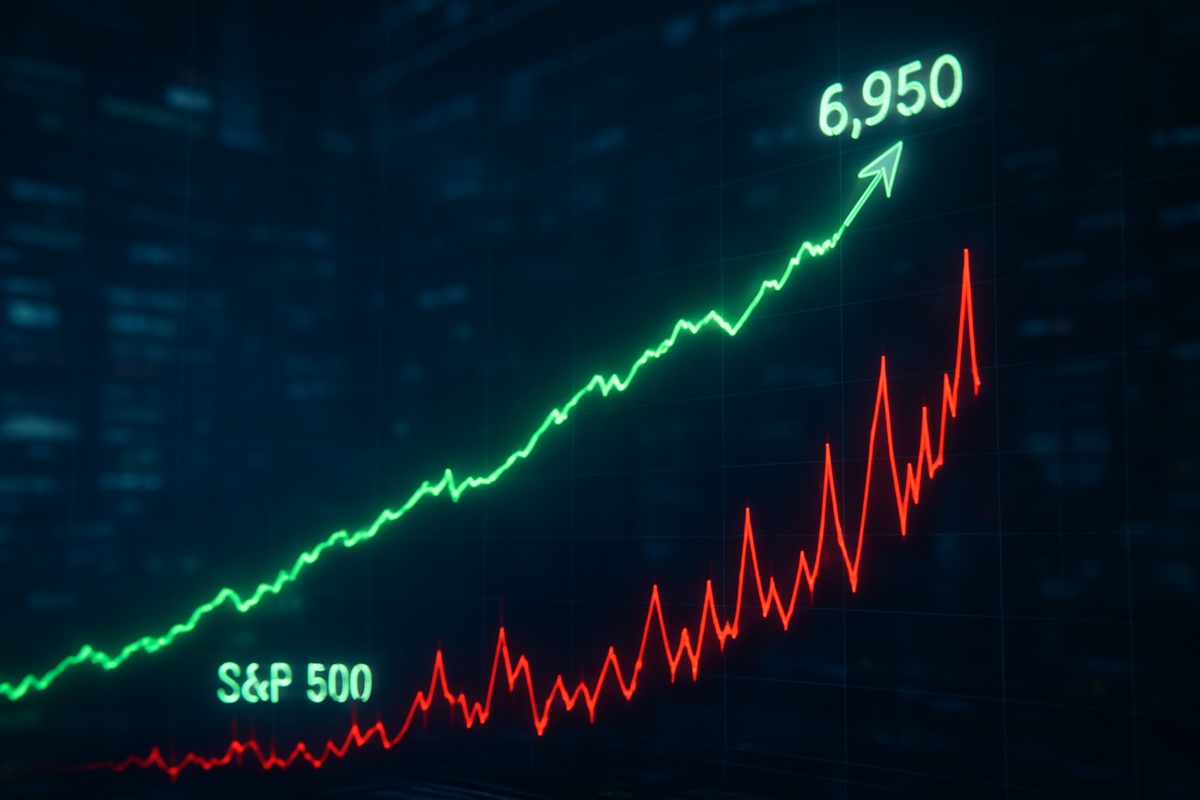
As the final trading days of 2025 wind down, investors are witnessing a rare and unsettling phenomenon in the financial markets. Despite the S&P 500 hovering near a staggering record high of 6,950 and the Nasdaq-100 showing resilient strength, the Cboe Volatility Index (VIX) has refused to settle into its traditional year-end slumber. Instead, the "fear gauge" has exhibited sharp, erratic spikes, signaling a growing "volatility paradox" where record prices are no longer synonymous with investor calm.
This disconnect suggests that while the "everything rally" of 2025 remains intact, the underlying foundation is becoming increasingly brittle. The recent mid-December surge in the VIX to nearly 22—a level typically reserved for market corrections—has left analysts scrambling to reconcile a "spot-up, vol-up" environment. As of December 29, 2025, the market is grappling with the aftermath of a historic government shutdown and a deeply divided Federal Reserve, creating a landscape where the cost of protection is rising even as the indices climb.
The Ghost of the 'Blackout' and the Divided Fed
The seeds of the current volatility were sown in the autumn of 2025 during a grueling 43-day federal government shutdown. This "economic blackout" halted the flow of critical government data for over a month, leaving investors flying blind through much of November and early December. When the shutdown finally ended in the first week of December, the sudden deluge of delayed statistics—including a surprisingly robust 4.3% annualized GDP growth for Q3—forced a violent and immediate repricing of risk. The lack of clarity during the shutdown pushed the VIX to a mid-month peak of 21.89, as market participants scrambled to hedge against potential "data bombs."
Compounding this uncertainty was the Federal Reserve’s highly anticipated December 10 meeting. While the FOMC ultimately delivered a 25-basis-point rate cut, lowering the target range to 3.5%–3.75%, the decision was far from unanimous. The committee revealed a rare three-way split vote, reflecting deep internal disagreements over the path of inflation and the looming threat of a 2026 slowdown. This lack of a clear mandate from the central bank has prevented the VIX from retreating to its historical "complacency" levels, keeping the index in a stubborn range of 13.5 to 15.0 even as the S&P 500 tests new heights.
Furthermore, the memory of "Liberation Day" in April 2025 continues to haunt institutional desks. The massive VIX spike to over 60 following the surprise tariff announcements earlier this year fundamentally altered the market's "volatility regime." Investors who were burned in the spring are now far more aggressive in purchasing downside protection at the first sign of trouble, leading to the current environment where the VIX rises alongside the market as a form of "speculative hedging."
Winners in the Chaos and Losers in the Lag
The persistent elevation of the VIX has created a bifurcated environment for public companies, with exchange operators and market makers reaping the benefits of heightened activity. Cboe Global Markets (BATS: CBOE) has been a primary beneficiary, reporting record-breaking volumes in VIX futures and options as institutional players rush to manage their tail risks. Similarly, market-making giants like Virtu Financial (NASDAQ: VIRT) and the European-based Flow Traders (AMS: FLOW) have seen their net trading income swell, capitalizing on the wider bid-ask spreads and the "whipsaw" price action that has characterized the final quarter of the year.
Conversely, the "volatility tax" is beginning to weigh on the momentum leaders of the 2025 rally. Mega-cap technology staples such as Broadcom (NASDAQ: AVGO) and Alphabet (NASDAQ: GOOGL) have shown signs of institutional distribution, with both stocks recording "bearish outside months" in December. The high-volatility environment increases the discount rate for these growth-sensitive firms, making their record valuations harder to justify. Meanwhile, short-volatility products like the ProShares Short VIX Short-Term Futures ETF (BATS: SVXY) have faced significant drawdowns, as the sudden mid-month spikes in the VIX curve caused brief but painful inversions that wiped out months of steady gains for "vol-sellers."
The pain is also being felt in the small-cap sector. Companies within the Russell 2000 index, many of which are burdened by floating-rate debt, are seeing their financial conditions tighten as the VIX-induced "risk-off" sentiment bleeds into the credit markets. This has led to what some analysts call "credit cockroaches"—small, unexpected defaults in the high-yield bond sector that are starting to crawl out from the shadows of the broader market rally.
The 2026 Horizon: Midterms and Mandate Shifts
The current spike in volatility is not just a reaction to past events but a proactive pricing of 2026 risks. Market participants are increasingly focused on the upcoming 2026 U.S. Midterm Elections, which many fear will lead to a period of legislative gridlock or a reversal of the pro-growth policies that fueled the 2024-2025 bull run. The "volatility paradox" reflects a market that is trying to enjoy the current momentum while simultaneously bracing for a potential shift in the political and regulatory winds.
Beyond politics, a major transition at the Federal Reserve is looming. With several key leadership terms set to expire in 2026, the market is pricing in the possibility of a more hawkish "inflation-fighting" regime taking over. This transition risk, combined with a 35% recession probability for 2026 recently forecasted by major institutions, has made the VIX a more sensitive instrument than it was in the relatively stable years of 2023 and 2024.
This environment mirrors historical precedents like the "Volmageddon" of 2018 or the pre-recession jitters of late 2007, where the VIX began to "perk up" months before the actual price peak in the equity markets. The ripple effect is already being felt in the commodities space, where "safe-haven" demand has pushed gold to all-time highs above $4,500/oz, often moving in tandem with the ProShares Ultra VIX Short-Term Futures ETF (BATS: UVXY) during intraday panics.
Strategic Pivots in a High-Vol World
Looking ahead to the first quarter of 2026, investors will likely need to adapt to a "new normal" of higher baseline volatility. The days of the VIX sitting comfortably at 12 for months on end appear to be over. Short-term, the market faces a "January Effect" that could be more volatile than usual as the delayed economic data from the government shutdown is fully digested and analyzed. Strategic pivots are already underway, with many hedge funds shifting from "pure growth" to "quality-plus-protection" strategies that prioritize cash flow and low-beta exposure.
In the long term, the persistence of the VIX spike may force a re-evaluation of the "passive indexing" craze. If the correlation between the VIX and the S&P 500 remains positive—meaning they rise together—the traditional benefits of diversification may be challenged. This could lead to a resurgence in active management and "long volatility" strategies as investors seek ways to profit from the swings rather than just surviving them. The primary challenge will be navigating the "choppiness" without being shaken out of long-term positions that remain fundamentally sound.
A Fragile Peak: The Takeaway for 2026
The year 2025 is ending on a high note in terms of price, but a low note in terms of confidence. The recent VIX spikes are a clear warning that the "complacency phase" of this bull market has concluded. While the S&P 500 at 6,950 is a testament to the power of the AI revolution and corporate earnings resilience, the elevated fear gauge suggests that the margin for error has evaporated.
Moving forward, investors should watch the VIX "term structure" closely. If the front-month futures remain significantly higher than the long-term average, it indicates that the market is expecting a "event-driven" shock in early 2026. The combination of a divided Fed, a looming leadership change, and the 2026 election cycle creates a "perfect storm" for continued volatility. In this environment, the most successful investors will be those who can distinguish between the "noise" of daily VIX spikes and the "signal" of a true structural market shift.
This content is intended for informational purposes only and is not financial advice