As the final trading days of 2025 unfold, the "AI-at-any-cost" mantra that propelled the markets for nearly three years has hit a formidable wall. A collective retreat by the tech megacaps, colloquially known as the "Magnificent Seven," has sent ripples through the major U.S. indices, turning what was once a narrow leadership into a significant drag on the S&P 500 and the Nasdaq 100. This structural shift, which analysts are calling the "Great Rotation," marks a pivot where valuation discipline and capital flows into neglected sectors are finally outweighing the sheer momentum of the tech titans.
The immediate implications are stark: while the broader market has shown resilience through its non-tech constituents, the heavy concentration of these seven stocks—now accounting for approximately 37% of the S&P 500's total value—has left the benchmarks vulnerable. As of December 29, 2025, the Nasdaq 100 is facing a corrective phase, sliding over 1.25% in the final week of the year alone, as investors lock in profits and reassess the long-term return on investment for massive artificial intelligence expenditures.
The Perfect Storm: Shutdowns and Sell-the-News
The downturn did not occur in a vacuum but was the result of a "perfect storm" of macroeconomic friction and shifting investor sentiment throughout the fourth quarter. The primary catalyst was a historic 43-day federal government shutdown that lasted from October 1 to mid-November. This prolonged paralysis shaved an estimated 1.5% off Q4 GDP growth and delayed critical economic data, creating a fog of uncertainty that tech investors, usually sensitive to growth projections, found impossible to ignore. By the time the government reopened, the momentum that had carried NVIDIA Corporation (NASDAQ: NVDA) toward a $5 trillion market cap earlier in the year had begun to sour.
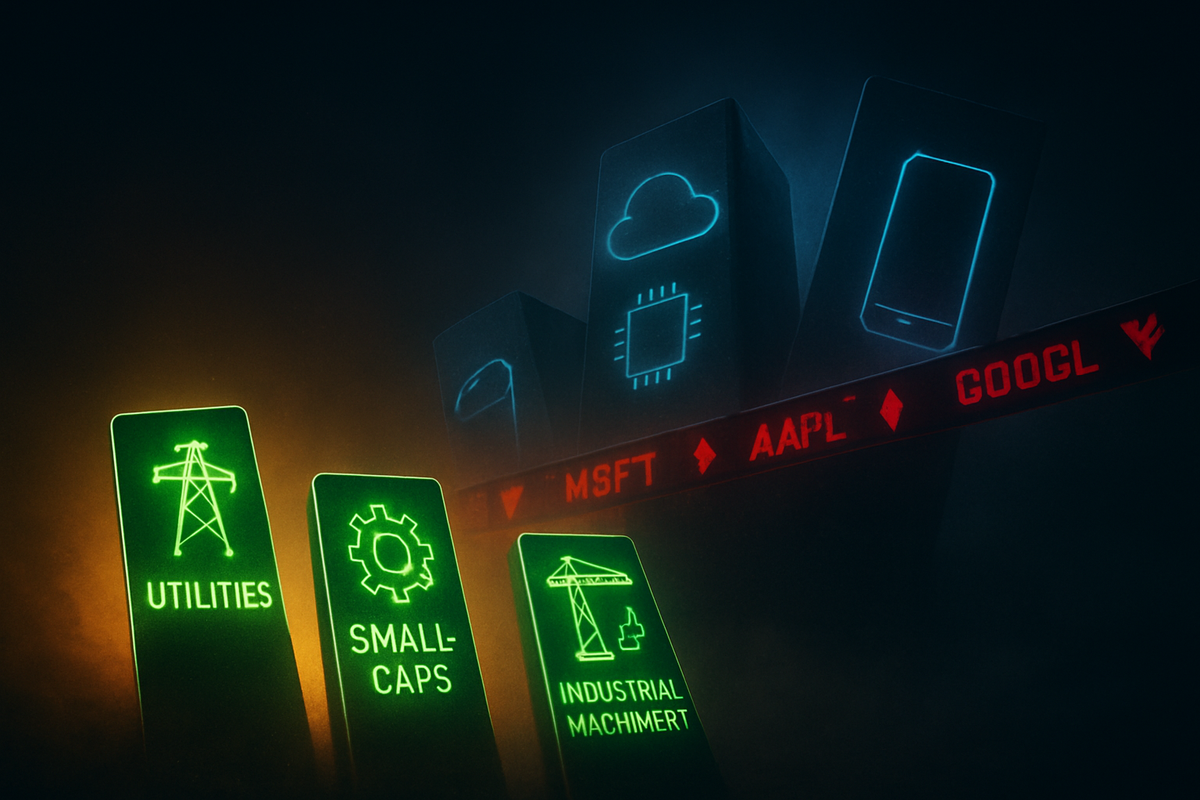
The timeline of the retreat accelerated in early December. On December 10, 2025, the Federal Reserve delivered a long-awaited 25-basis-point interest rate cut, bringing the target range to 3.50%–3.75%. In a classic "sell the news" reaction, the market did not rally; instead, capital flooded out of high-multiple tech stocks and into "bond proxy" sectors like utilities and small-caps. This was followed by a series of "AI hangovers" during late-year strategy updates, most notably from Meta Platforms, Inc. (NASDAQ: META), which spooked the street by announcing planned AI-related capital expenditures exceeding $100 billion for 2026.
Key stakeholders, including institutional pension funds and large-scale asset managers, have been the primary drivers of this de-risking. After a mid-year drawdown in April caused by trade tensions, these players have become increasingly wary of the "monetization crossroads." The initial market reaction has been a sharp divergence: while the "S&P 493" (the S&P 500 excluding the top tech names) has actually seen positive momentum, the headline index numbers remain suppressed by the sluggishness of the tech giants, leading to a year-end environment defined by high volatility and low conviction in the previous leaders.
Winners and Losers in the Great Rotation
The "Magnificent Seven" have found themselves on the losing side of this rotation, albeit to varying degrees. Tesla, Inc. (NASDAQ: TSLA) has struggled significantly, finishing the year with volatile performance as margin compression and the expiration of key EV tax credits weighed on its bottom line. Similarly, Apple Inc. (NASDAQ: AAPL) and Amazon.com, Inc. (NASDAQ: AMZN) have underperformed the broader market, with Apple facing skepticism over its slower AI integration and Amazon grappling with the staggering costs of its AWS division's infrastructure build-out. Even the year's former darlings, Microsoft Corporation (NASDAQ: MSFT) and Alphabet Inc. (NASDAQ: GOOGL), have seen their gains trimmed in the December sell-off as the market demands more immediate revenue proof from their AI software suites.
Conversely, the clear winners of this shift have been the "old economy" stocks and small-cap enterprises. The Russell 2000 index entered a decisive bull market in December, breaking the 2,500 level. This surge was heavily incentivized by the "One Big Beautiful Bill Act" (OBBBA), signed in July 2025, which expanded tax benefits for small businesses and shortened holding periods for capital gains exclusions. This legislative tailwind has made smaller, domestic-focused companies far more attractive than the globally exposed tech giants.
In the industrial and defensive spaces, Caterpillar Inc. (NYSE: CAT) has emerged as a surprising powerhouse, outpacing nearly all of the Magnificent Seven with gains of over 60% year-to-date. Investors are also flocking to the Utilities sector, represented by the Utilities Select Sector SPDR Fund (NYSEARCA: XLU), which has been rebranded as the "AI power play." As massive data centers strain the national power grid, the companies providing the electricity and infrastructure have become the new safe havens, offering both yield and growth that the overextended tech sector currently lacks.
Broader Significance and Historical Precedents
This event fits into a broader industry trend of "earnings convergence." For the past two years, the Magnificent Seven were the only game in town because their earnings growth was vastly superior to the rest of the market. However, by late 2025, that gap has narrowed. While megacap growth decelerated to the 18–24% range, the rest of the S&P 500 saw accelerating growth as traditional companies successfully integrated AI to cut costs and improve efficiency. This "democratization of AI" means that the technology is now benefiting the users more than the providers, a classic historical precedent seen during the build-out of the internet and the railroads.
The ripple effects are also being felt in the regulatory and policy spheres. The 43-day government shutdown highlighted the fragility of a market overly dependent on a few massive entities. Regulators are now looking more closely at the "concentration risk" inherent in the U.S. indices, with some calling for new weighting limits to prevent a handful of companies from dictating the retirement savings of millions. Furthermore, the massive $400–$500 billion in annual AI-linked capital expenditures across the tech sector has drawn the attention of environmental regulators concerned about the localized impact of data center expansion on power grids and water supplies.
Comparisons to the 2000 Dot-com bubble or the 2022 tech correction are frequent, but 2025 feels different to many analysts. Unlike the 2000 crash, these companies are highly profitable and possess massive cash reserves. However, like 2022, the market is currently re-rating what those profits are worth in a world where interest rates are no longer at zero. The historical precedent suggests that when market leadership broadens, it is generally a healthy sign for the long-term stability of the economy, even if it causes short-term pain for those heavily invested in the previous year's winners.
Strategic Pivots and the Road to 2026
Looking ahead to 2026, the tech megacaps face a period of necessary strategic pivots. The era of "build it and they will come" regarding AI infrastructure is over; the market is now demanding a transition to "show me the money." Companies like Microsoft and Alphabet will need to demonstrate that their AI assistants and cloud enhancements are translating into tangible subscription growth and corporate productivity gains. Failure to do so could lead to a further "valuation reset" as investors move their capital toward sectors with more predictable and less expensive growth profiles.
In the short term, the market may remain choppy as it digests the "Great Rotation." We may see a scenario where the S&P 500 remains flat or slightly down even as the majority of its constituent stocks rise, simply because the largest components are being sold off. This creates a challenging environment for passive index investors but a potential goldmine for active managers who can identify the "catch-up" trades in value, energy, and healthcare. The emergence of silver and gold as high-performing assets in late 2025 also suggests a lingering hedge against geopolitical instability and domestic policy shifts.
Conclusion: A More Balanced Market Landscape
The key takeaway from the close of 2025 is that the market is no longer a one-trick pony. The retreat of the Magnificent Seven has effectively ended the period of extreme market concentration that defined the post-pandemic era. While the headlines focus on the drag these giants are placing on the indices, the underlying health of the broader market—boosted by legislative support like the OBBBA and the resilience of the "S&P 493"—paints a picture of a more balanced, if less explosive, economic landscape.
Moving forward, the market assessment is one of cautious optimism for the diversified investor. The "Great Rotation" is not necessarily a sign of an impending crash, but rather a long-overdue rebalancing. Investors should watch closely for the Q1 2026 earnings reports, which will be the first real test of whether the massive AI investments of 2025 are beginning to bear fruit. In the coming months, the focus will likely shift from "who is building the AI" to "who is using AI to dominate their own industry," signaling a new chapter in the digital evolution of the global economy.
This content is intended for informational purposes only and is not financial advice.