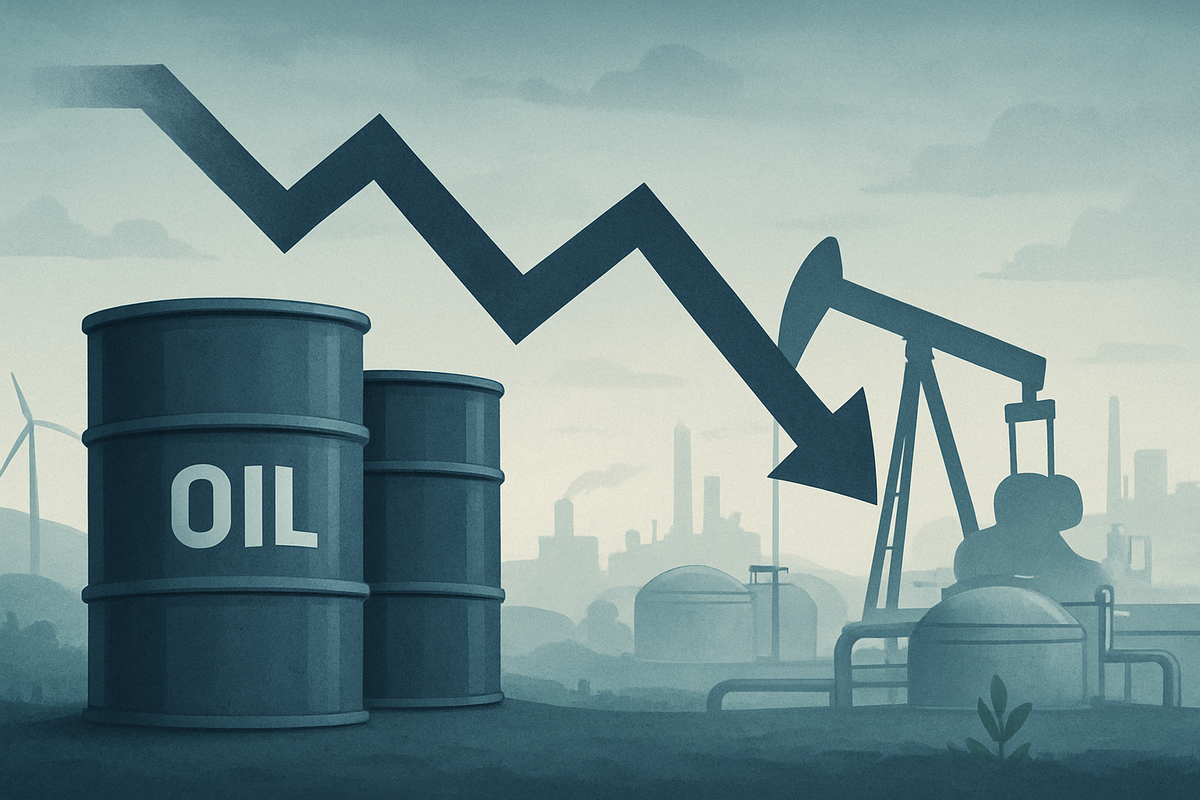
Global commodity markets are currently experiencing a significant "great divergence" as of December 2025, with a clear split between declining energy prices and robust growth in metals. Brent Crude oil and European natural gas are at the forefront of this energy downturn, facing substantial downward pressure driven by an abundance of supply and subdued global demand. This trend signals a complex economic landscape, offering immediate relief to consumers through lower energy costs while simultaneously raising concerns about broader economic weakness and the profitability of energy producers.
The broader commodity index reflects this weakness, with forecasts from the World Bank predicting a 7% decline in overall commodity prices for both 2025 and 2026, potentially reaching six-year lows. This widespread softening is largely attributed to sluggish global economic growth and persistent policy uncertainties. While the Bloomberg Commodity Index (BCOM) shows an overall year-to-date gain, this masks the sharp contrast within its sub-indices, where the energy component has fallen by nearly 10% while metals have surged by approximately 43%. This divergence underscores the distinct supply-demand dynamics at play across different sectors of the commodity market, setting a challenging tone for energy stakeholders as the year draws to a close.
Energy Markets Retreat: A Deep Dive into Brent Crude and European Gas Declines
The global energy landscape in December 2025 is defined by a significant retreat in prices for key commodities, Brent Crude oil and European natural gas, marking a stark reversal from the volatility of previous years. This downturn is a culmination of robust supply growth meeting a period of subdued demand, creating an environment of surplus that has steadily eroded prices.
Brent Crude oil, the international benchmark, was trading around $61.07 per barrel (Bbl) on December 12, 2025. This figure represents a 0.35% daily dip, a more substantial 3.08% decline over the past month, and a significant 18.02% decrease compared to December 2024. The commodity has been observed moving within a persistent bearish trend throughout 2025, culminating in what analysts are calling its worst annual performance since 2020, with a year-to-date depreciation of nearly 18%. The timeline leading to this decline is marked by consistent forecasts of oversupply in the latter half of 2025, fueled by surging non-OPEC+ production from countries like the United States, Brazil, Canada, Guyana, and Argentina, all operating at or near record output levels. The U.S. Energy Information Administration (EIA) notably projected U.S. crude oil production to average an unprecedented 13.5 million barrels per day (bpd) in both 2025 and 2026. Simultaneously, moderating global demand, particularly in advanced economies and China, coupled with the gradual unwinding of voluntary production cuts by OPEC+, has led to global oil inventories reaching four-year highs by October 2025. While geopolitical events, such as the US interception of a Venezuelan tanker and Ukrainian (INDEX: UA) strikes on Russian (MOEX: RU) oil infrastructure, introduced brief market "noise," they were largely overshadowed by the fundamental supply-demand imbalance.
European natural gas, benchmarked by the Dutch TTF (Title Transfer Facility), mirrored this downward trend, trading around €27.38 per MWh on December 12, 2025. Despite a slight daily uptick, this price reflects a 10.10% fall over the past month and a dramatic 33.46% decline compared to December 2024. The year-to-date drop is approximately 45%, and remarkably, prices have plummeted over 90% from the record highs witnessed during the 2022 energy crisis, reaching levels not seen since April 2024. The primary drivers for this significant decline include ample supply, predominantly from record US Liquefied Natural Gas (LNG) exports—which accounted for roughly 56% of Europe's LNG imports in 2025—and stable Norwegian supply. Muted demand across Europe, influenced by warmer-than-usual weather forecasts and relatively weak Asian demand, has further exacerbated the surplus. European gas inventories, though below the European Commission's 90% target at 72% full as of December 7th, are still considered robust given the prevailing demand. Adding to the bearish sentiment are hopes for a Russia-Ukraine (INDEX: UA) peace deal, which, if realized, could potentially soften EU sanctions on Russian (MOEX: RU) energy and reduce geopolitical risk premiums. Key players in this market include the United States as a pivotal LNG exporter and mediator in peace talks, Norway as a consistent supplier, and the European Commission (EC) in its role of setting inventory targets.
The initial market reaction to these converging factors has been overwhelmingly bearish across both crude oil and natural gas. Futures markets have consistently reflected downward pressure, with any short-lived rallies quickly giving way to the underlying reality of abundant supply and moderate demand. This sentiment has led to an extension of declines for natural gas futures to lows not seen in over a year, while oil markets continue to brace for sustained oversupply into early 2026.
Corporate Fortunes Diverge: Winners and Losers in the Shifting Energy Landscape
The precipitous decline in Brent Crude oil and European natural gas prices as of December 2025 is creating a clear bifurcation in corporate fortunes across the energy sector, impacting everything from balance sheets to operational strategies and stock valuations. Companies' exposure to these commodity price fluctuations will largely determine whether they emerge as winners or losers in this evolving market.
Upstream (Exploration & Production - E&P) companies are among the most direct losers. Firms like Aker BP (OSL: AKRBP) in Norway and UK-listed Harbour Energy (LSE: HBR) face significant revenue contraction as the prices they receive for their extracted oil and gas plummet. This directly translates to compressed profit margins, reduced cash flow, and potential asset impairment charges, especially if reserves become uneconomical at lower price points. Consequently, these companies are scaling back capital expenditures, delaying or canceling new exploration projects, and reducing drilling activity. The U.S. pure-play E&Ps, such as Diamondback Energy (NASDAQ: FANG) and Coterra Energy (NYSE: CTRA), have already trimmed their 2025 capital budgets and rig counts, signaling a challenging period ahead. Their stock performance is expected to remain under significant pressure due to a dimming profit outlook and reduced investor confidence.
Oilfield Services (OFS) companies, which provide essential support to E&P firms, also face headwinds. Major players like Schlumberger (NYSE: SLB), Halliburton (NYSE: HAL), and Baker Hughes (NASDAQ: BKR) are experiencing reduced demand for their equipment and services as upstream operators cut back. This results in lower revenues, tighter profit margins, and potential underutilization of expensive assets. Baker Hughes, for instance, has already forecast a low double-digit drop in North American spending, highlighting the direct impact of reduced E&P activity on their business volumes and pricing power. Historically, OFS companies have shown greater financial sensitivity to crude oil price volatility than E&P firms, making this downturn particularly challenging for them.
Conversely, Downstream (Refining & Marketing) companies are poised to be significant beneficiaries. Lower Brent Crude prices translate directly into reduced feedstock costs for refiners. Companies like Valero Energy Corporation (NYSE: VLO), Marathon Petroleum Corporation (NYSE: MPC), and Phillips 66 (NYSE: PSX) will likely see improved refining margins (crack spreads) if refined product prices do not fall as sharply or as quickly as crude. This can lead to increased profitability, higher refinery utilization rates, and a positive impact on their stock performance. Integrated majors with substantial downstream operations, such as Shell (LSE: SHEL) and TotalEnergies (EPA: TTE), will see their refining segments provide a crucial buffer, helping to offset losses from their upstream divisions.
Gas Utilities, particularly those focused on the European market, are also set to win. For companies like Spain's Naturgy (BME: NTGY), natural gas is a primary input cost. The sharp decline in European natural gas prices directly reduces their cost of goods sold, leading to improved profit margins. In regulated markets, this can contribute to stable returns, and lower prices might even stimulate increased gas sales volumes as gas becomes more competitive. This improved financial health typically translates to more secure dividends and positive stock performance. Similarly, Petrochemical companies that utilize natural gas or natural gas liquids (NGLs) as feedstock will benefit from lower input costs, leading to enhanced profitability and potentially increased production.
Integrated oil and gas companies like ExxonMobil (NYSE: XOM), Chevron (NYSE: CVX), BP (LSE: BP), and TotalEnergies (EPA: TTE) will experience a mixed impact. While their upstream segments suffer from lower commodity prices, their robust downstream and petrochemical operations often benefit from cheaper feedstocks, partially buffering the overall negative impact. The extent of their financial performance will depend on the proportional size and profitability of their diversified portfolios, though overall profits may still be lower than in periods of high commodity prices. These companies will likely focus on strategic capital allocation towards more profitable segments and aggressive cost-cutting across all divisions to navigate the challenging environment.
A Broader Economic Ripple: The Far-Reaching Implications of Declining Energy Prices
The sustained decline in Brent Crude oil and European natural gas prices in December 2025 is more than just a market fluctuation; it represents a significant inflection point with wider significance for global industry trends, geopolitical dynamics, and regulatory landscapes. This downturn is intrinsically linked to the accelerating energy transition and signals a complex shift in the global economic order.
This price retreat fits squarely into broader industry trends emphasizing a global pivot away from fossil fuels. With global fossil fuel demand projected to peak by 2030, and solar power rapidly emerging as a primary energy source, natural gas is increasingly seen as a bridging fuel rather than a long-term growth commodity. The "super glut" in crude oil, where supply from non-OPEC+ nations like the U.S., Brazil, Canada, and Guyana consistently outpaces slower global demand (partially due to EV adoption and industrial slowdowns), reinforces this narrative. Meanwhile, the "great energy divide" sees European natural gas prices falling due to ample LNG supply, while U.S. natural gas prices show resilience, reflecting regional demand and supply dynamics. This trend is already leading to declining upstream investments in traditional oil and gas, as capital discipline becomes paramount in a changing energy landscape.
The ripple effects of these price trends are extensive. For oil-exporting nations, including the U.S., which has transitioned to a net exporter, lower oil prices can strain the domestic energy industry and reduce export revenues, presenting a "double-edged sword." Conversely, consumers globally benefit from relief at the pump, with U.S. retail gasoline prices forecast to drop to $2.90 per gallon in 2026, marking a significant post-pandemic low. Industries reliant on energy as a key input, such as transportation and manufacturing, stand to gain from reduced operational costs. However, the downturn in oil prices is also seen as a leading indicator of a broader economic slowdown, characterized by weak manufacturing and trade, potentially pressuring central banks to consider interest rate cuts in 2026. This, in turn, could make oil more affordable for non-dollar economies but also risks exacerbating inflationary pressures. Energy companies are responding with strategic pivots, focusing on cost reduction, operational efficiency, and portfolio optimization towards high-margin assets, while global supply chains face uncertainty, potentially leading to reshoring or nearshoring efforts.
Regulatory and policy implications are equally profound. The OPEC+ alliance remains a critical player, with its decisions to unwind and potentially extend production cuts directly impacting market stability. In the U.S., a potential Trump administration in 2025 could prioritize domestic fossil fuel production and deregulation, further enhancing the U.S.'s energy cost advantage, but potentially at the expense of leadership in clean energy. The European Union (EU) continues its commitment to reducing reliance on Russian (MOEX: RU) energy, while also exploring measures to mitigate rising electricity costs and implementing environmental regulations that influence industrial fuel choices. Escalating trade disputes and tariffs, such as those between the EU and the U.S., also threaten to disrupt global supply chains and hinder economic growth, indirectly impacting commodity demand.
Historically, the current energy price decline bears resemblances to several past events. The 2014-2016 oil price collapse, driven by surging U.S. shale production and OPEC's market share defense, created similar economic challenges for producers. The 2008 financial crisis and the 2020 COVID-19 pandemic both demonstrated how severe demand destruction can lead to dramatic oil price plunges. The regional divergence in gas prices also has precedents, with North American shale gas previously creating significant price disparities. These historical comparisons underscore that a combination of oversupply and demand shocks are potent drivers of energy price downturns, with lasting consequences for global economic stability and the energy sector's evolution.
The Road Ahead: Navigating a Volatile and Transitioning Energy Future
The significant decline in Brent Crude oil and European natural gas prices as of December 2025 sets the stage for a highly dynamic and potentially volatile energy future. Both short-term market fluctuations and long-term structural shifts driven by the accelerating energy transition will demand strategic agility from all stakeholders.
In the short-term (Q1 2026 - end of 2026), Brent Crude is expected to remain under pressure. The U.S. Energy Information Administration (EIA) forecasts Brent to average $55 per barrel in Q1 2026 and persist around that level throughout the year, with some analyses suggesting a dip to $49-$50 by early 2026 due to continued global supply surplus and rising inventories. While OPEC+ policies and China's continued inventory builds could offer some floor, the unwinding of OPEC+ production cuts is a significant bearish factor. Geopolitical tensions, such as those involving Venezuela and the Russia-Ukraine (INDEX: UA) conflict, might trigger temporary price spikes, but these are unlikely to reverse the broader trend of oversupply. For European natural gas, continued moderation is expected, with Capital Economics forecasting TTF prices to decline to €20 per MWh by the end of 2027. However, weather-driven volatility remains a key short-term risk; a colder-than-average winter could significantly increase heating demand, leading to temporary price spikes, especially given European storage levels below the 90% target.
Looking at the long-term (2027-2030 and beyond), the energy transition will increasingly dictate the trajectory of both commodities. Brent Crude prices are generally anticipated to stabilize in the $60-$73 range by 2030, but with a significant downside risk if renewable adoption accelerates. Bearish scenarios, such as Wood Mackenzie's "Accelerated Energy Transition 2" (AET-2), project Brent averaging $37-$42/bbl by 2030, underscoring the potential for structural demand destruction as the concept of "peak oil demand" takes hold. For European natural gas, further price declines are projected, with Rabobank forecasting prices to drop to the high €20s/MWh between 2027-2030. Europe's commitment to decarbonization and the significant expansion of global LNG capacity expected between 2025-2026 will continue to ease market balances and exert downward pressure on prices, even as natural gas maintains its role as a crucial "bridge fuel."
Energy companies are already implementing strategic pivots and adaptations. Many integrated majors, including TotalEnergies (EPA: TTE), Shell (LSE: SHEL), BP (LSE: BP), and Equinor (OSL: EQNR), are showing a strategic realignment towards traditional hydrocarbon assets, balancing this with investments in decarbonization technologies like Carbon Capture, Utilization, and Storage (CCUS) and hydrogen. Strict cost optimization, portfolio restructuring, and capital discipline are paramount, with a focus on shareholder returns through dividends and buybacks. Investment in natural gas and LNG, particularly for growing demand from data centers and for "coal-to-gas switching" in Asia, is expected to increase. Potential policy changes could also stimulate mergers and acquisitions (M&A) as companies seek to optimize their portfolios in this challenging environment.
Market opportunities lie in the robust demand for natural gas as a bridge fuel and for the petrochemical industry. The development of CCUS and hydrogen technologies also presents new revenue streams. However, challenges include persistent oversupply, regulatory pressures for emissions reductions, the long-term competitive threat from renewables, and the growing risk of "stranded assets" for high-cost oil and gas projects. The overarching outcome will likely be a prolonged period of intense competition, innovation, and strategic re-evaluation across the energy sector.
Navigating the New Energy Paradigm: A Comprehensive Wrap-up
The significant decline in Brent Crude oil and European natural gas prices as of December 2025 marks a pivotal moment in the global energy landscape, characterized by a fundamental shift from scarcity to surplus. This downturn, driven by robust supply growth from non-OPEC+ nations and a moderation in global demand, has ushered in a period of recalibration for the entire sector.
Key takeaways from this market trend include the persistent global oil supply glut, with inventories reaching four-year highs, and the dramatic plunge in European natural gas prices by over 90% from their 2022 peaks, largely due to record US LNG exports and muted demand. While consumers are benefiting from lower energy costs, easing inflationary pressures, upstream producers and oilfield service companies face significant financial headwinds, leading to reduced capital expenditures and operational adjustments. Conversely, downstream refiners, European gas utilities, and petrochemical companies are experiencing improved margins due to cheaper feedstocks.
Moving forward into 2026, the market is anticipated to remain oversupplied. Brent Crude is forecast to average around $55-$66 per barrel, with non-OPEC+ supply continuing to outstrip demand growth. For European natural gas, while the medium to long-term outlook remains bearish due to expanding LNG capacity, short-term volatility driven by winter weather remains a significant risk. The "great energy divide" between European and U.S. natural gas prices is also a trend to watch, with growing demand from data centers potentially providing a structural floor for U.S. natural gas.
The significance and lasting impact of these trends are far-reaching. They highlight a shifting power dynamic in the global energy market, with OPEC+'s influence being challenged by surging non-OPEC+ output. Lower oil prices could disincentivize investment in new conventional oil projects, potentially accelerating the pace of diversification towards renewable energy sources in the long run. The broader economic implications include potential pressure on central banks to cut interest rates, balanced against the risk of exacerbating energy-related inflation.
Investors should closely monitor OPEC+ production policy, global economic indicators (especially demand from China), the trajectory of non-OPEC+ supply growth (particularly U.S. shale), European winter weather forecasts, and global inventory levels. Geopolitical developments, while not the primary driver of the current downturn, could still introduce rapid price volatility. Finally, the escalating energy demand from new sectors like data centers could provide a structural floor for natural gas prices, offering a nuanced investment opportunity within an otherwise bearish energy market. The overarching theme for the coming months is one of vigilance and strategic adaptation amidst persistent volatility and an evolving energy paradigm.
This content is intended for informational purposes only and is not financial advice