SoFi Technologies (SOFI) and Mastercard (MA) recently agreed to allow SoFi's stablecoin, SoFiUSD, to be settled on Mastercard's payments network. However, there are reasons to believe that the deal will not move the needle for SOFI stock. Further, SOFI stock may pose a relatively high level of risk for investors. As a result of these issues, investors may want to avoid shares at this point.
Let's take a closer look at what's going on with SoFi.
About SOFI Stock
Based in San Francisco, California, SoFi primarily provides student loans and personal loans via its “consumer-focused financial technology platform.” In the fourth quarter, the fintech company's revenues jumped 40% versus the same period a year earlier to $1.02 billion. Meanwhile, its EBITDA, excluding certain items, soared 60% year-over-year (YOY) to $317.6 million.
With shares changing hands at a forward price-to-earnings (P/E) ratio of 30.8 times, SoFi has a market capitalization of $24.5 billion.
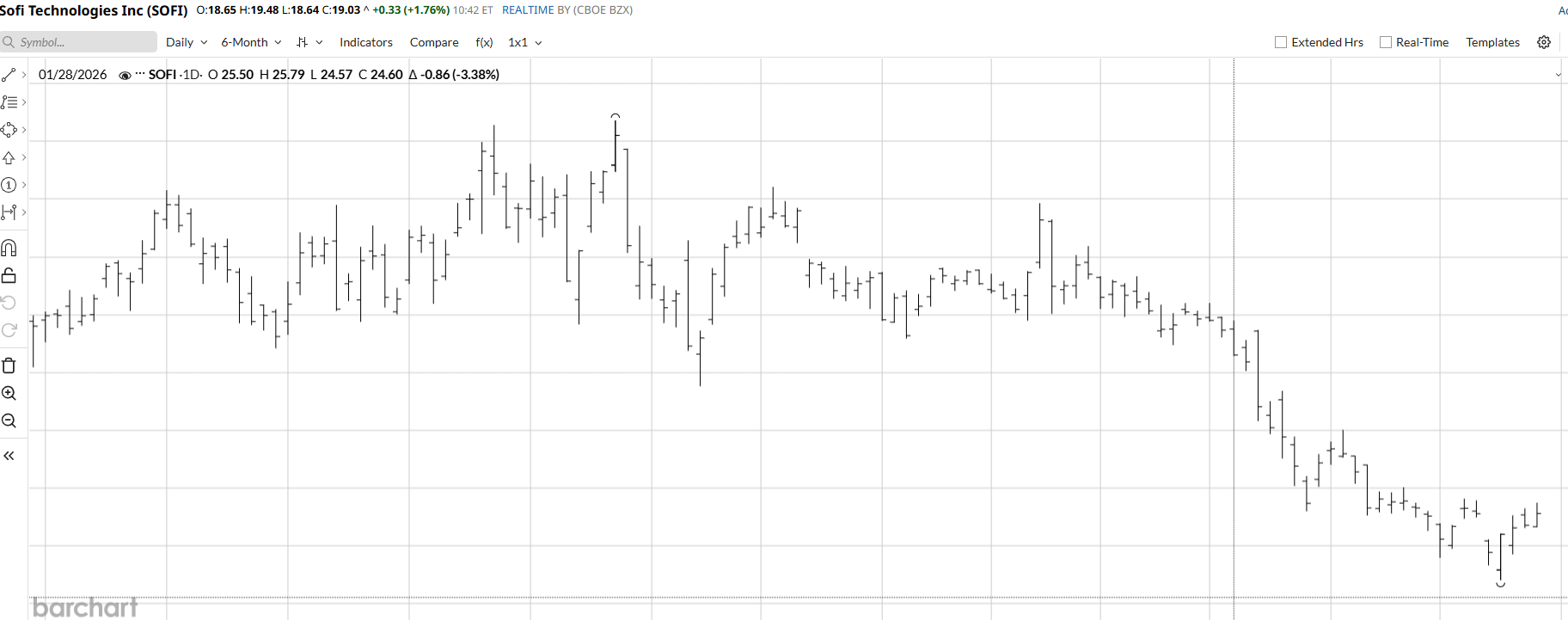
Why the Mastercard Deal May Not Move the Needle for SOFI Stock
“SoFiUSD is at the heart of our strategy to make it faster, cheaper, and safer for people around the world to move money," said SoFi CEO Anthony Noto in a release on March 3. “With SoFiUSD as a settlement currency across Mastercard’s network, card issuers and acquirers can more easily enable the millions of businesses they serve around the globe to instantly settle transactions, 24 hours a day, 7 days a week.”
That may sound enticing. But there are currently many digital payment platforms — such as PayPal (PYPL), Zelle, Revolut, and BitPay — that enable payments to be transferred quickly and fairly cheaply. What's more, a number of these platforms already accept stablecoins for payments. Moreover, because crypto prices tumbled recently, merchants that have not already started using crypto may be reluctant to do so due to fears about the soundness of digital assets.
Given these points, I'm doubtful as to whether the SoFi-Mastercard deal wlll move the needle for SOFI stock, even though the agreement could result in SoFiUSD being marketed to millions of businesses globally.
The Meaningful Risk Posed by SOFI Stock
Historically, SoFi has obtained a high percentage of its revenue from student loans, although Noto stated last year that the percentage of the company's revenue which was derived from such loans had dropped below 50%. Still, for investors thinking of buying SOFI stock, it's noteworthy that, according to a report last month, “Roughly a million borrowers defaulted on their federal student loans late last year, with millions delinquent on their payments and sliding toward the same fate.” On top of that, student loan delinquencies "have continued to worsen,” a trend that is expected to continue going forward.
Neil Patel, a well-known financial commentator, noted last May that from Q1 2022 to Q1 2025 the company "originated $46.7 billion worth of personal loans.” As there is usually no collateral for such loans, they are unsecured and “inherently riskier to the lender.” Further, the labor market is currently less than stellar. If unemployment climbs a great deal amid higher oil prices and the advent of AI, the default rates on SoFI's student loans and personal loans could soar tremendously.
The Bottom Line on SOFI Stock
SoFI's valuation is attractive relative to its growth rate. However, its student loans and personal loans make it quite risky in my view, especially since the labor market is not very strong right now. Finally, the Mastercard deal probably won't move the needle for SOFI.
On the date of publication, Larry Ramer did not have (either directly or indirectly) positions in any of the securities mentioned in this article. All information and data in this article is solely for informational purposes. For more information please view the Barchart Disclosure Policy here.
More news from Barchart