The two Vs -- volatility and volume -- are what drive the options markets. While there are plenty of volatile stocks, options tend to favor those with significant volume.
Stocks and ETFs like Nvidia (NVDA), Tesla (TSLA), SPDR S&P 500 ETF Trust (SPY)and the Invesco QQQ Trust (QQQ) tend to attract much of the action.
When I discuss unusual options activity, as I will today, my fundamentals-driven, long-term investor hat is usually firmly in place. It’s just that I’m wired.
Stocks such as Berkshire Hathaway (BRK.B), Fairfax Financial (FRFHF), Exor NV (EXXRF), Loews (L), and many other excellent long-term investors will always get my attention.
But when it comes to the options markets, none of them matter much, which is why I often struggle coming up with subjects to write about. Sure, I could cover Palantir (PLTR), which I have covered many times in the past—it is a stock I generally like—but I’m always looking for something unusual or under the radar. Those rarely come with significant options volume.
So, yesterday, I thought: why not compromise and discuss one or more ETFs -- not the S&P 500, Nasdaq 100, or a small-cap-specific -- with high options volume, unusually high options activity, and excellent long-term investment potential?
I came up with three ideas.
A Regional Bank ETF

The State Street SPDR S&P Regional Banking ETF (KRE) tracks the performance of the S&P Regional Banks Select Industry Index, a modified equal-weighted index that tends to spread holdings across large-, mid-, and small-cap stocks. I like to think of it as a sports team; you never know who’s going to come through in the clutch.
Because it’s equal-weighted, you’re not overweighting the top 10 holdings. With 144, you’re back to about 0.69% per stock at the beginning of April, July, October and January. By comparison, the iShares U.S. Regional Banks ETF’s (IAT) top 10 holdings account for 71% of the fund’s net assets.
Yesterday’s options volume was 452,959, 3.3 times its 30-day average. That volume helped produce the 67.28 Vol/OI (volume-to-open-interest) ratio for the June 18 $73 call above. Approximately 14.1% OTM (out-of-the-money), if you’re bullish on regional banks, the obvious play is to buy one or more of these calls.
A majority of the 78,579 in volume was for two trades at ask prices of $1.12 (18,480 call contracts) and $1.01 (60,000). So, your net debit was between $101 and $112 per contract, or less than 2% of KRE’s share price. Not a lot.
Of course, the likelihood of being ITM (in-the-money) by the June expiration is low, with an expected move of 11.91%, below the 14.1% needed, so you might be better off doing a Long Call Diagonal Spread. This involves buying one June 18 $73 call and selling one April 17 $75 call, for a net debit of $98, which is less than the cost of the long call on its own.
 India’s Emerging Fast

I haven’t been so excited about an emerging market since Brazil’s economy started to recover in the early 2020s. India has all the hallmarks of growth without the authoritarianism seen in China. Although the rule of law has recently been tested, it remains the best system for doing business globally and should survive the current turmoil.
Earlier in March, I suggested the iShares India 50 ETF (INDY)was a good way to lean into the country’s economic growth, especially at current prices, which have been hurt by India’s reliance on energy imports to run its factories, etc.
While INDY tracks the performance of 50 of India’s largest companies, the iShares MSCI India ETF (INDA) tracks the performance of the MSCI India Index. As a result, INDA owns 165 Indian stocks, with an average market cap of $35.4 billion, about half of INDY; they’re still large companies.
As you can imagine, given the current situation in Iran, the volatility for Indian stocks has ramped up, which might not be good for your heart, but it provides the fuel to fire options strategies such as a Bull Call Spread. The volume from the June 18 $54 call was nearly eight times INDA’s 30-day average of 9,979. That’s significant.
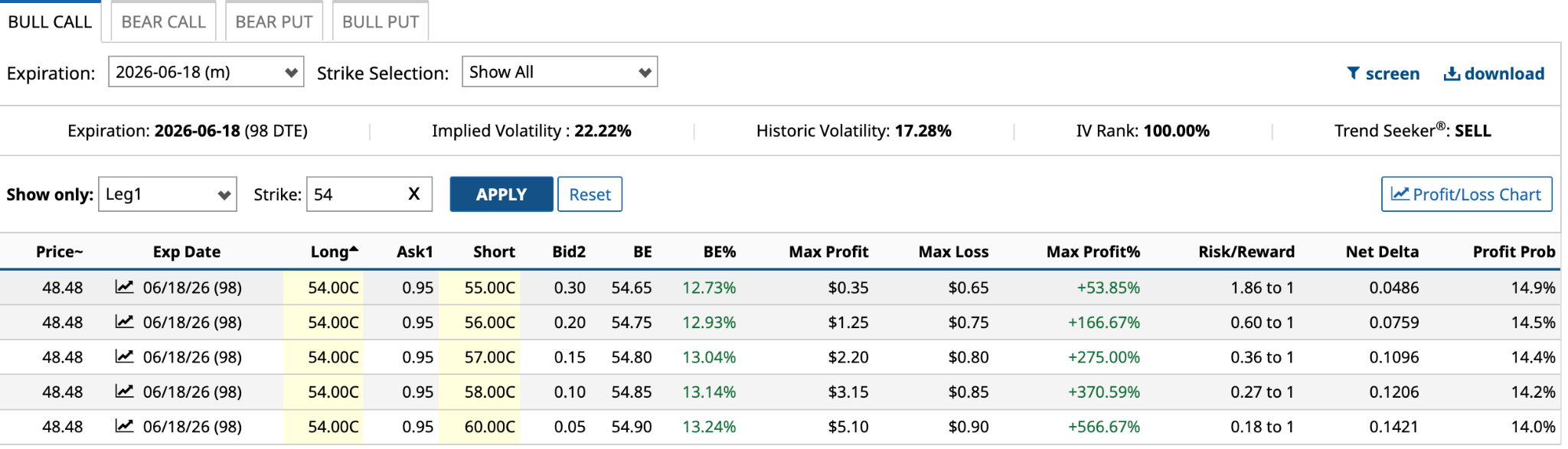
In this example, the bull call spread involves buying the $54 call and selling a put with calls ranging from $55 to $60. As you can see from the profit probability percentages to the right, the likelihood of the share price being above the breakeven is very low, below 15%. However, in every case, the debit is less than the cost of buying a single call.
And who knows, if the war in Iran ends with some sort of enforceable truce, INDA will shoot higher in no time.
Staples Rarely Go Out of Style

Let’s face it, there are some terrible stocks in the consumer staples sector right now. For example, Campbell’s Co.’s stock is down 21% in 2026, 43% in the past year, and down 54% in the past five years; a trifecta of misery.
Campbell’s is one of the 36 stocks held by the State Street Consumer Staples Select Sector SPDR ETF (XLP). However, thanks to its poor performance, it has the second-lowest weighting at 0.2862%, just ahead of Brown-Forman (BF.B), which has been pummeled by lower consumption due to health and financial concerns, as well as a boycott by most Canadian provinces and territories in retaliation for the White House’s tariff policies. But I digress.
The point is that consumer staples companies produce products we use every day. They’re not going away anytime soon. With a 5% retreat in XLP’s share price over the past month, its shares are more attractive than they’ve been since early February. You’re not going to get rich owning XLP, but with options, you might be able to juice your returns a little.
In this case, you might begin the first part of a Wheel strategy, which involves selling the cash-secured April 17 $76 put for income over the next 37 days. As you can see from above, there’s no bid price showing. It turns out the 10,000 volume for the $76 put was on a single trade at 12:41 ET yesterday at $0.24. 
Selling the put generates an annualized return of 2.8% [$0.24 trade price / $84.59 share price - $0.24 trade price * 365 / 37 DTE].
It’s not a lot of income, I’ll grant you, but it allows you to get paid to wait for a better entry point to buy shares, in this case at $76. The downside risk is that the share price flies through the $76 strike price into the $60s, forcing you to buy XLP shares for more than they’d be trading at.
With an expected move of 4.14%, the odds of this happening are slim to none.
As for the Wheel strategy, once you buy shares, you move to a Covered Call for income, and keep selling calls every 30-45 days until the call buyer acquires your shares.
On the date of publication, Will Ashworth did not have (either directly or indirectly) positions in any of the securities mentioned in this article. All information and data in this article is solely for informational purposes. For more information please view the Barchart Disclosure Policy here.
More news from Barchart
- 3 High-Volume ETF Options to Trade Now and Profit from Hot Market Themes
- A Better-Calculated Way to Play the ‘Fear Trade’ in AMD Stock Now
- The Best Covered Call Strategy to Trade High-Yielding Pfizer Stock and Earn Extra Income
- Marvell Technology's Strong Outlook Provokes Huge Unusual Options Trading