AI-driven heat seal inspection cameras enable real-time packaging quality checks, detecting micro-leaks and weak seals to improve safety, compliance, and production efficiency.
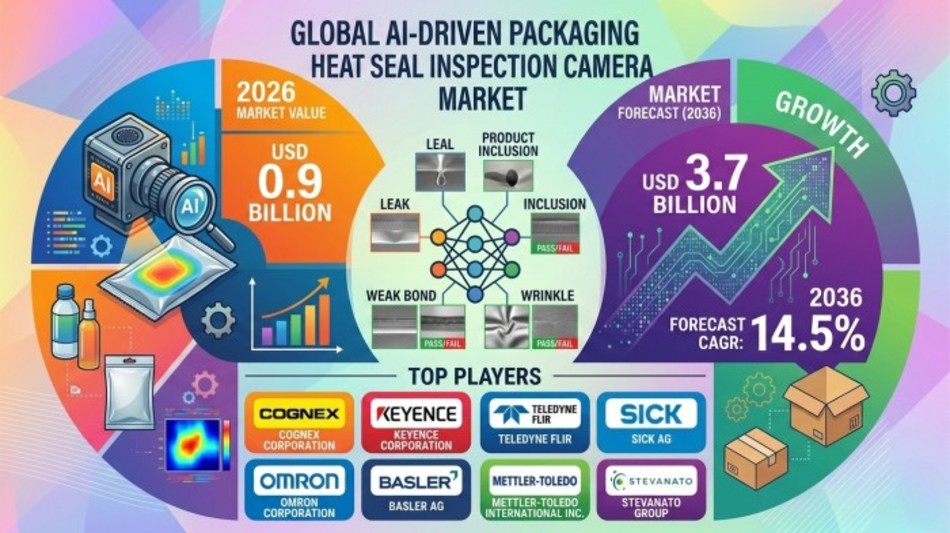
NEWARK, DE / ACCESS Newswire / March 10, 2026 / The global AI-driven packaging heat seal inspection cameras market is entering a period of accelerated technological transformation as manufacturers move away from manual quality checks and statistical sampling toward fully automated inspection systems. Valued at USD 0.9 billion in 2026, the market is forecast to reach USD 3.7 billion by 2036, expanding at a robust CAGR of 14.5% during the forecast period.
According to a comprehensive strategic outlook from Future Market Insights (FMI), this rapid expansion reflects the packaging industry's decisive shift toward real-time AI-enabled quality verification. High-speed production lines across pharmaceuticals, food processing, and medical devices are increasingly deploying advanced thermal and hyperspectral camera systems capable of detecting micro-leaks and weak seals that conventional optical sensors cannot identify.
AI-Driven Packaging Heat Seal Inspection Camera Market Metrics
Market Metric |
Value / Detail |
|---|---|
Market Size (2026) |
USD 0.9 Billion |
Market Value (2036) |
USD 3.7 Billion |
Global CAGR |
14.5% |
Leading Camera Type |
Thermal Imaging Cameras (52.0% Share) |
Leading Deployment Model |
Inline Inspection (80.0% Share) |
Fastest Growth Region |
China (16.5% CAGR) |
Request Your Sample Now - Unlock Growth Potential and Discover Key Market Opportunities!
https://www.futuremarketinsights.com/reports/sample/rep-gb-32214
The Inspection Revolution: From Sampling to Continuous AI Verification
The economics of packaging quality control are undergoing a structural transformation. Traditional inspection methods-such as destructive burst testing or manual visual checks-are proving inadequate in modern high-speed manufacturing environments where thousands of sealed packages are produced every minute.
AI-driven heat seal inspection cameras overcome these limitations by integrating thermal imaging sensors and neural network algorithms directly into the sealing station. By analyzing the residual heat signature of each package immediately after sealing, the system can detect hidden defects such as micro-channels, material inclusions, or weak bonding zones.
This transformation is especially critical in industries where seal integrity directly impacts product sterility, shelf life, and consumer safety.
A New Cost Structure for Packaging Quality Assurance
The integration of advanced machine-vision inspection systems is redefining the cost dynamics of packaging operations. Rather than absorbing losses from batch-level defects or product recalls, manufacturers are allocating capital toward automated defect detection and predictive maintenance systems.
Packaging machinery engineers now embed edge computing processors directly inside inspection cameras, enabling complex thermal image analysis to occur locally without sending massive data streams to centralized servers. This architectural shift eliminates latency and allows high-speed packaging lines to maintain full throughput while still inspecting every product.
As a result, inspection systems increasingly function as active control mechanisms, dynamically adjusting sealing temperature, pressure, and dwell time whenever anomalies are detected. These closed-loop feedback systems transform packaging lines from reactive production environments into self-correcting quality ecosystems.
Segment Spotlight: Thermal Imaging and Inline Inspection
Several key technology segments are shaping the market's growth trajectory.
Thermal Imaging Cameras: The Core Technology
Thermal imaging cameras dominate the market with a 52.0% share in 2026, reflecting their unique ability to detect invisible anomalies within complex packaging materials such as multi-layer laminates, foil barriers, and transparent polymer films.
Key advantages include:
Micro-Leak Detection: Thermal gradients reveal hidden seal failures that optical lenses cannot capture.
Product Inclusion Identification: Residual heat mapping highlights contamination trapped within seal zones.
Predictive Maintenance: Abnormal heat patterns allow engineers to identify worn sealing jaws before they cause widespread defects.
Inline Inspection: The New Industry Standard
Deployment trends clearly show a shift toward continuous inline inspection systems, which hold 80.0% of the market share in 2026.
Unlike offline testing protocols, inline inspection enables defective units to be rejected instantly without interrupting production. Automated rejection mechanisms remove flawed packages before they reach downstream cartoning or palletizing systems, significantly reducing scrap rates and material waste.
This approach also generates permanent digital quality records for each individual package an increasingly important requirement for regulatory compliance and traceability.
Pharmaceutical Industry Drives Early Adoption
Among end-use sectors, the pharmaceutical industry represents the largest adoption segment, accounting for 45.0% of total demand in 2026.
Strict sterile barrier validation requirements and serialization mandates have forced pharmaceutical manufacturers to deploy inspection systems capable of non-destructive verification. Even micron-level seal defects can compromise sterile packaging, leading to contamination risks or reduced drug stability.
AI-driven inspection cameras provide the precision required to monitor complex materials such as cold-form foil blister packs and advanced multilayer polymer structures used in biologics packaging.
As global healthcare supply chains become increasingly regulated, manufacturers that cannot demonstrate 100% inline verification risk losing contracts with major pharmaceutical brands and medical device OEMs.
Regional Powerhouses: Asia Leads Industrial Expansion
While demand for automated packaging inspection systems is expanding globally, adoption rates vary significantly by region.
China (16.5% CAGR): China leads the global market with the fastest projected growth rate. Massive investments in new pharmaceutical and biopharmaceutical manufacturing facilities are driving the adoption of fully automated inspection architectures built directly into new production lines.
United States (15.0% CAGR): The U.S. market is shaped by strict regulatory frameworks such as FDA electronic record requirements, which mandate verifiable digital quality documentation for sterile packaging operations.
Germany (14.5% CAGR): Germany's strong presence in packaging machinery engineering is accelerating the integration of advanced inspection hardware into next-generation form-fill-seal equipment.
United Kingdom (14.0% CAGR): Food safety regulations and national grocery supply chains are pushing manufacturers to adopt hyperspectral and thermal imaging technologies capable of verifying packaging integrity at scale.
Japan (13.0% CAGR): Highly automated manufacturing environments and stringent consumer safety standards are fueling continuous upgrades in vision inspection systems.
South Korea (12.5% CAGR): High-value export industries are adopting zero-defect production architectures requiring ultra-fast anomaly detection capabilities.
Italy (11.5% CAGR): The country's advanced food packaging machinery sector continues integrating AI modules into equipment platforms to support global exports.
Dynamics of the Decade: Predictive Quality and Sustainable Packaging
Looking ahead to 2036, several structural trends are expected to shape the competitive landscape.
Predictive Maintenance Integration: Manufacturers increasingly link thermal inspection data to machine maintenance systems. Early detection of uneven heat distribution prevents sealing equipment failures and reduces unplanned downtime.
Sustainable Material Processing: The shift toward recyclable mono-material films and thinner packaging structures requires extremely precise sealing parameters. AI-enabled thermal inspection systems allow manufacturers to process delicate materials without damaging them.
Centralized Quality Analytics: Global brands are aggregating inspection telemetry from multiple factories into unified quality dashboards. This enables process engineers to standardize sealing parameters across geographically dispersed facilities.
Competitive Landscape
The market for AI-driven packaging heat seal inspection cameras is highly competitive and innovation-driven. Leading machine-vision providers are focusing on edge-processing architectures and high-bandwidth sensor arrays capable of analyzing complex thermal signatures in milliseconds.
Industry leaders are also prioritizing interoperable communication protocols, allowing inspection systems to integrate seamlessly with factory analytics platforms and digital manufacturing ecosystems.
Key players operating in the global market include:
Cognex Corporation
Keyence Corporation
Teledyne FLIR
Sick AG
Omron Corporation
Basler AG
Mettler-Toledo International Inc.
Stevanato Group
These companies are setting the technological benchmark for high-speed anomaly detection and AI-based quality verification in packaging production lines.
For an in-depth analysis of evolving formulation trends and to access the complete strategic outlook for the AI-Driven Packaging Heat Seal Inspection Cameras Market through 2036, visit the official report page at: https://www.futuremarketinsights.com/reports/ai-driven-packaging-heal-seal-inspection-camera-market
Explore More Research Reports by FMI
Art Supplies Packaging Market - https://www.futuremarketinsights.com/reports/art-supplies-packaging-market
Aerosol Valves Market - https://www.futuremarketinsights.com/reports/aerosol-valves-market
Recycled Polyethylene Terephthalate (rPET) Market - https://www.futuremarketinsights.com/reports/recycled-polyethylene-terephthalate-packaging-market
Tamper-Evidence & Anti-Counterfeit Packaging Features for High-Value DPP-Tagged Packs Market - https://www.futuremarketinsights.com/reports/tamper-evidence-and-anti-counterfeit-packaging-features-for-high-value-dpp-tagged-packs-market
E-Grocery Compostable Delivery Bags Market - https://www.futuremarketinsights.com/reports/e-grocery-compostable-delivery-bags-market
About Future Market Insights (FMI)
Future Market Insights (FMI) is a leading provider of market intelligence and consulting services, serving clients in over 150 countries. Headquartered in Delaware, USA, with a global delivery center in India and offices in the UK and UAE, FMI delivers actionable insights to businesses across industries including automotive, technology, consumer products, manufacturing, energy, and chemicals.
An ESOMAR-certified research organization, FMI provides custom and syndicated market reports and consulting services, supporting both Fortune 1,000 companies and SMEs. Its team of 300+ experienced analysts ensures credible, data-driven insights to help clients navigate global markets and identify growth opportunities.
For Press & Corporate Inquiries
Rahul Singh
AVP - Marketing and Growth Strategy
Future Market Insights, Inc.
+91 8600020075
For Sales - sales@futuremarketinsights.com
For Media - Rahul.singh@futuremarketinsights.com
For web - https://www.futuremarketinsights.com/
SOURCE: Future Market Insights, Inc.
View the original press release on ACCESS Newswire