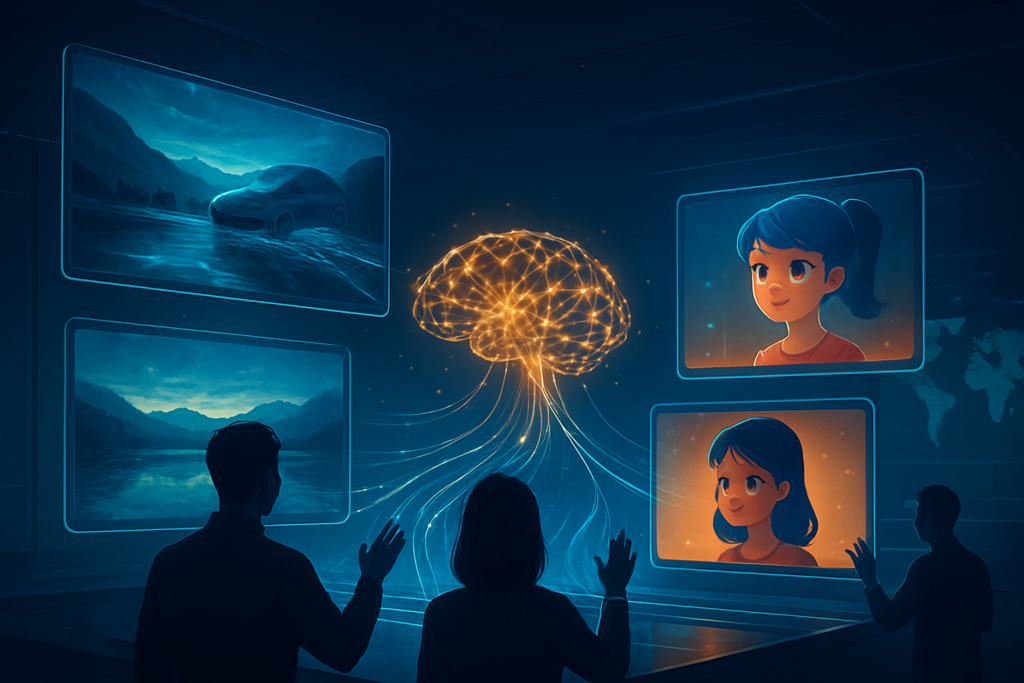
The landscape of digital media has reached a fever pitch as we enter 2026. What was once a series of impressive but glitchy tech demos in 2024 has evolved into a high-stakes, multi-billion dollar competition for the future of visual storytelling. Today, the "Big Three" of AI video—OpenAI, Google, and a surge of high-performing Chinese labs—are no longer just fighting for viral clicks; they are competing to become the foundational operating system for Hollywood, global advertising, and the creator economy.
This week's latest benchmarks reveal a startling convergence in quality. As OpenAI (Microsoft MSFT) and Google (Alphabet GOOGL) push the boundaries of cinematic realism and enterprise integration, challengers like Kuaishou (HKG: 1024) and MiniMax have narrowed the technical gap to mere months. The result is a democratization of high-end animation that allows a single creator to produce footage that, just three years ago, would have required a mid-sized VFX studio and a six-figure budget.
Architectural Breakthroughs: From World Models to Physics-Aware Engines
The technical sophistication of these models has leaped forward with the release of Sora 2 Pro and Google’s Veo 3.1. OpenAI’s Sora 2 Pro has introduced a breakthrough "Cameo" feature, which finally solves the industry’s most persistent headache: character consistency. By allowing users to upload a reference image, the model maintains over 90% visual fidelity across different scenes, lighting conditions, and camera angles. Meanwhile, Google’s Veo 3.1 has focused on "Ingredients-to-Video," a system that allows brand managers to feed the AI specific color palettes and product assets to ensure that generated marketing materials remain strictly on-brand.
In the East, Kuaishou’s Kling 2.6 has set a new standard for audio-visual synchronization. Unlike earlier models that added sound as an afterthought, Kling utilizes a latent alignment approach, generating audio and video simultaneously. This ensures that the sound of a glass shattering or a footstep hitting gravel occurs at the exact millisecond of the visual impact. Not to be outdone, Pika 2.5 has leaned into the surreal, refining its "Pikaffects" library. These "physics-defying" tools—such as "Melt-it," "Explode-it," and the viral "Cake-ify it" (which turns any realistic object into a sliceable cake)—have turned Pika into the preferred tool for social media creators looking for physics-bending viral content.
The research community notes that the underlying philosophy of these models is bifurcating. OpenAI continues to treat Sora as a "world simulator," attempting to teach the AI the fundamental laws of physics and light interaction. In contrast, models like MiniMax’s Hailuo 2.3 function more as "Media Agents." Hailuo uses an AI director to select the best sub-models for a specific prompt, prioritizing aesthetic appeal and render speed over raw physical accuracy. This divergence is creating a diverse ecosystem where creators can choose between the "unmatched realism" of the West and the "rapid utility" of the East.
The Geopolitical Pivot: Silicon Valley vs. The Dragon’s Digital Cinema
The competitive implications of this race are profound. For years, Silicon Valley held a comfortable lead in generative AI, but the gap is closing. While OpenAI and Google dominate the high-end Hollywood pre-visualization market, Chinese firms have pivoted toward the high-volume E-commerce and short-form video sectors. Kuaishou’s integration of Kling into its massive social ecosystem has given it a data flywheel that is difficult for Western companies to replicate. By training on billions of short-form videos, Kling has mastered human motion and "social realism" in ways that Sora is still refining.
Market positioning has also been influenced by infrastructure constraints. Due to export controls on high-end Nvidia (NVDA) chips, Chinese labs like MiniMax have been forced to innovate in "compute-efficiency." Their models are significantly faster and cheaper to run than Sora 2 Pro, which can take up to eight minutes to render a single 25-second clip. This efficiency has made Hailuo and Kling the preferred choices for the "Global South" and budget-conscious creators, potentially locking OpenAI and Google into a "premium-only" niche if they cannot reduce their inference costs.
Strategic partnerships are also shifting. Disney and other major studios have reportedly begun integrating Sora and Veo into their production pipelines for storyboarding and background generation. However, the rise of "good enough" video from Pika and Hailuo is disrupting the stock footage industry. Companies like Adobe (ADBE) and Getty Images are feeling the pressure as the cost of generating a custom, high-quality 4K clip drops below the cost of licensing a pre-existing one.
Ethics, Authenticity, and the Democratization of the Imagination
The wider significance of this "video-on-demand" era cannot be overstated. We are witnessing the death of the "uncanny valley." As AI video becomes indistinguishable from filmed reality, the potential for misinformation and deepfakes has reached a critical level. While OpenAI and Google have implemented robust C2PA watermarking and "digital fingerprints," many open-source and less-regulated models do not, creating a bifurcated reality where "seeing is no longer believing."
Beyond the risks, the democratization of storytelling is a monumental shift. A teenager in Lagos or a small business in Ohio now has access to the same visual fidelity as a Marvel director. This is the ultimate fulfillment of the promise made by the first generative text models: the removal of the "technical tax" on creativity. However, this has led to a glut of content, sparking a new crisis of discovery. When everyone can make a cinematic masterpiece, the value shifts from the ability to create to the ability to curate and conceptualize.
This milestone echoes the transition from silent film to "talkies" or the shift from hand-drawn to CGI animation. It is a fundamental disruption of the labor market in creative industries. While new roles like "AI Cinematographer" and "Latent Space Director" are emerging, traditional roles in lighting, set design, and background acting are facing an existential threat. The industry is currently grappling with how to credit and compensate the human artists whose work was used to train these increasingly capable "world simulators."
The Horizon of Interactive Realism
Looking ahead to the remainder of 2026 and beyond, the next frontier is real-time interactivity. Experts predict that by 2027, the line between "video" and "video games" will blur. We are already seeing early versions of "generative environments" where a user can not only watch a video but step into it, changing the camera angle or the weather in real-time. This will require a massive leap in "world consistency," a challenge that OpenAI is currently tackling by moving Sora toward a 3D-aware latent space.
Furthermore, the "long-form" challenge remains. While Veo 3.1 can extend scenes up to 60 seconds, generating a coherent 90-minute feature film remains the "Holy Grail." This will require AI that understands narrative structure, pacing, and long-term character arcs, not just frame-to-frame consistency. We expect to see the first "AI-native" feature films—where every frame, sound, and dialogue line is co-generated—hit independent film festivals by late 2026.
A New Epoch for Visual Storytelling
The competition between Sora, Veo, Kling, and Pika has moved past the novelty phase and into the infrastructure phase. The key takeaway for 2026 is that AI video is no longer a separate category of media; it is becoming the fabric of all media. The "physics-defying" capabilities of Pika 1.5 and the "world-simulating" depth of Sora 2 Pro are just two sides of the same coin: the total digital control of the moving image.
As we move forward, the focus will shift from "can it make a video?" to "how well can it follow a director's intent?" The winner of the AI video wars will not necessarily be the model with the most pixels, but the one that offers the most precise control. For now, the world watches as the boundaries of the possible are redrawn every few weeks, ushering in an era where the only limit to cinema is the human imagination.
This content is intended for informational purposes only and represents analysis of current AI developments.
TokenRing AI delivers enterprise-grade solutions for multi-agent AI workflow orchestration, AI-powered development tools, and seamless remote collaboration platforms.
For more information, visit https://www.tokenring.ai/.