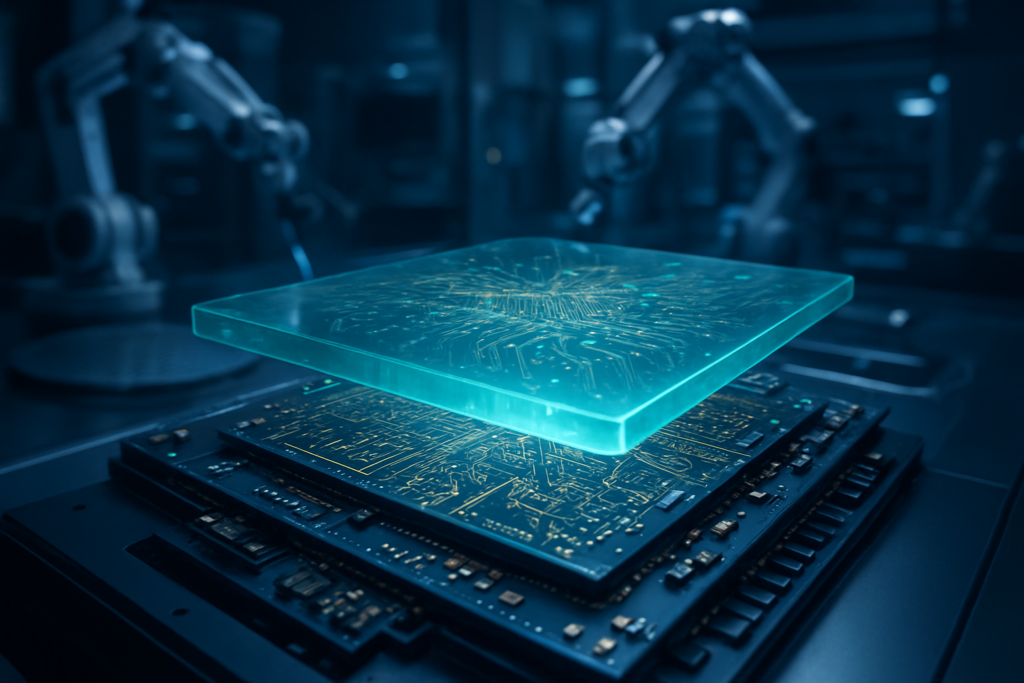
The semiconductor industry reached a historic milestone this month as Intel Corporation (NASDAQ: INTC) officially transitioned its glass substrate technology into high-volume manufacturing (HVM). Announced during CES 2026, the shift from traditional organic materials to glass marks the most significant change in chip packaging in over two decades. By moving beyond the physical limitations of organic resin, Intel has successfully launched the Xeon 6+ "Clearwater Forest" processor, the first commercial product to utilize a glass core, signaling a new era for massive AI systems-on-package (SoP).
This development is not merely a material swap; it is a structural necessity for the survival of Moore’s Law in the age of generative AI. As artificial intelligence models demand increasingly larger silicon footprints and more high-bandwidth memory (HBM), the industry had hit a "warpage wall" with traditional organic substrates. Intel’s leap into glass provides the mechanical rigidity and thermal stability required to build the "reticle-busting" chips of the future, enabling interconnect densities that were previously thought to be impossible outside of a laboratory setting.
Breaking the Warpage Wall: The Technical Leap to Glass
For years, the industry relied on organic substrates—specifically Ajinomoto Build-up Film (ABF)—which are essentially high-tech plastics. While cost-effective, organic materials expand and contract at different rates than the silicon chips sitting on top of them, a phenomenon known as Coefficient of Thermal Expansion (CTE) mismatch. In the high-heat environment of a 1,000-watt AI accelerator, this causes the substrate to warp, cracking the microscopic solder bumps that connect the chip to the board. Glass, however, possesses a CTE that nearly matches silicon. This allows Intel to manufacture packages exceeding 100mm x 100mm without the risk of mechanical failure, providing a perfectly flat "optical" surface with less than 1 micrometer of roughness.
The most transformative technical achievement lies in the Through Glass Vias (TGVs). Intel’s new manufacturing process at its Chandler, Arizona facility allows for a 10-fold increase in interconnect density compared to organic substrates. These ultra-fine TGVs enable pitch widths of less than 10 micrometers, allowing thousands of additional pathways for data to travel between compute chiplets and memory stacks. Furthermore, glass is an exceptional insulator, leading to a 40% reduction in signal loss and a nearly 50% improvement in power delivery efficiency. This technical trifecta—flatness, density, and efficiency—allows for the integration of up to 12 HBM4 stacks alongside multiple compute tiles, creating a singular, massive AI engine.
Initial reactions from the AI hardware community have been overwhelmingly positive. Research analysts at the Interuniversity Microelectronics Centre (IMEC) noted that the transition to glass represents a "paradigm shift" in how we define a processor. By moving the complexity of the interconnect into the substrate itself, Intel has effectively turned the packaging into a functional part of the silicon architecture, rather than just a protective shell.
Competitive Stakes and the Global Race for "Panel-Level" Dominance
While Intel currently holds a clear first-mover advantage with its 2026 HVM rollout, other industry titans are racing to catch up. Taiwan Semiconductor Manufacturing Co. (NYSE: TSM) recently accelerated its own glass roadmap, unveiling the CoPoS (Chip-on-Panel-on-Substrate) platform. However, TSMC’s mass production is not expected until late 2028, as the foundry giant remains focused on maximizing its current silicon-based CoWoS (Chip-on-Wafer-on-Substrate) capacity to meet the relentless demand for NVIDIA GPUs. This window gives Intel a strategic opportunity to win back high-performance computing (HPC) clients who are outgrowing the size limits of silicon interposers.
Samsung Electronics (KRX: 005930) has also entered the fray, announcing a "Triple Alliance" at CES 2026 that leverages its display division’s glass-handling expertise and its semiconductor division’s HBM4 production. Samsung aims to reach mass production by the end of 2026, positioning itself as a "one-stop shop" for custom AI ASICs. Meanwhile, the SK Hynix (KRX: 000660) subsidiary Absolics is finalizing its specialized facility in Georgia, USA, with plans to provide glass substrates to companies like AMD (NASDAQ: AMD) by mid-2026.
The implications for the market are profound. Intel’s lead in glass technology could make its foundry services (IFS) significantly more attractive to AI startups and hyperscalers like Amazon (NASDAQ: AMZN) and Google (NASDAQ: GOOGL), who are designing their own custom silicon. As AI models scale toward trillions of parameters, the ability to pack more compute power into a single, thermally stable package becomes the primary competitive differentiator in the data center market.
The Broader AI Landscape: Efficiency in the Era of Giant Models
The shift to glass substrates is a direct response to the "energy crisis" facing the AI industry. As training clusters grow to consume hundreds of megawatts, the inefficiency of traditional packaging has become a bottleneck. By reducing signal loss and improving power delivery, glass substrates allow AI chips to perform more calculations per watt. This fits into a broader trend of "system-level" optimization, where performance gains are no longer coming from shrinking transistors alone, but from how those transistors are connected and cooled within a massive system-on-package.
This transition also mirrors previous semiconductor milestones, such as the introduction of High-K Metal Gate or FinFET transistors. Just as those technologies allowed Moore’s Law to continue when traditional planar transistors reached their limits, glass substrates solve the "packaging limit" that threatened to stall the growth of AI hardware. However, the transition is not without concerns. The manufacturing of glass substrates requires entirely new supply chains and specialized handling equipment, as glass is more brittle than organic resin during the assembly phase. Reliability over a 10-year data center lifecycle remains a point of intense study for the industry.
Despite these challenges, the move to glass is viewed as inevitable. The ability to create "reticle-busting" designs—chips that are larger than the standard masks used in lithography—is the only way to meet the memory bandwidth requirements of future large language models (LLMs). Without glass, the physical footprint of the next generation of AI accelerators would likely be too unstable to manufacture at scale.
The Future of Glass: From Chiplets to Integrated Photonics
Looking ahead, the roadmap for glass substrates extends far beyond simple structural support. By 2028, experts predict the introduction of "Panel-Level Packaging," where chips are processed on massive 600mm x 600mm glass sheets, similar to how flat-panel displays are made. This would drastically reduce the cost of advanced packaging and allow for even larger AI systems that could bridge the gap between individual chips and entire server racks.
Perhaps the most exciting long-term development is the integration of optical interconnects. Because glass is transparent, it provides a natural medium for silicon photonics. Future iterations of Intel’s glass substrates are expected to include integrated optical wave-guides, allowing chips to communicate using light instead of electricity. This would virtually eliminate data latency and power consumption for chip-to-chip communication, paving the way for the first truly "planetary-scale" AI computers.
While the industry must still refine the yields of these complex glass structures, the momentum is irreversible. Engineers are already working on the next generation of 14A process nodes that will rely exclusively on glass-based architectures to handle the massive power densities of the late 2020s.
A New Foundation for Artificial Intelligence
The launch of Intel’s high-volume glass substrate manufacturing marks a definitive turning point in computing history. It represents the moment the industry moved beyond the "plastic" era of the 20th century into a "glass" era designed specifically for the demands of artificial intelligence. By solving the critical issues of thermal expansion and interconnect density, Intel has provided the physical foundation upon which the next decade of AI breakthroughs will be built.
As we move through 2026, the industry will be watching the yields and field performance of the Xeon 6+ "Clearwater Forest" chips closely. If the performance and reliability gains hold, expect a rapid migration as NVIDIA, AMD, and the hyperscalers scramble to adopt glass for their own flagship products. The "Glass Age" of semiconductors has officially begun, and it is clear that the future of AI will be transparent, flat, and more powerful than ever before.
This content is intended for informational purposes only and represents analysis of current AI developments.
TokenRing AI delivers enterprise-grade solutions for multi-agent AI workflow orchestration, AI-powered development tools, and seamless remote collaboration platforms.
For more information, visit https://www.tokenring.ai/.