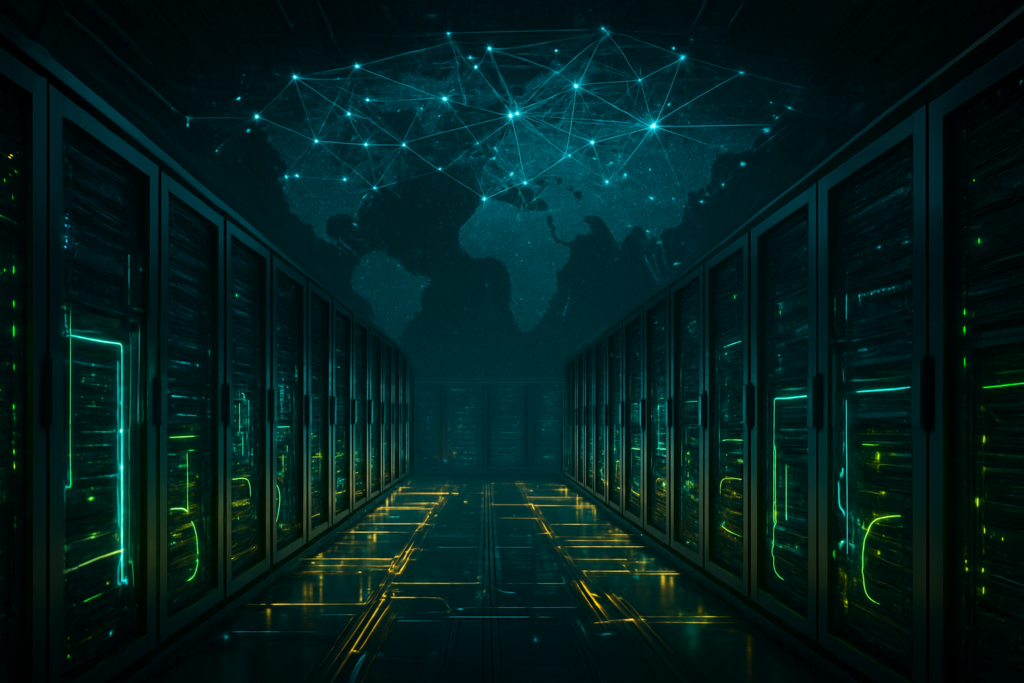
As of January 19, 2026, the artificial intelligence sector has entered a new phase of industrial-scale deployment, driven almost entirely by the ubiquity of NVIDIA's (NASDAQ: NVDA) Blackwell architecture. What began as a highly anticipated hardware launch in late 2024 has evolved into the foundational infrastructure for the "AI Factory" era. Jensen Huang, CEO of NVIDIA, recently described the current appetite for Blackwell-based systems like the B200 and the liquid-cooled GB200 NVL72 as "off the charts," a sentiment backed by a staggering backlog of approximately 3.6 million units from major cloud service providers and sovereign nations alike.
The significance of this moment cannot be overstated. We are no longer discussing individual chips but rather integrated, rack-scale supercomputers that function as a single unit of compute. This shift has enabled the first generation of truly "agentic" AI—models capable of multi-step reasoning and autonomous task execution—that were previously hampered by the communication bottlenecks and memory constraints of the older Hopper architecture. As Blackwell units flood into data centers across the globe, the focus of the tech industry has shifted from whether these models can be built to how quickly they can be scaled to meet a seemingly bottomless well of enterprise demand.
The Blackwell architecture represents a radical departure from the monolithic GPU designs of the past, utilizing a dual-die chiplet approach that packs 208 billion transistors into a single package. The flagship B200 GPU delivers up to 20 PetaFLOPS of FP4 performance, a five-fold increase over the H100’s peak throughput. Central to this leap is the second-generation Transformer Engine, which introduces support for 4-bit floating point (FP4) precision. This allows massive Large Language Models (LLMs) to run with twice the throughput and significantly lower memory footprints without sacrificing accuracy, effectively doubling the "intelligence per watt" compared to previous generations.
Beyond the raw compute power, the real breakthrough of 2026 is the GB200 NVL72 system. By interconnecting 72 Blackwell GPUs with the fifth-generation NVLink (offering 1.8 TB/s of bidirectional bandwidth), NVIDIA has created a single entity capable of 1.4 ExaFLOPS of AI inference. This "rack-as-a-GPU" philosophy addresses the massive communication overhead inherent in Mixture-of-Experts (MoE) models, where data must be routed between specialized "expert" layers across multiple chips at microsecond speeds. Initial reactions from the research community suggest that Blackwell has reduced the cost of training frontier models by over 60%, while the dedicated hardware decompression engine has accelerated data loading by up to 800 GB/s, removing one of the last major bottlenecks in deep learning pipelines.
The deployment of Blackwell has solidified a "winner-takes-most" dynamic among hyperscalers. Microsoft (NASDAQ: MSFT) has emerged as a primary beneficiary, integrating Blackwell into its "Fairwater" AI superfactories to power the Azure OpenAI Service. These clusters are reportedly processing over 100 trillion tokens per quarter, supporting a new wave of enterprise-grade AI agents. Similarly, Amazon (NASDAQ: AMZN) Web Services has leveraged a multi-billion dollar agreement to deploy Blackwell and the upcoming Rubin chips within its EKS environment, facilitating "gigascale" generative AI for its global customer base. Alphabet (NASDAQ: GOOGL), while continuing to develop its internal TPU silicon, remains a major Blackwell customer to ensure its Google Cloud Platform remains a competitive destination for multi-cloud AI workloads.
However, the competitive landscape is far from static. Advanced Micro Devices (NASDAQ: AMD) has countered with its Instinct MI400 series, which features a massive 432GB of HBM4 memory. By emphasizing "Open Standards" through UALink and Ultra Ethernet, AMD is positioning itself as the primary alternative for organizations wary of NVIDIA’s proprietary ecosystem. Meanwhile, Intel (NASDAQ: INTC) has pivoted its strategy toward the "Jaguar Shores" platform, focusing on the cost-effective "sovereign AI" market. Despite these efforts, NVIDIA’s deep software moat—specifically the CUDA 13.0 stack—continues to make Blackwell the default choice for developers, creating a strategic advantage that rivals are struggling to erode as the industry standardizes on Blackwell-native architectures.
The broader significance of the Blackwell rollout extends into the realms of energy policy and national security. The power density of these new clusters is unprecedented; a single GB200 NVL72 rack can draw up to 120kW, requiring advanced liquid cooling infrastructure that many older data centers simply cannot support. This has triggered a global "cooling gold rush" and pushed data center electricity demand toward an estimated 1,000 TWh annually. Paradoxically, the 25x increase in energy efficiency for inference has allowed for the "Inference Supercycle," where the cost of running a sophisticated AI model has plummeted to a fraction of a cent per thousand tokens, making high-level reasoning accessible to small businesses and individual developers.
Furthermore, we are witnessing the rise of "Sovereign AI." Nations now view compute capacity as a critical national resource. In Europe, countries like France and the UK have launched multi-billion dollar infrastructure programs—such as "Stargate UK"—to build domestic Blackwell clusters. In Asia, Saudi Arabia’s "Project HUMAIN" is constructing massive 6-gigawatt AI data centers, while India’s National AI Compute Grid is deploying over 10,000 GPUs to support regional language models. This trend suggests a future where AI capability is as geopolitically significant as oil reserves or semiconductor manufacturing capacity, with Blackwell serving as the primary currency of this new digital economy.
Looking ahead to the remainder of 2026 and into 2027, the focus is already shifting toward NVIDIA’s next milestone: the Rubin (R100) architecture. Expected to enter mass availability in the second half of 2026, Rubin will mark the definitive transition to HBM4 memory and a 3nm process node, promising a further 3.5x improvement in training performance. We expect to see the "Blackwell Ultra" (B300) serve as a bridge, offering 288GB of HBM3e memory to support the increasingly massive context windows required by video-generative models and autonomous coding agents.
The next frontier for these systems will be "Physical AI"—the integration of Blackwell-scale compute into robotics and autonomous manufacturing. With the computational overhead of real-time world modeling finally becoming manageable, we anticipate the first widespread deployment of humanoid robots powered by "miniaturized" Blackwell architectures by late 2027. The primary challenge remains the global supply chain for High Bandwidth Memory (HBM), where manufacturers like SK Hynix (KRX:000660) and TSMC (NYSE: TSM) are operating at maximum capacity to meet NVIDIA's relentless release cycle.
In summary, the early 2026 landscape is defined by the transition of AI from a specialized experimental tool to a core utility of the global economy, powered by NVIDIA’s Blackwell architecture. The "off the charts" demand described by Jensen Huang is not merely hype; it is a reflection of a fundemental shift in how computing is performed, moving away from general-purpose CPUs toward accelerated, interconnected AI factories.
As we move forward, the key metrics to watch will be the stabilization of energy-efficient cooling solutions and the progress of the Rubin architecture. Blackwell has set a high bar, effectively ending the era of "dumb" chatbots and ushering in an age of reasoning agents. Its legacy will be recorded as the moment when the "intelligence per watt" curve finally aligned with the needs of global industry, making the promise of ubiquitous artificial intelligence a physical and economic reality.
This content is intended for informational purposes only and represents analysis of current AI developments.
TokenRing AI delivers enterprise-grade solutions for multi-agent AI workflow orchestration, AI-powered development tools, and seamless remote collaboration platforms.
For more information, visit https://www.tokenring.ai/.