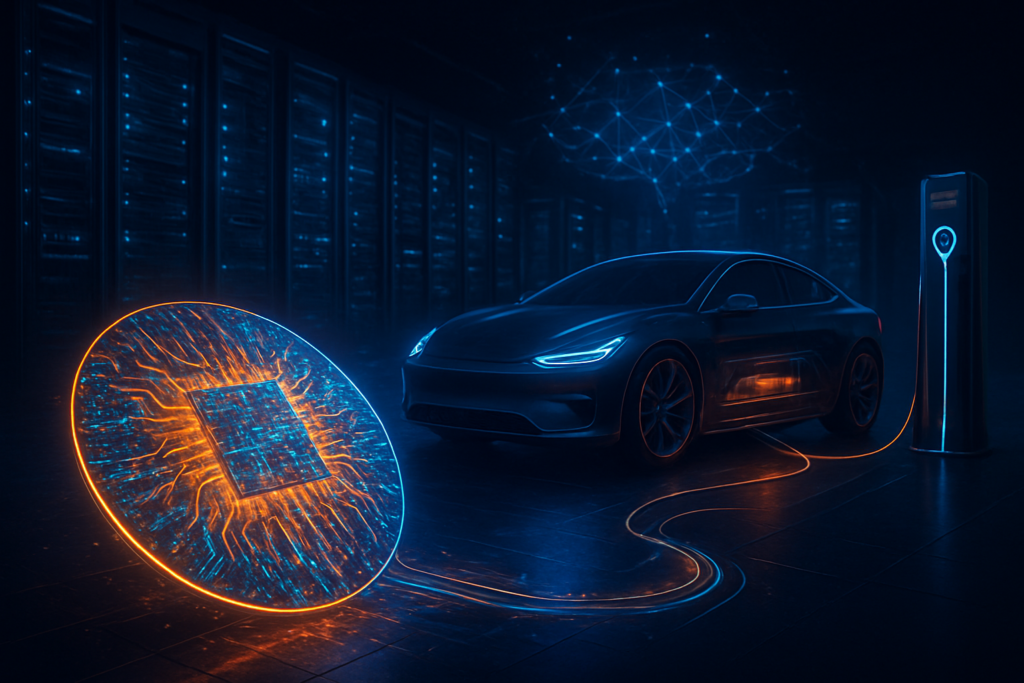
As of January 12, 2026, the global technology landscape has reached a critical "tipping point" where traditional silicon is no longer sufficient to meet the voracious energy demands of generative AI and the performance expectations of the mass-market electric vehicle (EV) industry. The transition to Wide-Bandgap (WBG) semiconductors—specifically Gallium Nitride (GaN) and Silicon Carbide (SiC)—has moved from a niche engineering preference to the primary engine of industrial growth. This shift, often described as the "Power Revolution," is fundamentally rewriting the economics of data centers and the utility of electric transportation, enabling a level of efficiency that was physically impossible just three years ago.
The immediate significance of this revolution is most visible in the cooling aisles of hyperscale data centers and the charging stalls of highway rest stops. With the commercialization of Vertical GaN transistors and the stabilization of 200mm (8-inch) SiC wafer yields, the industry has finally solved the "cost-parity" problem. For the first time, WBG materials are being integrated into mid-market EVs priced under $40,000 and standard AI server racks, effectively ending the era of silicon-only power inverters. This transition is not merely an incremental upgrade; it is a structural necessity for an era where AI compute power is the world's most valuable commodity.
The Technical Frontier: Vertical GaN and the 300mm Milestone
The technical cornerstone of this 2026 breakthrough is the widespread adoption of Vertical GaN architecture. Unlike traditional lateral GaN, which conducts electricity across the surface of the chip, vertical GaN allows current to flow through the bulk of the material. This shift has unlocked a 30% increase in efficiency and a staggering 50% reduction in the physical footprint of power supply units (PSUs). For AI data centers, where rack density is the ultimate metric of success, this allows for more GPUs—such as the latest "Vera Rubin" architecture from NVIDIA (NASDAQ: NVDA)—to be packed into the same physical space without exceeding thermal limits. These new GaN-based PSUs are now achieving peak efficiencies of 97.5%, a critical threshold for managing the 100kW+ power requirements of modern AI clusters.
Simultaneously, the industry has mastered the manufacturing of 200mm Silicon Carbide wafers, significantly driving down the cost per chip. Leading the charge is Infineon Technologies (OTCMKTS: IFNNY), which recently sent shockwaves through the industry by announcing the world’s first 300mm (12-inch) power GaN production capability. By moving to 300mm wafers, Infineon is achieving a 2.3x higher chip yield compared to 200mm competitors. This scaling is essential for the 800V EV architectures that have become the standard in 2026. These high-voltage systems, powered by SiC inverters, allow for thinner wiring, lighter vehicles, and range improvements of approximately 7% without the need for larger, heavier battery packs.
Market Dynamics: A New Hierarchy in Power Semiconductors
The competitive landscape of 2026 has seen a dramatic reshuffling of power. STMicroelectronics (NYSE: STM) has solidified its position as a vertically integrated powerhouse, with its Catania Silicon Carbide Campus in Italy reaching full mass-production capacity for 200mm wafers. Furthermore, their joint venture with Sanan Optoelectronics (SHA: 600703) in China has reached a capacity of 480,000 wafers annually, specifically targeting the dominant Chinese EV market led by BYD (OTCMKTS: BYDDY). This strategic positioning has allowed STMicro to capture a massive share of the mid-market EV transition, where cost-efficiency is paramount.
Meanwhile, Wolfspeed (NYSE: WOLF) has emerged from its late-2025 financial restructuring as a leaner, more focused entity. Operating the world’s largest fully automated 200mm SiC facility at the Mohawk Valley Fab, Wolfspeed has successfully pivoted from being a generalist supplier to a specialized provider for AI, aerospace, and defense. On Semiconductor (NASDAQ: ON), also known as ON Semi, has found its niche with the EliteSiC M3e platform. By securing major design wins in the AI sector, ON Semi’s 1200V die is now the standard for heavy industrial traction inverters and high-power AI server power stages, offering 20% more output power than previous generations.
The AI Energy Crisis and the Sustainability Mandate
The wider significance of the GaN and SiC revolution cannot be overstated in the context of the global AI landscape. As hyperscalers like Microsoft (NASDAQ: MSFT) and Google (NASDAQ: GOOGL) race to build out massive AI infrastructure, they have encountered a "power wall." The sheer amount of electricity required to train and run large language models has threatened to outpace grid capacity. WBG semiconductors are the only viable solution to this crisis. By standardizing on 800V High-Voltage DC (HVDC) power distribution within data centers—made possible by SiC and GaN—operators are reducing electrical losses by up to 12%, saving millions of dollars in energy costs and significantly lowering the carbon footprint of AI operations.
This shift mirrors previous technological milestones like the transition from vacuum tubes to transistors, or the move from incandescent bulbs to LEDs. It represents a fundamental decoupling of performance from energy consumption. However, this revolution also brings concerns, particularly regarding the supply chain for raw materials and the geopolitical concentration of wafer manufacturing. The ongoing price war in the substrate market, triggered by Chinese competitors like TanKeBlue, has accelerated adoption but also pressured the margins of Western manufacturers, leading to a complex web of subsidies and trade protections that define the 2026 semiconductor trade environment.
The Road Ahead: 300mm Scaling and Heavy Electrification
Looking toward the late 2020s, the next frontier for power semiconductors lies in the electrification of heavy transport and the further scaling of GaN. Near-term developments will focus on the "300mm race," as competitors scramble to match Infineon’s manufacturing efficiency. We also expect to see the emergence of "Multi-Level" SiC inverters, which will enable the electrification of long-haul trucking and maritime shipping—sectors previously thought to be unreachable for battery-electric technology due to weight and charging constraints.
Experts predict that by 2027, "Smart Power" modules will integrate GaN transistors directly onto the same substrate as AI processors, allowing for real-time, AI-driven power management at the chip level. The primary challenge remains the scarcity of specialized engineering talent capable of designing for these high-frequency, high-temperature environments. As the industry moves toward "Vertical GaN on Silicon" to further reduce costs, the integration of power and logic will likely become the defining technical challenge of the next decade.
Conclusion: The New Foundation of the Digital Age
The GaN and SiC revolution of 2026 marks a definitive end to the "Silicon Age" of power electronics. By solving the dual challenges of EV range anxiety and AI energy consumption, these wide-bandgap materials have become the invisible backbone of modern civilization. The key takeaways are clear: 800V is the new standard for mobility, 200mm is the baseline for production, and AI efficiency is the primary driver of semiconductor innovation.
In the history of technology, this period will likely be remembered as the moment when the "Power Paradox"—the need for more compute with less energy—was finally addressed through material science. As we move into the second half of 2026, the industry will be watching for the first 300mm GaN products to hit the market and for the potential consolidation of smaller WBG startups into the portfolios of the "Big Five" power semiconductor firms. The revolution is no longer coming; it is already here, and it is powered by GaN and SiC.
This content is intended for informational purposes only and represents analysis of current AI developments.
TokenRing AI delivers enterprise-grade solutions for multi-agent AI workflow orchestration, AI-powered development tools, and seamless remote collaboration platforms.
For more information, visit https://www.tokenring.ai/.