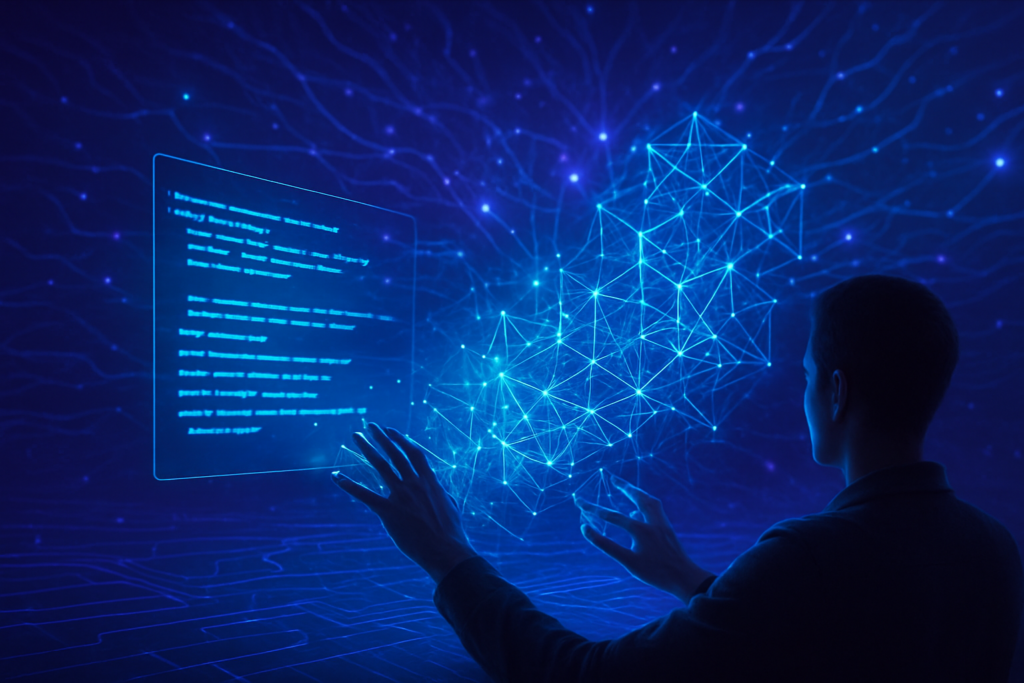
As 2025 draws to a close, the landscape of software engineering looks unrecognizable compared to just eighteen months ago. The industry has been swept by "Vibe Coding," a movement where the primary interface for creating software is no longer a programming language like Python or Rust, but natural language and aesthetic intent. This shift has empowered a new generation of "citizen developers" to build complex, full-stack applications by simply describing a "vibe" to AI agents, effectively moving the bottleneck of creation from technical syntax to human imagination.
The significance of this transition cannot be overstated. Throughout 2025, tools that were once seen as mere autocomplete helpers evolved into autonomous architects. This has led to a fundamental decoupling of software creation from the traditional requirement of a Computer Science degree. As Andrej Karpathy, the former Tesla AI lead who helped popularize the term, famously noted, the "hottest new programming language is English," and the market has responded with a valuation explosion for the startups leading this charge.
From Syntax to Sentiment: The Technical Architecture of the Vibe
The technical foundation of Vibe Coding rests on the evolution from "Copilots" to "Agents." In late 2024 and early 2025, the release of Cursor’s "Composer" mode and the Replit Agent marked a turning point. Unlike traditional IDEs that required developers to review every line of a code "diff," these tools allowed users to prompt for high-level changes—such as "make the dashboard look like a futuristic control center and add real-time crypto tracking"—and watch as the AI edited dozens of files simultaneously. By mid-2025, Replit (private) released Agent 3, which introduced "Max Autonomy Mode," enabling the AI to browse its own user interface, identify visual bugs, and fix them without human intervention for hours at a time.
This technical leap was powered by the massive context windows and improved reasoning of models like Claude 3.5 Sonnet and GPT-4o. These models allowed the AI to maintain a "mental map" of an entire codebase, rather than just the file currently open. The "vibe" part of the equation comes from the iterative feedback loop: when the code breaks, the user doesn't debug the logic; they simply copy the error message back into the prompt or tell the AI, "it doesn't feel right yet." The AI then re-architects the solution based on the desired outcome. This "outcome-first" methodology has been hailed by the AI research community as the first true realization of "Natural Language Programming."
The Market Disruption: Startups vs. The Giants
The rise of Vibe Coding has created a seismic shift in the tech sector's valuation and strategic positioning. Anysphere, the parent company of Cursor, saw its valuation skyrocket from $2.6 billion in late 2024 to an estimated $29.3 billion by December 2025. This meteoric rise has put immense pressure on established players. Microsoft (NASDAQ: MSFT), despite its early lead with GitHub Copilot, found itself in a defensive position as developers flocked to "AI-native" IDEs that offered deeper agentic integration than the traditional VS Code environment. In response, Microsoft spent much of 2025 aggressively retrofitting its developer tools to match the "agentic" capabilities of its smaller rivals.
Alphabet (NASDAQ: GOOGL) and Amazon (NASDAQ: AMZN) have also pivoted their cloud strategies to accommodate the Vibe Coding trend. Google’s "Project IDX" and Amazon’s "Q" developer assistant have transitioned from simple code generation to providing "full-stack intent" environments, where the AI manages the underlying AWS or Google Cloud infrastructure automatically. This has led to a commoditization of the "coding" layer, shifting the competitive advantage toward companies that can provide the most intuitive orchestration and the most reliable "agentic reasoning" models.
Democratization, Debt, and the 'Vibe Coding Hangover'
The broader significance of Vibe Coding lies in the radical democratization of technology. In 2025, the barrier to entry for starting a software company fell to an all-time low. Y Combinator reported that nearly 25% of its Spring 2025 batch consisted of companies with codebases that were over 95% AI-generated. This has allowed founders with backgrounds in design, sales, or philosophy to build "Weekend MVPs" that are as functional as products that previously required a team of five engineers. The trend was so pervasive that "Vibe Coding" was named the Collins Dictionary Word of the Year for 2025.
However, this rapid expansion has not come without costs. By the fourth quarter of 2025, the industry began experiencing what experts call the "Vibe Coding Hangover." A study by METR found that applications built purely through "vibes" were 40% more likely to contain critical security vulnerabilities, such as unencrypted databases. Furthermore, the lack of human understanding of the underlying code has created a new form of "technical debt" where, if the AI makes a fundamental architectural error, the non-technical creator is unable to fix it, leading to "zombie apps" that are functional but unmaintainable.
The Future of Intent-Based Creation
Looking toward 2026, the next frontier for Vibe Coding is "Self-Healing Software." Experts predict that the next generation of tools will not just build apps but actively monitor them in production, fixing bugs and optimizing performance in real-time without any human prompting. We are moving toward a world of "Disposable Software," where an app might be generated for a single use case—such as a specific data visualization for a one-off meeting—and then discarded, because the cost of creation has dropped to near zero.
The challenge for the coming year will be the integration of "Vibe" with "Verification." As AI agents become more autonomous, the industry is calling for "Guardrail Agents"—secondary AIs whose only job is to audit the "vibe-coded" output for security and efficiency. The goal is to move from "blindly accepting" the AI's work to a "trust but verify" model where the human acts as a high-level creative director and security auditor.
A New Era for the Human-Computer Relationship
The Vibe Coding trend of 2025 marks a definitive end to the era where humans had to learn the language of machines to be productive. Instead, we have successfully taught machines to understand the language of humans. This development is as significant to software as the transition from assembly language to high-level languages like C was in the 20th century. It represents the ultimate abstraction layer, where the focus of the "programmer" has finally shifted from "how" a system works to "what" it should achieve.
As we move into 2026, the industry will be watching to see if the "Vibe Coding Hangover" leads to a return to traditional engineering rigors or if a new hybrid discipline—the "Product Architect"—becomes the standard for the next decade. For now, one thing is certain: the era of the "syntax-obsessed" developer is fading, replaced by a world where the best code is the code you never even had to see.
This content is intended for informational purposes only and represents analysis of current AI developments.
TokenRing AI delivers enterprise-grade solutions for multi-agent AI workflow orchestration, AI-powered development tools, and seamless remote collaboration platforms.
For more information, visit https://www.tokenring.ai/.