
Healthcare tech company Omnicell (NASDAQ: OMCL) met Wall Street’s revenue expectations in Q4 CY2025, with sales up 2.3% year on year to $314 million. The company expects next quarter’s revenue to be around $305 million, coming in 8.2% above analysts’ estimates. Its non-GAAP profit of $0.40 per share was 19.4% below analysts’ consensus estimates.
Is now the time to buy Omnicell? Find out by accessing our full research report, it’s free.
Omnicell (OMCL) Q4 CY2025 Highlights:
- Revenue: $314 million vs analyst estimates of $314.2 million (2.3% year-on-year growth, in line)
- Adjusted EPS: $0.40 vs analyst expectations of $0.50 (19.4% miss)
- Adjusted EBITDA: $36.79 million vs analyst estimates of $41.13 million (11.7% margin, 10.5% miss)
- Revenue Guidance for Q1 CY2026 is $305 million at the midpoint, above analyst estimates of $281.8 million
- Adjusted EPS guidance for the upcoming financial year 2026 is $1.75 at the midpoint, missing analyst estimates by 7%
- EBITDA guidance for the upcoming financial year 2026 is $152.5 million at the midpoint, below analyst estimates of $158.2 million
- Operating Margin: 0.1%, down from 4% in the same quarter last year
- Free Cash Flow Margin: 5.8%, down from 15.4% in the same quarter last year
- Market Capitalization: $2.10 billion
“We finished 2025 with solid fourth quarter financial results, delivering full year 2025 total revenues, product bookings and annual recurring revenues (‘ARR’) all above the mid-point of our previously issued guidance ranges,” stated Randall Lipps, chairman, president, chief executive officer, and founder of Omnicell.
Company Overview
Driven by the vision of an "Autonomous Pharmacy" with zero medication errors, Omnicell (NASDAQ: OMCL) provides medication management automation and adherence tools that help healthcare systems and pharmacies reduce errors and improve efficiency.
Revenue Growth
Examining a company’s long-term performance can provide clues about its quality. Any business can have short-term success, but a top-tier one grows for years. Over the last five years, Omnicell grew its sales at a mediocre 5.8% compounded annual growth rate. This was below our standard for the healthcare sector and is a tough starting point for our analysis.
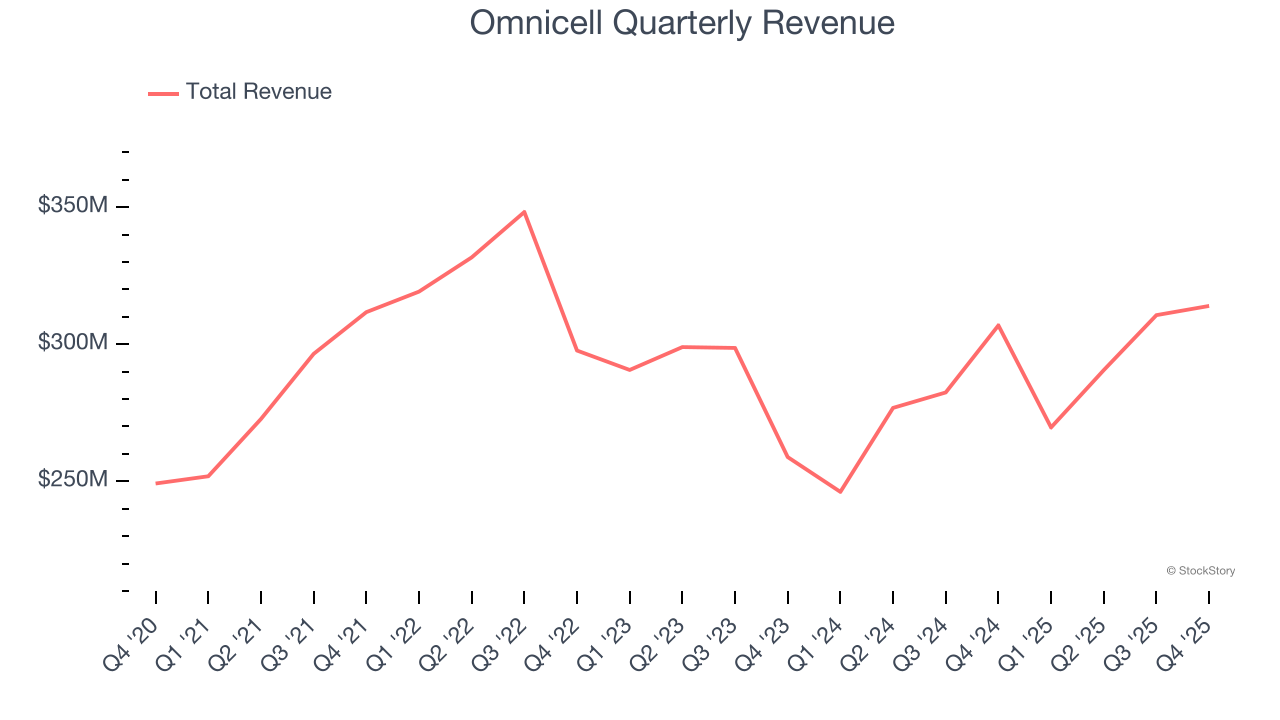
Long-term growth is the most important, but within healthcare, a half-decade historical view may miss new innovations or demand cycles. Omnicell’s recent performance shows its demand has slowed as its annualized revenue growth of 1.6% over the last two years was below its five-year trend. 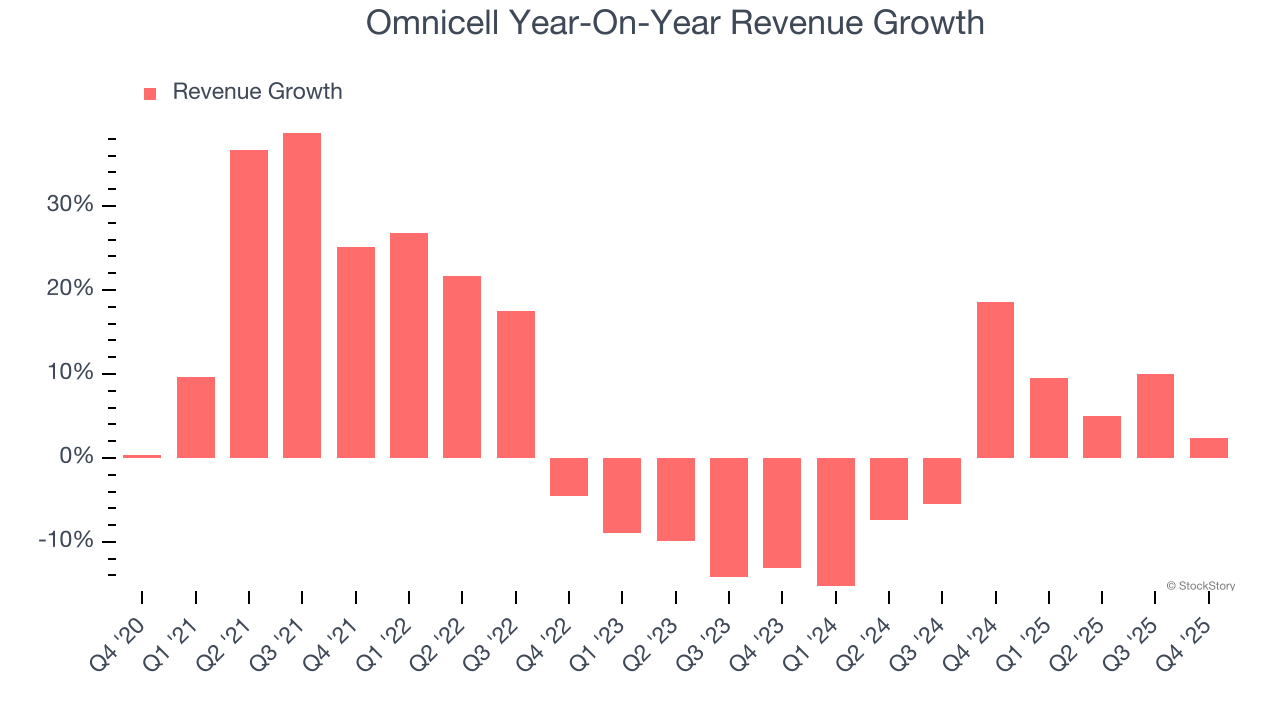
We can better understand the company’s revenue dynamics by analyzing its most important segment, Product. Over the last two years, Omnicell’s Product revenue averaged 1.5% year-on-year declines. This segment has lagged the company’s overall sales. 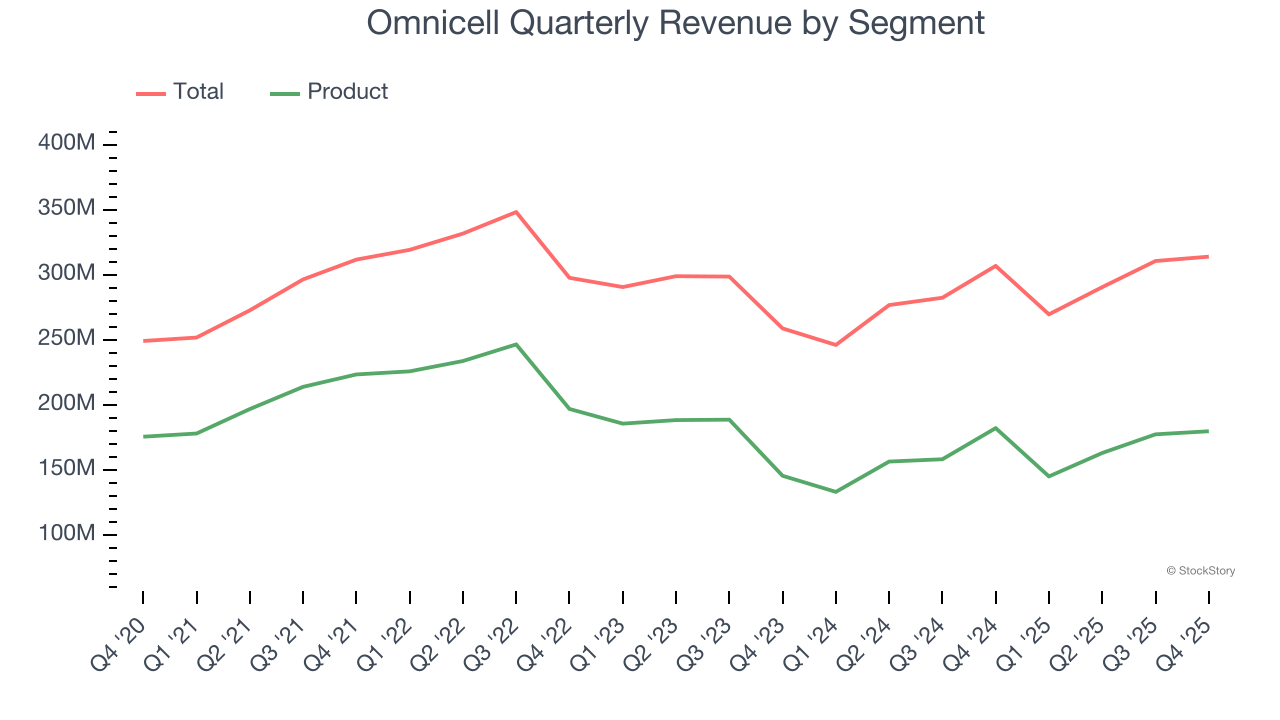
This quarter, Omnicell grew its revenue by 2.3% year on year, and its $314 million of revenue was in line with Wall Street’s estimates. Company management is currently guiding for a 13.1% year-on-year increase in sales next quarter.
Looking further ahead, sell-side analysts expect revenue to grow 4.3% over the next 12 months. While this projection suggests its newer products and services will catalyze better top-line performance, it is still below the sector average.
Software is eating the world and there is virtually no industry left that has been untouched by it. That drives increasing demand for tools helping software developers do their jobs, whether it be monitoring critical cloud infrastructure, integrating audio and video functionality, or ensuring smooth content streaming. Click here to access a free report on our 3 favorite stocks to play this generational megatrend.
Operating Margin
Omnicell was roughly breakeven when averaging the last five years of quarterly operating profits, lousy for a healthcare business.
Looking at the trend in its profitability, Omnicell’s operating margin decreased by 7.5 percentage points over the last five years, but it rose by 3.5 percentage points on a two-year basis. Still, shareholders will want to see Omnicell become more profitable in the future.
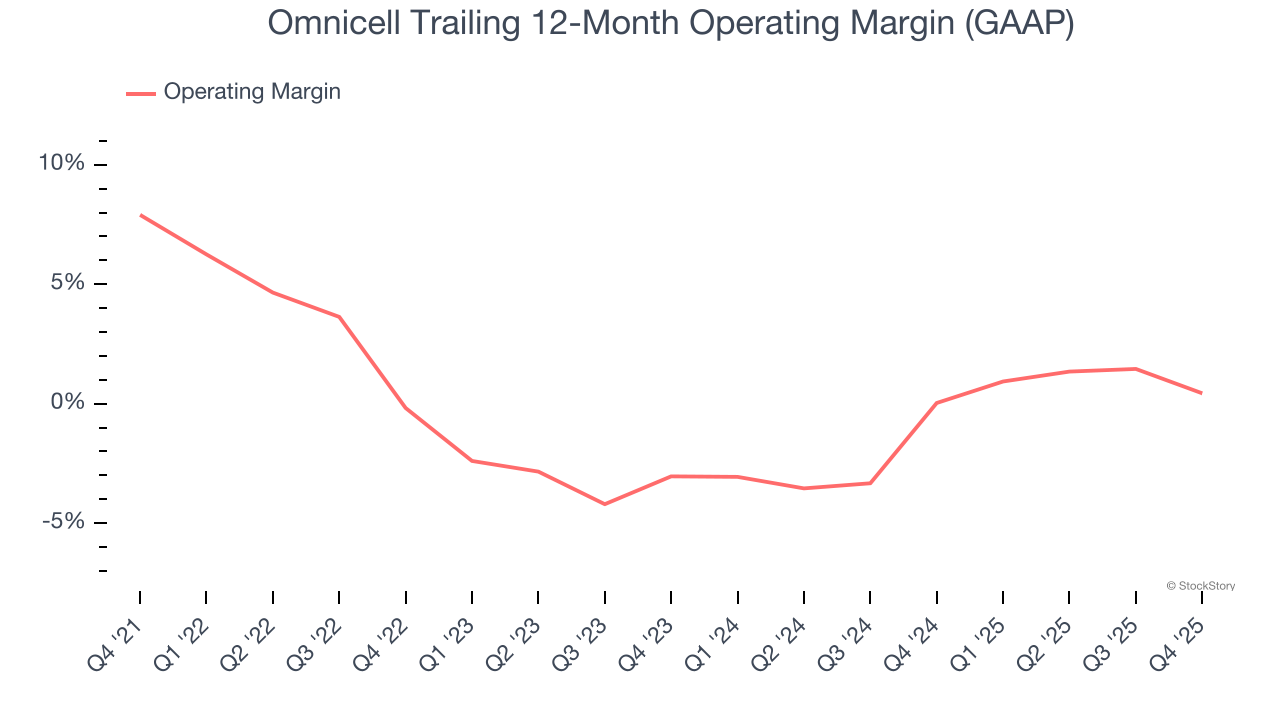
In Q4, Omnicell’s breakeven margin was 0.1%, down 3.9 percentage points year on year. This contraction shows it was less efficient because its expenses grew faster than its revenue.
Earnings Per Share
We track the long-term change in earnings per share (EPS) for the same reason as long-term revenue growth. Compared to revenue, however, EPS highlights whether a company’s growth is profitable.
Sadly for Omnicell, its EPS declined by 8.6% annually over the last five years while its revenue grew by 5.8%. This tells us the company became less profitable on a per-share basis as it expanded.
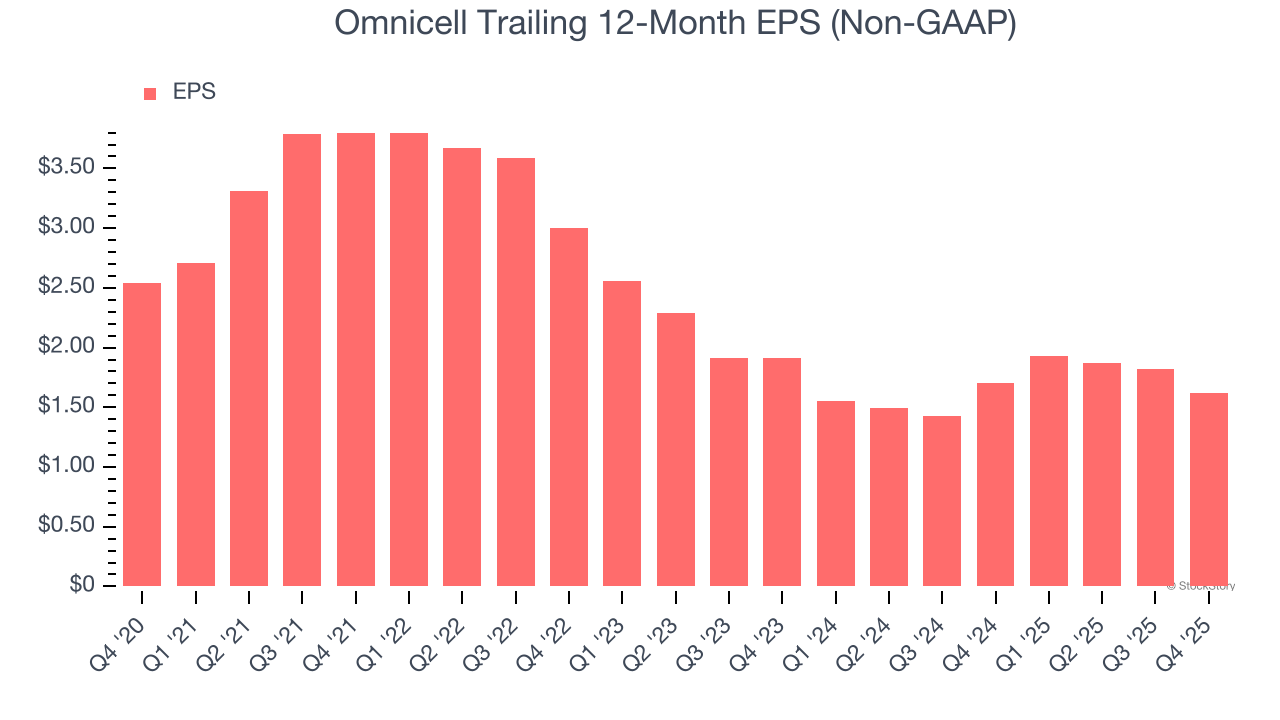
We can take a deeper look into Omnicell’s earnings to better understand the drivers of its performance. As we mentioned earlier, Omnicell’s operating margin declined by 7.5 percentage points over the last five years. Its share count also grew by 2.2%, meaning the company not only became less efficient with its operating expenses but also diluted its shareholders. 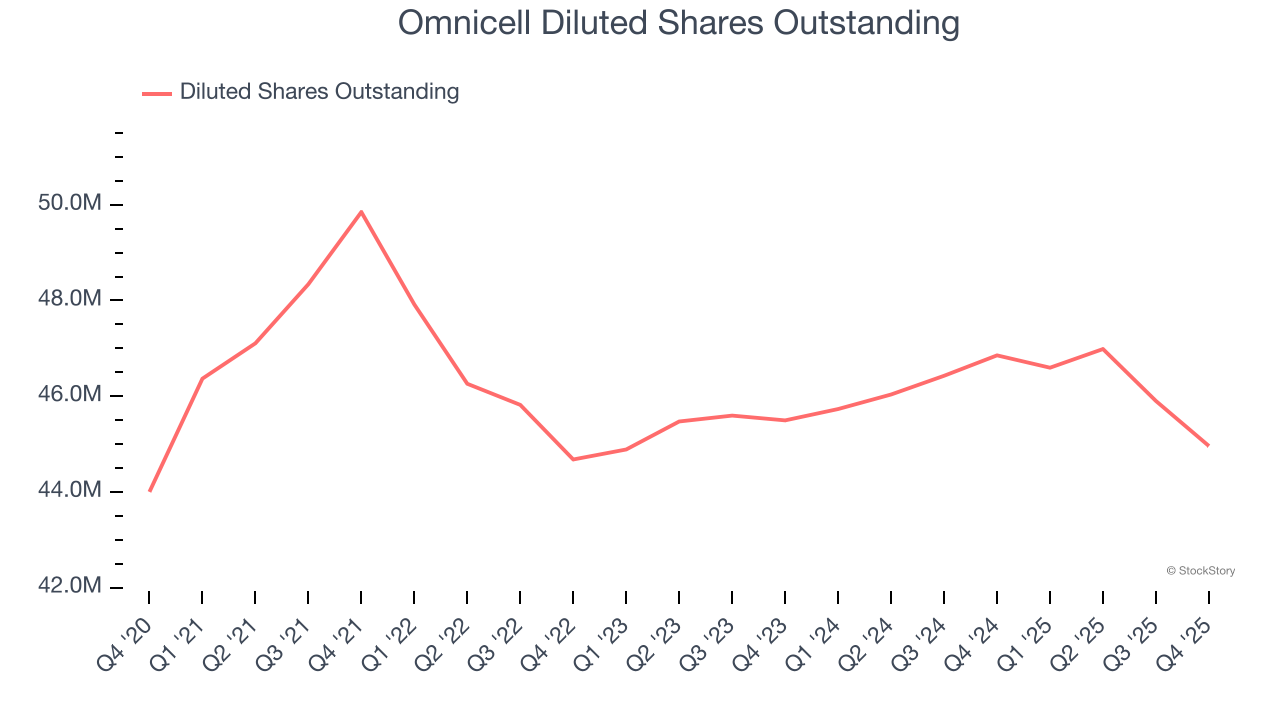
In Q4, Omnicell reported adjusted EPS of $0.40, down from $0.60 in the same quarter last year. This print missed analysts’ estimates. Over the next 12 months, Wall Street expects Omnicell’s full-year EPS of $1.62 to grow 16%.
Key Takeaways from Omnicell’s Q4 Results
We were impressed by Omnicell’s optimistic EBITDA guidance for next quarter, which blew past analysts’ expectations. We were also excited its EPS guidance for next quarter outperformed Wall Street’s estimates by a wide margin. On the other hand, its full-year EPS guidance missed and its EPS fell short of Wall Street’s estimates. Overall, this was a softer quarter. The stock remained flat at $46.72 immediately after reporting.
Big picture, is Omnicell a buy here and now? We think that the latest quarter is only one piece of the longer-term business quality puzzle. Quality, when combined with valuation, can help determine if the stock is a buy. We cover that in our actionable full research report which you can read here (it’s free).