
Freight transportation and logistics provider Saia (NASDAQ: SAIA) reported Q4 CY2025 results exceeding the market’s revenue expectations, but sales were flat year on year at $790 million. Its GAAP profit of $1.77 per share was 7% below analysts’ consensus estimates.
Is now the time to buy Saia? Find out by accessing our full research report, it’s free.
Saia (SAIA) Q4 CY2025 Highlights:
- Revenue: $790 million vs analyst estimates of $777 million (flat year on year, 1.7% beat)
- EPS (GAAP): $1.77 vs analyst expectations of $1.90 (7% miss)
- Adjusted EBITDA: $127 million vs analyst estimates of $135.3 million (16.1% margin, 6.1% miss)
- Operating Margin: 8.1%, down from 12.9% in the same quarter last year
- Free Cash Flow was $37.48 million, up from -$2.90 million in the same quarter last year
- Sales Volumes fell 1.5% year on year (10.1% in the same quarter last year)
- Market Capitalization: $10.88 billion
Saia President and CEO, Fritz Holzgrefe, commented on the quarter stating, “Results from our core business operations were in line with our expectations for the quarter. However, the quarter was impacted by unexpected adverse developments late in the quarter related to accidents that occurred in prior years, driving approximately $4.7 million in elevated self-insurance related costs. Excluding these costs, the performance in the quarter reflected our team’s strong commitment to customer service and disciplined execution despite a dynamic operating environment. Our team’s commitment to the customer was evidenced by our claims ratio of 0.47%, which was a record for any quarter in our company’s history.”
Company Overview
Pivoting its business model after realizing there was more success in delivering produce than selling it, Saia (NASDAQ: SAIA) is a provider of freight transportation solutions.
Revenue Growth
Reviewing a company’s long-term sales performance reveals insights into its quality. Any business can put up a good quarter or two, but many enduring ones grow for years. Over the last five years, Saia grew its sales at an excellent 12.2% compounded annual growth rate. Its growth beat the average industrials company and shows its offerings resonate with customers.
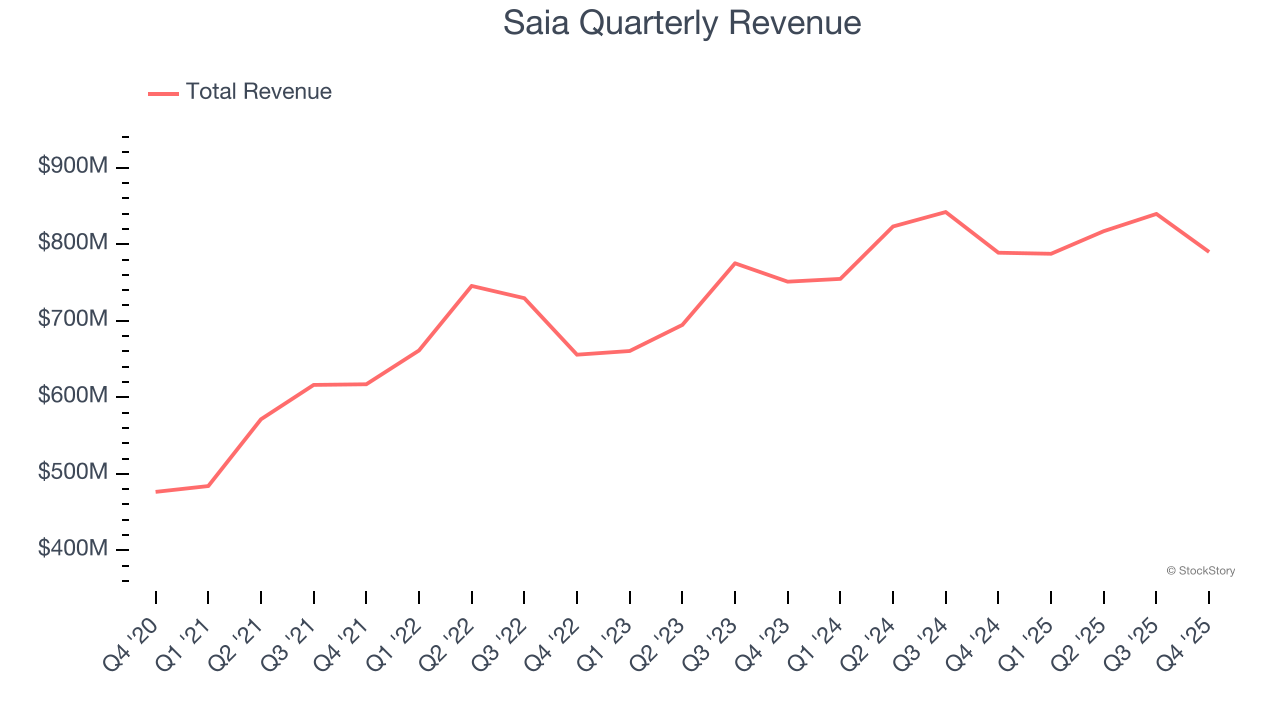
Long-term growth is the most important, but within industrials, a half-decade historical view may miss new industry trends or demand cycles. Saia’s recent performance shows its demand has slowed significantly as its annualized revenue growth of 5.9% over the last two years was well below its five-year trend. 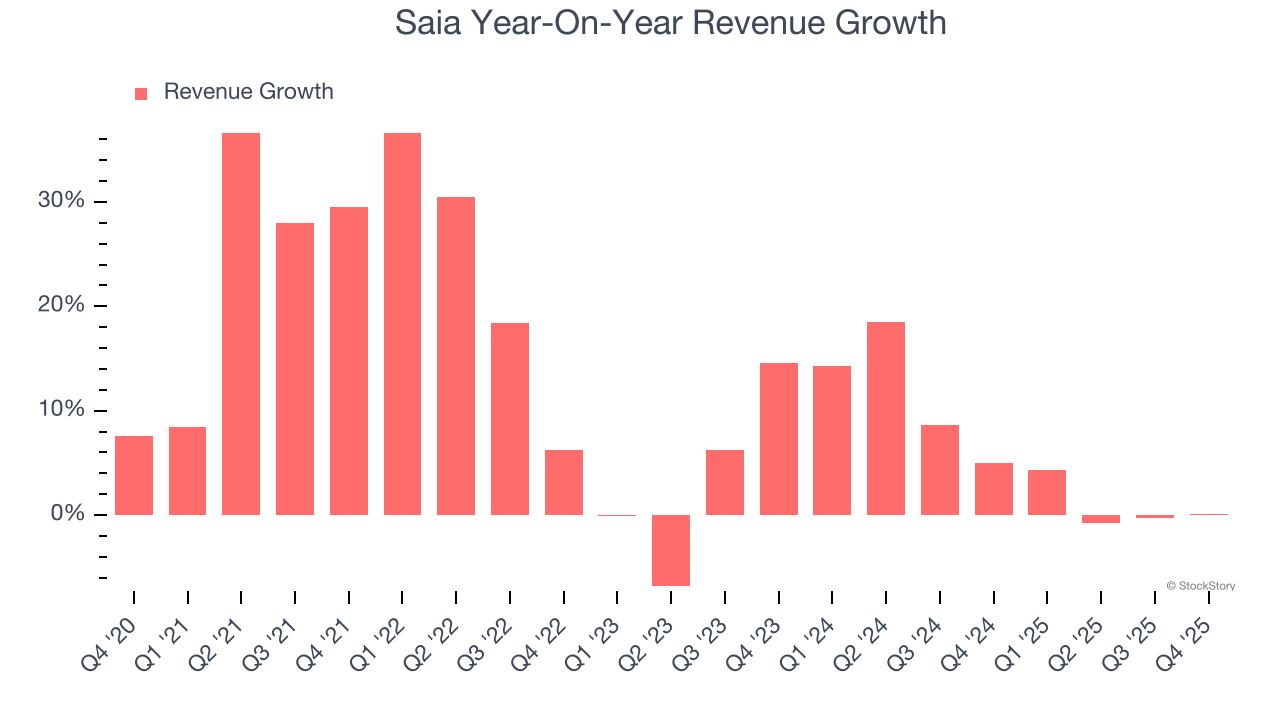
Saia also reports its number of tons shipped, which reached 1.46 million in the latest quarter. Over the last two years, Saia’s tons shipped averaged 5.6% year-on-year growth. Because this number is in line with its revenue growth, we can see the company kept its prices fairly consistent. 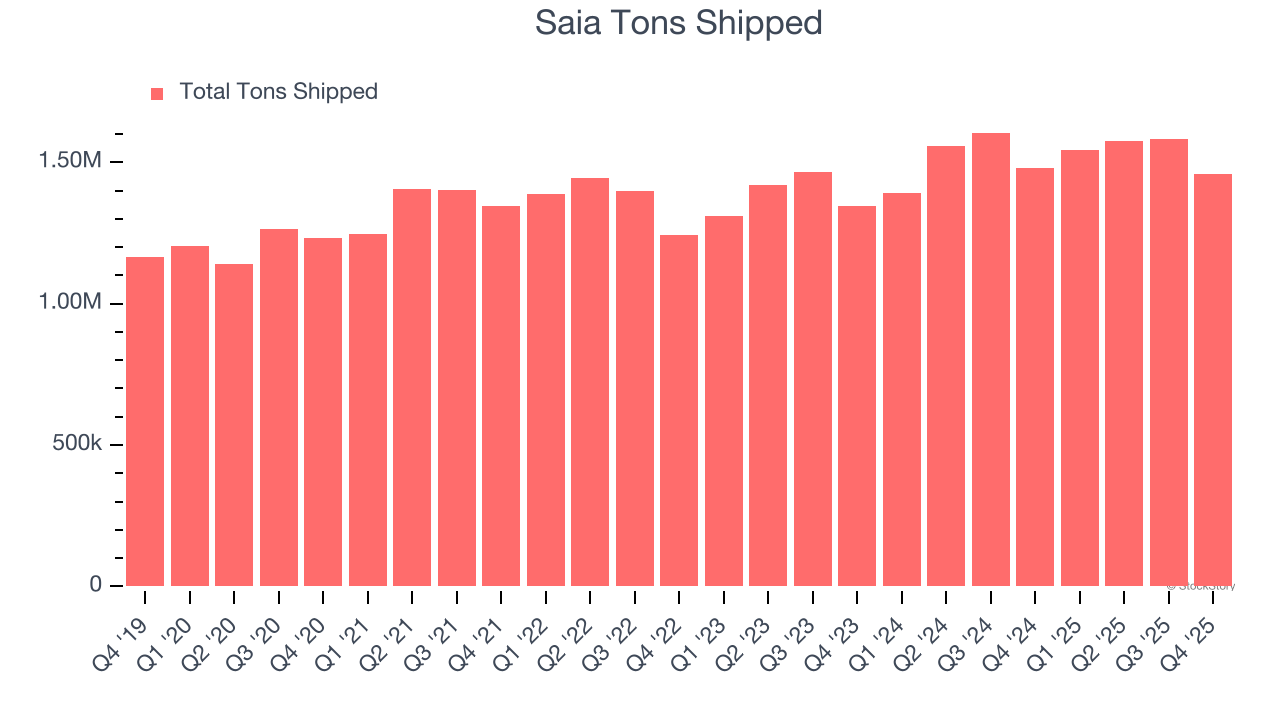
This quarter, Saia’s $790 million of revenue was flat year on year but beat Wall Street’s estimates by 1.7%.
Looking ahead, sell-side analysts expect revenue to grow 4.2% over the next 12 months, a slight deceleration versus the last two years. This projection doesn't excite us and implies its products and services will see some demand headwinds.
Microsoft, Alphabet, Coca-Cola, Monster Beverage—all began as under-the-radar growth stories riding a massive trend. We’ve identified the next one: a profitable AI semiconductor play Wall Street is still overlooking. Go here for access to our full report.
Operating Margin
Operating margin is an important measure of profitability as it shows the portion of revenue left after accounting for all core expenses – everything from the cost of goods sold to advertising and wages. It’s also useful for comparing profitability across companies with different levels of debt and tax rates because it excludes interest and taxes.
Saia has been an efficient company over the last five years. It was one of the more profitable businesses in the industrials sector, boasting an average operating margin of 14.6%. This result was particularly impressive because of its low gross margin, which is mostly a factor of what it sells and takes huge shifts to move meaningfully. Companies have more control over their operating margins, and it’s a show of well-managed operations if they’re high when gross margins are low.
Analyzing the trend in its profitability, Saia’s operating margin decreased by 3.8 percentage points over the last five years. This raises questions about the company’s expense base because its revenue growth should have given it leverage on its fixed costs, resulting in better economies of scale and profitability.
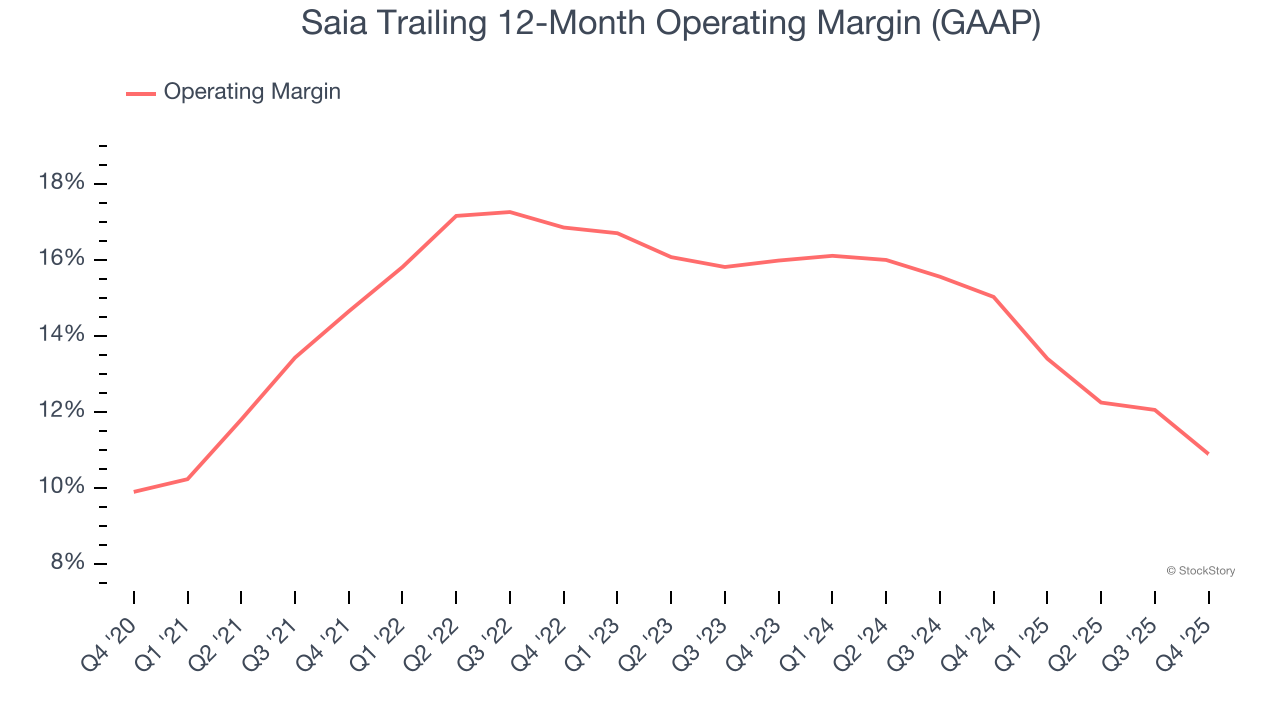
This quarter, Saia generated an operating margin profit margin of 8.1%, down 4.8 percentage points year on year. Since Saia’s operating margin decreased more than its gross margin, we can assume it was less efficient because expenses such as marketing, R&D, and administrative overhead increased.
Earnings Per Share
We track the long-term change in earnings per share (EPS) for the same reason as long-term revenue growth. Compared to revenue, however, EPS highlights whether a company’s growth is profitable.
Saia’s remarkable 12.8% annual EPS growth over the last five years aligns with its revenue performance. This tells us it maintained its per-share profitability as it expanded.
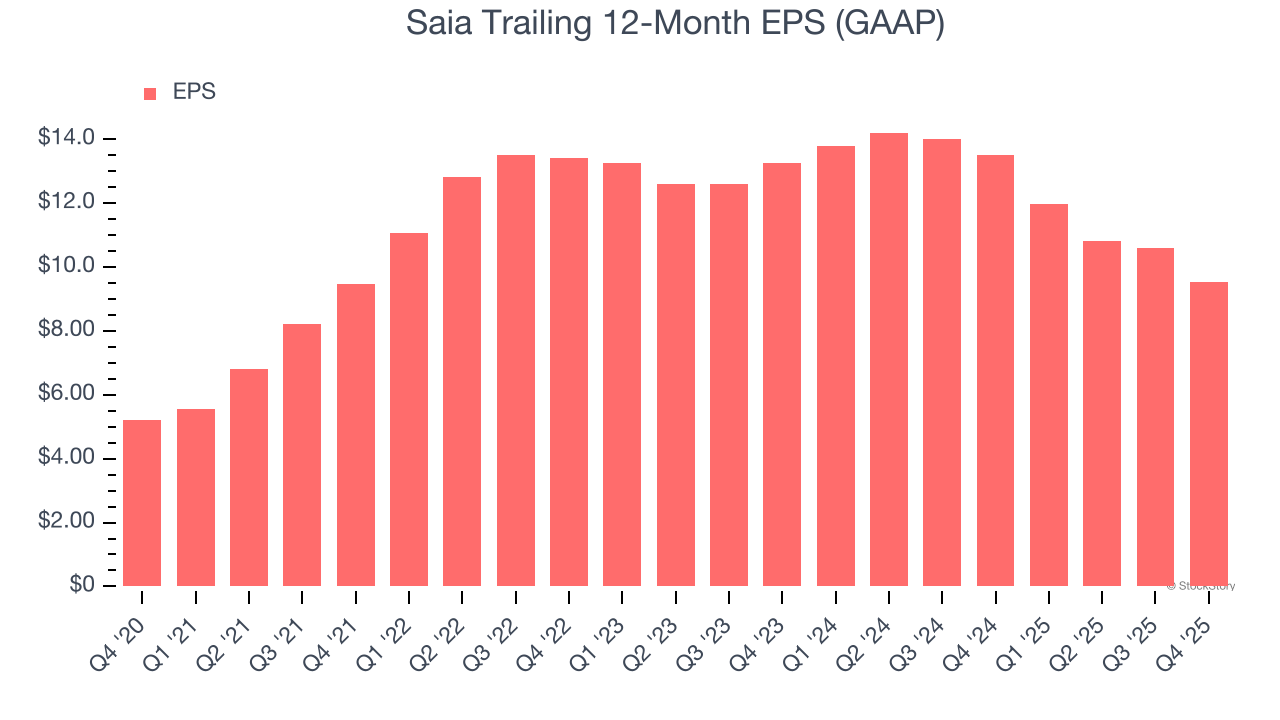
Like with revenue, we analyze EPS over a shorter period to see if we are missing a change in the business.
Saia’s two-year annual EPS declines of 15.3% were bad and lower than its 5.9% two-year revenue growth.
We can take a deeper look into Saia’s earnings to better understand the drivers of its performance. Saia’s operating margin has declined over the last two years. This was the most relevant factor (aside from the revenue impact) behind its lower earnings; interest expenses and taxes can also affect EPS but don’t tell us as much about a company’s fundamentals.
In Q4, Saia reported EPS of $1.77, down from $2.84 in the same quarter last year. This print missed analysts’ estimates, but we care more about long-term EPS growth than short-term movements. Over the next 12 months, Wall Street expects Saia’s full-year EPS of $9.52 to grow 12.2%.
Key Takeaways from Saia’s Q4 Results
It was encouraging to see Saia beat analysts’ revenue expectations this quarter. On the other hand, its EBITDA missed and its EPS fell short of Wall Street’s estimates. Overall, this quarter could have been better. The stock traded down 3% to $393.96 immediately after reporting.
Saia may have had a tough quarter, but does that actually create an opportunity to invest right now? What happened in the latest quarter matters, but not as much as longer-term business quality and valuation, when deciding whether to invest in this stock. We cover that in our actionable full research report which you can read here (it’s free).