SolarEnergies.ca announced the release of a new guide explaining how British Columbia residents can significantly cut their energy expenses and charge electric vehicles at minimal cost under BC Hydro’s Self-Generation program. The publication arrives at a moment of rising public curiosity, fueled by stories online claiming that homeowners with large electric trucks are powering their homes, driving daily, and still ending the year with a surplus payment from the utility. SolarEnergies.ca stated that such claims often reach British Columbia without context, creating confusion about what is possible under local rules and what requires careful sizing of solar equipment.
https://www.youtube.com/watch?v=O_nUf6K4_xY
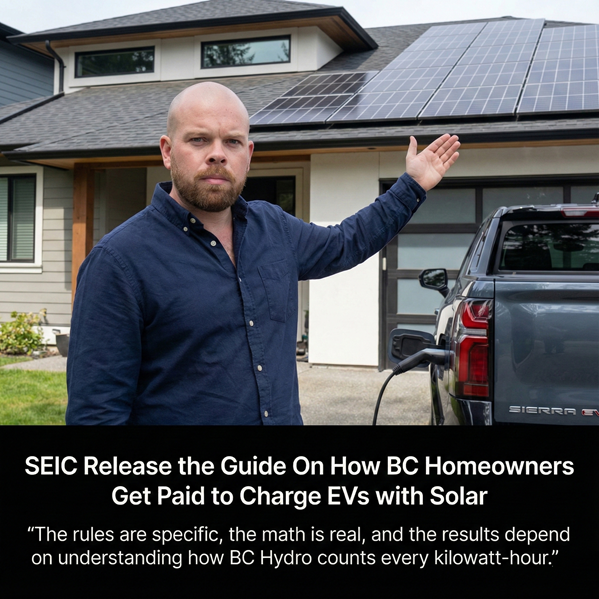
Vitaliy Lano, founder of SolarEnergies.ca and author of the guide, stated that the goal was “to provide clarity for families who feel overwhelmed by technical chatter and inconsistent information.” Lano commented that many residents approach the publication with frustration, saying they hear success stories but cannot confirm whether they apply in BC. He added that “the rules are specific, the math is real, and the results depend on understanding how BC Hydro counts every kilowatt-hour.” The guide, he said, aims to give residents the confidence to make informed decisions rather than rely on speculation.
The new release outlines the essential principle behind self-generation: exported power earns energy credits that offset imported power later in the year. SEIC reports that the exchange is close to one-for-one for the energy portion of the bill, while still requiring customers to pay the daily basic charge. Lano expressed that this straightforward mechanism “tends to get buried under layers of misunderstanding,” especially when stories originate from provinces with different incentive structures. He stated that “BC Hydro’s program rewards efficient planning, consistent household use, and proper sizing of solar arrays rather than oversized installations meant for resale.”
A central part of the guide highlights the case study adapted from a GMC Sierra EV owner who paired an 18kW solar array with a long daily commute. SEIC explained that heavy electric trucks regularly consume around 30 kWh per 100 kilometres under Canadian driving conditions, which leads to annual charging needs exceeding ten thousand kilowatt-hours. Lano noted that this consumption level “shifts the economics dramatically,” since a household with a high-use EV can offset a substantial amount of energy that would otherwise be purchased at retail rates. He added that oversizing panels purely to export power makes poor financial sense, while sizing panels to match a real EV load often offers strong payback.
The guide also introduces a key development that SEIC says homeowners have been waiting for: the updated Solar Panels Calculator. The tool provides instant, location-specific estimates using actual BC production data, roof angle considerations, system size definitions, and incentive calculations. Lano stated that “people want a clear answer without technical jargon. They want to know how many panels fit their roof, what their energy offset might look like, and what their monthly payment could become after rebates.” He commented that many families expressed relief when discovering that the calculator shows results in seconds rather than requiring a lengthy consultation. According to SEIC, the calculator reflects typical residential conditions and offers an honest range of likely outcomes rather than overly optimistic predictions.
Lano said that SEIC included the calculator because Canadian residents frequently misjudge the number of panels needed to offset both home usage and an EV. He suggested that the tool “bridges the gap between confusion and confidence” by giving homeowners a personal snapshot of their expected performance and investment. He added that the calculator integrates BC Hydro’s rebate structure, including the current offer of up to ten thousand dollars for qualifying solar and battery installations.
Lano emphasised that the updated guide and calculator are particularly timely after the closure of the federal Greener Homes Loan in 2025. Lano commented that “the loss of the interest-free loan created a feeling of uncertainty, but BC Hydro stepped forward with meaningful incentives that softened the initial investment.” He added that several banks continue offering green financing products, which many homeowners overlook. The guide encourages residents to ask lenders directly about eco-loan structures or solar-specific repayment plans.
The guide also compares BC’s results with those achievable in Alberta, Saskatchewan, and Ontario. Alberta’s Solar Club offers high export rates that create opportunities for income generation, while Saskatchewan’s lower credit rates and Ontario’s credit expiration rules limit long-term surplus value. Lano stated that “each province runs a different system, and residents should avoid drawing conclusions from success stories that operate under rules we simply do not have in BC.” He added that many residents feel empowered once they understand that BC’s strength lies in predictable savings and long-term stability rather than retail-rate energy sales.
The full guide and the free solar calculator are available on SEIC's website.
###
For more information about Solar Energies In Canada SEIC, contact the company here:
Solar Energies In Canada SEIC
Vitaliy Lano
2368680609
admin@solarenergies.ca