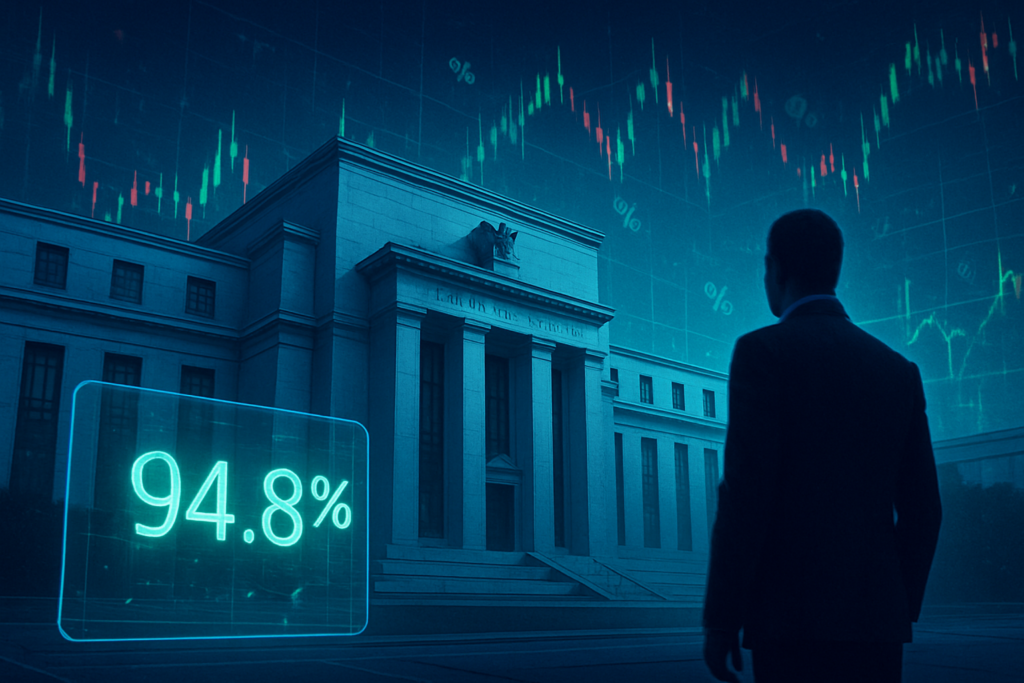
As the countdown to the end of Jerome Powell’s tenure at the Federal Reserve begins, prediction markets have reached a state of near-unanimity. Kevin Warsh, the former Fed Governor and long-time favorite of the Republican establishment, has emerged as the overwhelming frontrunner to be the next Chair of the Federal Reserve. According to data from Polymarket and CoinMarketCap, Warsh currently holds a commanding 94.8% probability of being nominated by President Donald Trump to lead the world’s most powerful central bank.
This market, which has seen hundreds of millions of dollars in trading volume, is generating intense interest because it signals more than just a personnel change; it represents a fundamental shift in the "Shadow Fed" strategy being deployed by the White House. With Powell’s term set to expire in May 2026, the market’s conviction suggests that the "Warsh era" has effectively begun months ahead of schedule, creating a unique "dual chair" dynamic that is already rippling through global bond and equity markets.
The Market: What's Being Predicted
The prediction market for the next Federal Reserve Chair has become one of the most liquid political events of the 2026 calendar. On Polymarket, the primary hub for crypto-native forecasting, the contract "Who will Trump nominate as Fed Chair?" has surpassed $432 million in total trading volume. Kevin Warsh’s "Yes" shares are currently trading at approximately 95 cents, mirroring the 94.8% figure seen on other aggregators.
While Polymarket dominates the retail and international space, Kalshi, the CFTC-regulated exchange, has seen a massive influx of institutional activity. Kalshi reported record-breaking participation in January 2026, with the Fed Chair contract maintaining a probability as high as 98%. The market is also seeing new liquidity from the Jupiter platform on the Solana blockchain, which recently integrated prediction market tools, allowing a wider range of retail traders to bet on the "Warsh Shock."
The resolution criteria for these markets are strictly defined: the market pays out once a formal nomination is sent to the U.S. Senate. While Trump announced his intention to nominate Warsh on January 30, 2026, the markets remain active as traders hedge against potential Senate confirmation hurdles or last-minute shifts in the President’s preference.
Why Traders Are Betting
The 94.8% probability isn't just a reflection of rumors; it is backed by a sequence of tactical moves from the White House. Traders shifted heavily toward Warsh after the President pivoted away from other high-profile candidates like Kevin Hassett, who was recently tapped to remain at the White House as Director of the National Economic Council, and Marc Rowan, the CEO of Apollo Global Management (NYSE: APO). While Rowan was a favorite for his "titan of industry" profile, prediction markets correctly sniffed out that his private equity ties might create too many conflict-of-interest hurdles in a closely divided Senate.
Notable "whale" activity has also solidified the odds. On-chain data has identified several multi-million dollar positions, including a legendary "French high-roller" on Polymarket and a strategic "insider" address on the Hyperliquid platform that realized significant gains by front-running the official announcement in late January.
Furthermore, traditional forecasting tools like the CME FedWatch tool from CME Group (NASDAQ: CME) have indirectly supported the Warsh narrative. As expectations for aggressive rate cuts in late 2026 grew to 94.8% in early January, traders deduced that Trump would want a Chair who—while historically hawkish—is perceived as more "market-sensitive" and "central casting" than the incumbent Powell.
Broader Context and Implications
The rise of Kevin Warsh is being interpreted by Wall Street as the beginning of a "Shadow Chair" period. Analysts at Goldman Sachs (NYSE: GS) and JPMorgan Chase (NYSE: JPM) have noted that a 95% market certainty effectively neuters Jerome Powell’s influence for the remainder of his term. JPMorgan (NYSE: JPM) has labeled this a "Shadow Policy Shift," arguing that the FOMC’s voting behavior may begin to tilt toward Warsh’s known preferences—specifically a more aggressive stance on balance sheet reduction—even before he takes the gavel.
This market also highlights the maturing of prediction markets as a geopolitical tool. Unlike 2020 or 2024, where these markets were often dismissed as "crypto-niche," the 2026 Fed Chair market has been cited by major financial news outlets as a primary source of truth. The high accuracy of these markets in predicting the Rowan-to-Warsh pivot has given them new-found legitimacy among institutional hedgers.
However, the real-world implications are stark. The "Warsh Shock" has already caused a "Great Metal Flush," with gold and silver prices retreating as investors price in a Fed that might prioritize price stability and a stronger dollar more aggressively than the Powell administration.
What to Watch Next
While the 94.8% probability suggests the race is over, two key factors could still inject volatility. First is the ongoing Department of Justice investigation into internal Fed operations. Some Republican Senators, including Thom Tillis, have hinted that Warsh’s confirmation could be delayed until the cloud over the current Fed leadership is cleared. If the confirmation process hits a snag, we could see Warsh’s odds dip back into the 80s as the market considers a "re-opening" of the shortlist.
Second, the market is closely watching the official Senate Banking Committee hearing schedule. Key dates in late February and early March will be critical milestones. Any sign of friction during the "vettings and greetings" phase on Capitol Hill will be immediately reflected in the contract prices. Traders should also monitor the Interactive Brokers (NASDAQ: IBKR) ForecastEx markets, which often attract the most conservative, professional-grade bets on regulatory outcomes.
Bottom Line
The prediction markets have spoken: the "Warsh Era" is no longer a question of "if," but "when." With a 94.8% probability, the markets are effectively treating the nomination as a settled fact, leaving only the logistics of confirmation and the timing of Jerome Powell’s exit to be determined.
This event serves as a masterclass in how prediction markets can serve as a leading indicator for institutional shifts. By the time traditional media outlets were reporting on the shortlist, Polymarket and Kalshi traders had already moved the needle, pricing in the transition weeks in advance. For investors, the takeaway is clear: the Fed is about to change its "aesthetic authority," and the markets are already trading the reality of a Kevin Warsh-led central bank.
This article is for informational purposes only and does not constitute financial or betting advice. Prediction market participation may be subject to legal restrictions in your jurisdiction.
PredictStreet focuses on covering the latest developments in prediction markets.
Visit the PredictStreet website at https://www.predictstreet.ai/.