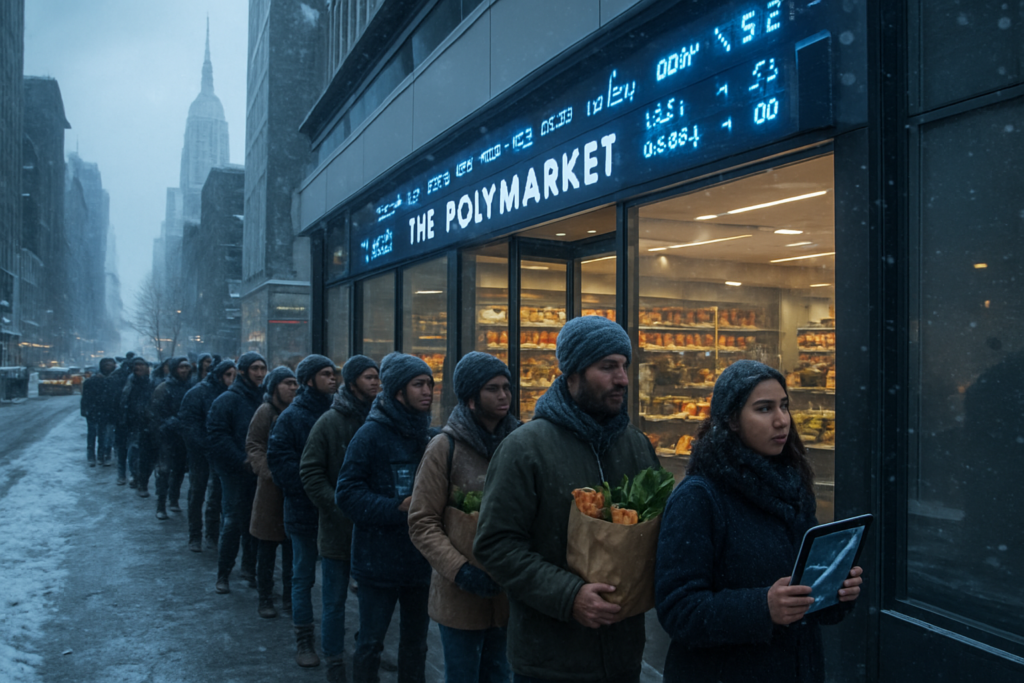
As of February 8, 2026, the intersection of decentralized finance and urban politics has reached a fever pitch in New York City. Prediction market giant Polymarket has announced a "free grocery store" pop-up in downtown Manhattan, a move that traders are betting will either be a masterstroke of PR or a regulatory lighting rod. Currently, markets on Polymarket and rival Kalshi are pricing in a 68% probability that the "The Polymarket" store will run out of stock before its scheduled closing on February 16, reflecting both the immense demand for free goods and the skepticism surrounding the logistics of this corporate-led "food sovereignty" experiment.
The event, which includes a massive $1 million donation to the Food Bank for NYC, is widely viewed by traders as a sardonic critique of the city's shifting political landscape. With the recent inauguration of Mayor Zohran Mamdani—a democratic socialist who campaigned on establishing city-run municipal grocery stores—the prediction markets are buzzing. Investors are not just betting on whether the milk stays on the shelves; they are wagering on whether this private-sector "flex" will successfully delegitimize the new administration's signature public policy before it even leaves the pilot phase.
The Market: What's Being Predicted
The primary market generating heat is "Will 'The Polymarket' run out of stock before Feb 15?", currently trading on Polymarket with high liquidity. Traders are also eyeing a secondary market on whether the NYC Department of Health will issue a "cease and desist" order to the pop-up before its five-day run concludes. Volume across these event-based contracts has surged to over $4.2 million in the last 48 hours, as New Yorkers and global speculators alike weigh the efficiency of "crypto-philanthropy" against the city’s notoriously stringent health and safety regulations.
Unlike traditional political betting, these markets are resolved based on verifiable on-the-ground outcomes. Resolution for the "stock-out" market depends on independent journalist verification and social media reports of empty shelves for more than four consecutive hours. Meanwhile, a "meta-market" has emerged regarding the user acquisition rates of prediction platforms: "Will Polymarket's NYC user base grow by >15% in Feb 2026?" This highlights the ultimate goal of the stunt—converting the visibility of the $1 million donation and the free store into a surge of new participants in the prediction ecosystem.
Why Traders Are Betting
Traders are leaning into the "logistical chaos" thesis. History shows that free giveaways in high-density urban areas like NYC often face overwhelming demand that outstrips even the most well-funded corporate budgets. The $1 million donation to the Food Bank for NYC—estimated to provide 10 million meals—adds a layer of legitimacy that makes some "Yes" bettors nervous, as it suggests Polymarket has secured the supply chain expertise of established nonprofits.
However, the political friction is the real driver of the "No" (shutdown) bets. Mayor Zohran Mamdani’s response to the stunt was a masterclass in sardonic politics. Quoting a viral Clickhole headline, Mamdani posted: "Heartbreaking: The Worst Person You Know Just Made A Great Point." While Mamdani acknowledges the desperate need for food security, his administration is reportedly wary of a private entity—especially one frequently at odds with the Commodity Futures Trading Commission (CFTC)—using hunger as a marketing tool. Traders are closely monitoring City Hall’s press briefings, looking for signs that the Department of Health might find a "technical violation" in the store’s refrigeration or labeling to shut down the mockery.
Broader Context and Implications
This stunt is a pointed jab at the legacy of former Mayor Eric Adams, whose failed "NYC Token" crypto-initiative left many in the tech sector frustrated by government-led blockchain experiments. By succeeding where the previous administration’s digital assets failed, Polymarket is attempting to prove a broader point: markets can provide immediate, tangible relief more efficiently than bureaucracy. This "free grocery" model is a direct challenge to the municipal grocery store pilot program, a $60 million initiative proposed by the Mamdani administration.
The real-world implications are stark. If Polymarket can operate a "frictionless" grocery store for five days without the administrative overhead of city-run programs, it strengthens the narrative that decentralized platforms can solve public goods problems. However, critics point out the temporary nature of the stunt. Unlike the proposed city stores, Polymarket’s pop-up is a five-day marketing budget line item, not a sustainable solution. This skepticism is reflected in the markets for "Mamdani’s Municipal Grocer Pilot Success", which have seen a slight dip in confidence as the public gets a taste of private-sector speed.
What to Watch Next
The key date to monitor is February 12, the store's opening day. If lines wrap around several city blocks, as expected, the "stock-out" probability will likely climb toward 80%. Conversely, if the Food Bank for NYC’s involvement ensures a steady replenishment of goods, we could see a massive "No" swing. Traders should also watch the social media accounts of the NYC Department of Health. Any mention of an unpermitted "distribution of perishables" could send the "Shutdown" market into a frenzy.
Furthermore, the competition between Polymarket and Kalshi is heating up. Kalshi recently countered with a $50-per-shopper giveaway at independent retailers, attempting to maintain its status as the "regulated" alternative. Any public company involvement, such as a logistics partnership with United Parcel Service, Inc. (NYSE: UPS) or a supply deal with a major distributor like Sysco Corporation (NYSE: SYY), could provide the store with the operational backbone needed to stay open, significantly moving the odds in the "No stock-out" direction.
Bottom Line
Polymarket’s "The Polymarket" pop-up is more than just a giveaway; it is a high-stakes experiment in brand positioning and political commentary. By putting $1 million on the line and mocking the mayor’s signature policy, the platform has turned the act of buying groceries into a tradable event. The markets currently favor a "chaotic success"—one where the store runs out of food due to overwhelming demand but succeeds in dominating the news cycle.
Ultimately, this event signals a new era for prediction markets, where platforms move beyond just predicting the news and start creating it to test their own market theories. Whether the store remains open or is shuttered by a wary City Hall, the real winner may be the prediction market format itself, which has once again proven its ability to capture the nuance of a complex, politically charged moment in real-time.
This article is for informational purposes only and does not constitute financial or betting advice. Prediction market participation may be subject to legal restrictions in your jurisdiction.
PredictStreet focuses on covering the latest developments in prediction markets.
Visit the PredictStreet website at https://www.predictstreet.ai/.