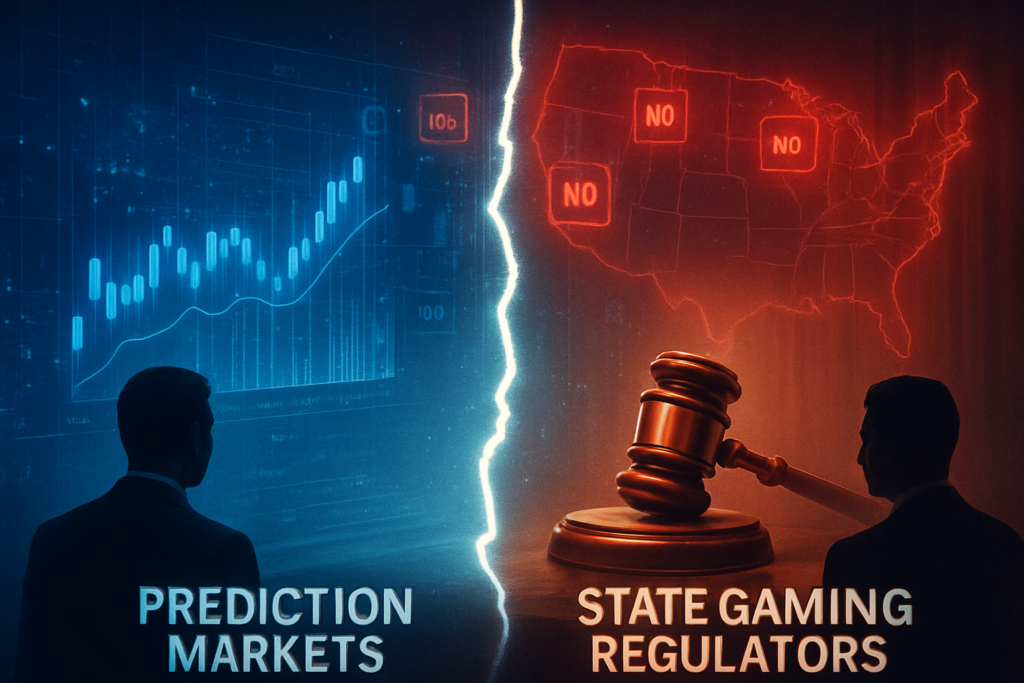
The high-stakes world of prediction markets is currently facing its most existential threat since the landmark 2024 election cycle. As of February 8, 2026, Kalshi—the first federally regulated prediction market—is locked in what legal scholars are calling a "guerrilla war" with state gaming regulators in Massachusetts, Nevada, and Connecticut. At the heart of the conflict is a fundamental disagreement over the definition of a "contract": Is an event-based prediction a federally protected financial derivative, or is it simply unlicensed gambling?
Traders are closely watching the fallout, with current market sentiment on peer-to-peer forecasting platforms shifting rapidly. While Kalshi dominated the late 2024 and early 2025 volume cycles, the threat of state-mandated geofencing has caused its probability of maintaining volume leadership for 2026 to slip. For the first time in two years, decentralized rival Polymarket has overtaken Kalshi in "Total 2026 Volume" odds, with traders pricing in a 47% chance for the offshore platform to lead the year, compared to Kalshi’s 34%, as regulatory "indigestion" begins to take its toll on domestic liquidity.
The Market: What’s Being Predicted
The primary market under the microscope isn't just a single event contract, but the survival and growth of the regulated prediction market industry itself. Specifically, traders are betting on whether Kalshi can successfully maintain its dominance in the "Sports Event Contract" sector—a category that accounted for a staggering 91.1% of its $9.1 billion trading volume in January 2026.
On Kalshi’s own platform and institutional dashboards like those offered by Interactive Brokers (NASDAQ: IBKR), liquidity has become fragmented as state-level injunctions take effect. The resolution of this legal friction hinges on several key criteria: the ability of Kalshi to overturn state-level cease-and-desist orders and whether the federal government will intervene to assert preemption over state "police powers." If Kalshi is forced to geofence more than 10 states by the end of Q3 2026, analysts expect a "liquidity crater" that could permanently hand the crown to decentralized competitors.
Why Traders Are Betting
The sudden bearishness on Kalshi’s 2026 outlook stems from a series of legal setbacks in early 2026. In late January, Judge Christopher K. Barry-Smith of the Suffolk County Superior Court granted a preliminary injunction in Commonwealth of Massachusetts v. KalshiEX LLC, ruling that Kalshi’s sports-related contracts constitute "unlicensed gambling." The judge’s observation that the interface "mirrors digital gambling experiences" has terrified bulls who believed federal CFTC regulation provided a "bulletproof vest" against state gaming commissions.
Whale activity has notably shifted toward defensive positions. Large-scale traders are hedging their domestic exposure by moving capital into macro-focused exchanges like ForecastEx, operated by Interactive Brokers (NASDAQ: IBKR), which focuses on non-sports contracts like CPI and interest rates to avoid the "gambling" label. Meanwhile, Robinhood (NASDAQ: HOOD), which previously partnered with Kalshi to offer event markets to its retail base, has seen its stock price face volatility as it weighs the risks of its own upcoming proprietary exchange launch, LedgerX.
Broader Context and Implications
This "guerrilla war" represents a classic clash between federal and state authority. While Kalshi remains a Designated Contract Market (DCM) under the oversight of the Commodity Futures Trading Commission (CFTC), states are utilizing the "Gaming Clause" of the Commodity Exchange Act to argue that federal law does not extinguish their right to regulate wagering. This has created a "phantom liquidity" scenario—where national price discovery exists in theory, but is physically blocked for millions of Americans via geofencing.
The real-world implications are profound. If state regulators succeed in reclassifying these markets as gambling, the dream of a unified, high-liquidity national prediction market may die. Instead, the industry would be forced into the fragmented, state-by-state licensing model used by sportsbooks like DraftKings or FanDuel. Furthermore, Coinbase (NASDAQ: COIN) has entered the fray, proactively suing regulators in Connecticut and Illinois to defend the federal preemption of blockchain-based prediction products, signaling that the entire crypto and fintech ecosystem sees this as a do-or-die moment for digital assets.
What to Watch Next
The most immediate catalyst for the market is a high-stakes hearing in Connecticut scheduled for February 12, 2026. Traders view this as a pivotal test for the "federal preemption" defense; a defeat for Kalshi here is expected to trigger a domino effect of geofencing across the Northeast.
Beyond February, the Ninth Circuit Court of Appeals is scheduled to hear oral arguments in KalshiEX LLC v. Nevada Gaming Control Board in April 2026. This case is particularly significant because Nevada is the epicenter of American gambling regulation. If Kalshi wins in the Ninth Circuit, it could provide the legal precedent needed to halt the state-level "guerrilla war" and restore investor confidence. Conversely, a loss would likely cement Kalshi's status as a regional, rather than national, player for the remainder of the year.
Bottom Line
The legal friction between Kalshi and state gaming commissions has transformed the prediction market landscape from a "blue ocean" of growth into a jurisdictional battlefield. While Kalshi’s $9.1 billion volume in January shows the massive appetite for regulated event contracts, the 91.1% concentration in sports contracts has left the platform uniquely vulnerable to state regulators who view any "win-loss" outcome as their exclusive domain.
Ultimately, the 2026 volume leadership race is no longer just about who has the better app or more markets—it is about who can navigate the complex web of American federalism. If Kalshi cannot secure a "preemption victory" in the coming months, the prediction market industry may face a Great Bifurcation: a regulated, institutional market for macro events, and a decentralized, offshore market for everything else. For now, the "guerrilla war" continues, and the odds of a Kalshi-dominated 2026 are narrowing by the day.
This article is for informational purposes only and does not constitute financial or betting advice. Prediction market participation may be subject to legal restrictions in your jurisdiction.
PredictStreet focuses on covering the latest developments in prediction markets.
Visit the PredictStreet website at https://www.predictstreet.ai/.