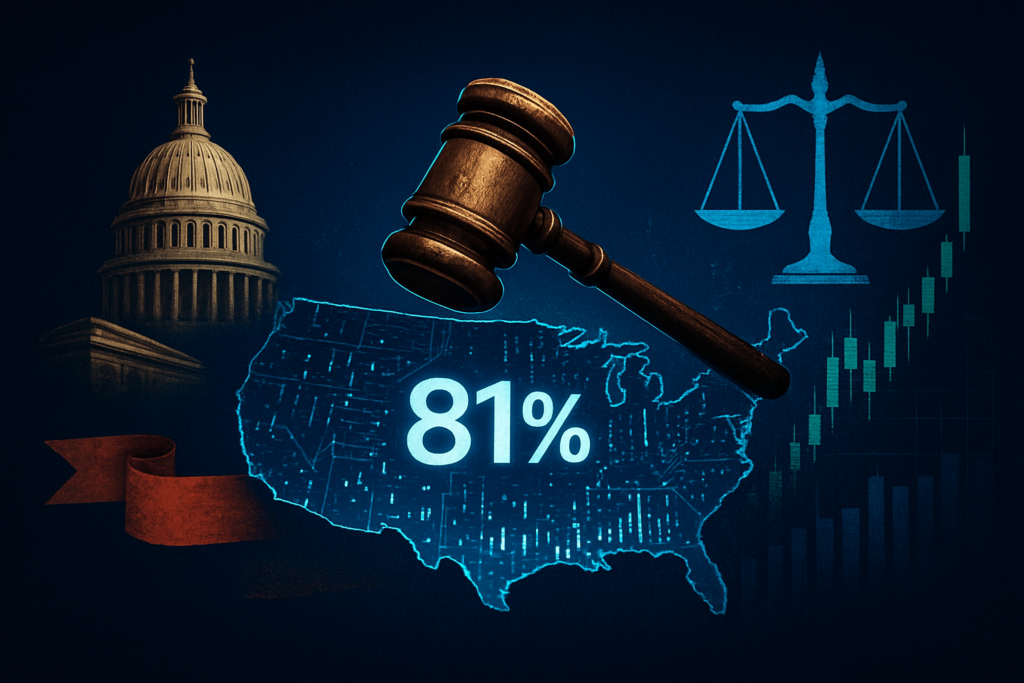
As the legal landscape for prediction markets enters its most volatile phase yet, a "Shadow Market" on the forecasting platform Manifold Markets has become the ultimate barometer for the industry's survival. Traders are currently placing an overwhelming 81% probability on a scenario where federal preemption—the legal doctrine that federal law overrides state law—will shield prediction markets from a growing wave of state-level bans.
This surge in confidence comes at a critical juncture. While state regulators in New York and Massachusetts have launched aggressive campaigns to shutter "event contract" trading, the market sentiment suggests a "knockout blow" from the federal judiciary is imminent. With a landmark ruling expected from the Third Circuit and a newly reformulated Commodity Futures Trading Commission (CFTC) taking a hands-off approach, the "Shadow Market" is signaling that the era of the state-by-state "gambling" label for prediction markets may be nearing its end.
The Market: What's Being Predicted
The specific contract driving this conversation is hosted on Manifold Markets, titled "Will Federal Preemption Protect DCMs from State Bans by End of 2026?" Because regulated exchanges like Kalshi and Interactive Brokers Group, Inc. (NASDAQ: IBKR) are legally restricted from listing contracts that speculate on their own regulatory status—to avoid self-referential conflicts of interest—Manifold has filled the void. This "Shadow Market" allows participants to trade on the legal fate of the entire industry using Manifold’s "Mana" currency, which often serves as a leading indicator for real-money sentiment.
Currently trading at 81%, the odds have climbed significantly from just 55% in late 2024. The market has seen a spike in volume over the last 48 hours, following a series of conflicting rulings in state courts. The resolution criteria for this market are strict: it requires either a definitive U.S. Supreme Court ruling or a federal appellate court decision that explicitly invokes the Supremacy Clause to strike down a state-level ban on a federally registered Designated Contract Market (DCM).
Liquidity in this Shadow Market has reached record highs, with over 1.5 million Mana traded. Professional "arbs" and legal analysts are increasingly using this market to hedge their exposure on regulated platforms. If the 81% probability holds true, it suggests that the industry is one court case away from achieving the same national regulatory status enjoyed by the stock and options markets.
Why Traders Are Betting
The bullish sentiment is largely driven by a pivot in federal strategy. Under the leadership of Chairman Michael Selig, who was confirmed in December 2025, the CFTC has abandoned the adversarial stance of the previous administration. In a historic move in mid-2025, the CFTC dropped its appeal in the Kalshi v. CFTC case, effectively conceding that the agency does not have a blanket mandate to ban political election markets. This federal "truce" has left state regulators as the primary antagonists, and traders believe the states are overplaying their hand.
Recent events have only strengthened this conviction. While a Massachusetts judge issued a preliminary injunction against Kalshi on January 20, 2026, many traders viewed this as a "last gasp" for state-level resistance. The logic among the "81% crowd" is that a DCM—a federally licensed entity—cannot be subjected to 50 different sets of state gambling laws. They argue that once a contract is approved at the federal level, the Supremacy Clause of the U.S. Constitution prevents states from "de-authorizing" it.
Furthermore, the entry of major retail players into the space has changed the political calculus. Companies like Robinhood Markets, Inc. (NASDAQ: HOOD) and Coinbase Global, Inc. (NASDAQ: COIN) have joined the Coalition for Prediction Markets, lobbying for the "Safe Harbor Act of 2026." This proposed legislation would provide permanent federal protection from state-level interference, and traders are betting heavily that the bill will find a path through Congress given the bipartisan interest in the data these markets provide.
Broader Context and Implications
This battle mirrors the historical struggle of the sports betting industry following the repeal of PASPA, but with a crucial difference: prediction markets are being framed as financial hedging tools rather than gambling. If federal preemption is upheld, it will treat a contract on the Consumer Price Index or a presidential election the same way the law treats a soybean future or a share of Apple stock.
The real-world implications of an 81% probability are staggering. A victory for federal preemption would likely trigger a massive influx of institutional capital. Currently, many hedge funds are sidelined by the "patchwork" of state laws, fearing that a position legal in Delaware might be deemed an "illegal wager" in New York. A unified federal standard would clear the path for prediction markets to become a standard asset class in diversified portfolios.
Moreover, this market reveals a profound shift in public sentiment. The "Shadow Market" traders are not just betting on the law; they are betting against the ability of state "vice laws" to contain digital, borderless financial innovation. The historical accuracy of Manifold’s legal shadow markets has been remarkably high, correctly predicting the outcome of the Loper Bright decision and the initial Kalshi victory in 2024 long before traditional pundits caught on.
What to Watch Next
The most immediate catalyst for this market is the pending ruling from the Third Circuit Court of Appeals regarding a New Jersey challenge to federal jurisdiction. A pro-preemption ruling there would likely push the Manifold odds into the 90% range, as New Jersey is a traditionally influential venue for gaming and financial law.
Investors should also keep a close eye on the "ORACLE Act" in New York. Introduced on January 7, 2026, this bill is a "scorched-earth" attempt to ban all prediction market trading within the state. If the bill passes but is immediately stayed by a federal judge, it will serve as the perfect "test case" for the preemption doctrine. Any movement on this bill in the Albany legislature will cause immediate volatility in the Shadow Market.
Finally, the role of the Supreme Court cannot be ignored. While traders are currently betting that the appellate courts will resolve the issue, any signal that SCOTUS intends to take up a case on the "DCM vs. State Gambling Law" conflict would create a massive liquidity event. Legal experts are monitoring the docket for any "Certiorari" filings that could redefine federalism for the 21st-century digital economy.
Bottom Line
The 81% probability on Manifold’s Shadow Market represents a high-conviction bet that the federal government—not the states—will ultimately hold the keys to the prediction market industry. It reflects a growing consensus that these markets are essential pieces of financial infrastructure that cannot be governed by the fragmented, archaic rules of state-level gaming commissions.
As a tool for insight, the Shadow Market has proven that "skin in the game" offers a clearer view of the legal horizon than partisan commentary. While the "resistance" from states like New York and Massachusetts remains a headwind, the markets suggest that the legal foundation for a unified, national prediction market is being laid in real-time.
Ultimately, if the traders are right, the resolution of this conflict will mark the beginning of a new era for American finance—one where the collective intelligence of the crowd is protected by the highest laws of the land.
This article is for informational purposes only and does not constitute financial or betting advice. Prediction market participation may be subject to legal restrictions in your jurisdiction.
PredictStreet focuses on covering the latest developments in prediction markets.
Visit the PredictStreet website at https://www.predictstreet.ai/.