CARACAS/NEW YORK — On January 3, 2026, at 4:21 a.m. EST, a post on Truth Social, the platform owned by Trump Media & Technology Group (NASDAQ: DJT), sent shockwaves across the globe: Venezuelan strongman Nicolás Maduro had been captured by U.S. special operations forces in "Operation Absolute Resolve." While the world grappled with the geopolitical fallout of the regime's collapse, a more localized explosion was occurring on the blockchain-based prediction platform Polymarket.
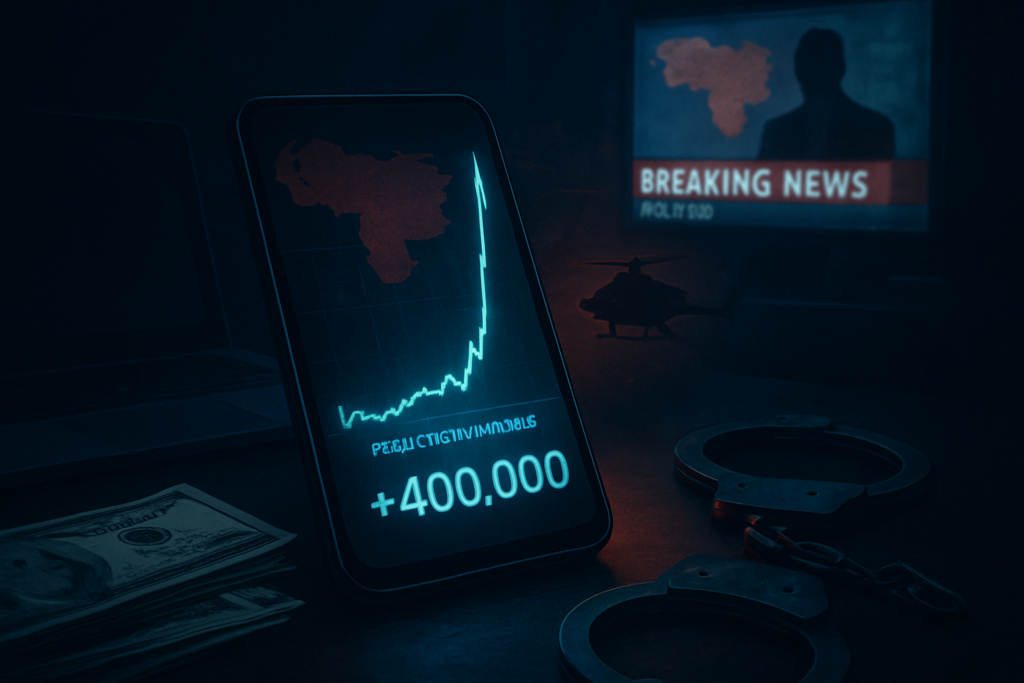
Just hours before the first official confirmation of the capture, a single anonymous trader turned a $32,000 gamble into a staggering $436,000 windfall. The "pitch-perfect" timing of the wager has ignited a firestorm of controversy, with critics alleging that the trade was not a feat of "crowd wisdom," but a blatant case of insider trading using classified military intelligence. As the dust settles on the streets of Caracas, the focus is shifting to Washington, where regulators are facing renewed pressure to police the "Wild West" of geopolitical betting.
The Market: What's Being Predicted
The specific contract at the center of the storm was titled "Will Nicolás Maduro be out of office by January 31, 2026?" For months, this market had been a niche corner of Polymarket, with the "Yes" shares trading at a dismal $0.05 to $0.08—implying less than a 10% chance of a transition of power. Trading volume remained steady but unremarkable until the final week of December 2025.
As the clock ticked toward the New Year, the market's liquidity deepened significantly. Total volume on Maduro-related contracts surpassed $15 million across Polymarket and its regulated competitor Kalshi. However, while Kalshi—which operates under the oversight of the Commodity Futures Trading Commission (CFTC)—saw odds hover around 13% based on public reports of civil unrest, Polymarket experienced a sudden, violent surge in "Yes" buying in the pre-dawn hours of January 3.
The resolution criteria for the market were straightforward: Maduro had to be physically removed from power, resign, or be captured by a foreign entity. While the "Out of Office" market resolved quickly in favor of "Yes" holders, a sister market regarding a "U.S. Invasion of Venezuela" has remained frozen in a $10.5 million legal limbo. Polymarket’s oracle has so far refused to pay out the "Invasion" contracts, arguing that a "snatch-and-extract" mission does not meet the technical definition of an invasion intended to occupy territory—a move that has left many retail traders feeling cheated by the "house."
Why Traders Are Betting
The focus of the investigation is an account originally named "Burdensome-Mix," which was created on December 26, 2025. Blockchain forensics provided by firms such as Chainalysis reveal that the account was funded via a direct transfer from Coinbase Global, Inc. (NASDAQ: COIN), suggesting the trader made little effort to hide their identity behind privacy mixers.
Between midnight and 2:00 a.m. on the day of the capture, "Burdensome-Mix" aggressively purchased nearly 500,000 "Yes" shares. "This wasn't a hedge or a speculative play," noted one high-volume trader on the platform. "This was someone who knew the helicopters were already in the air." By the time the Truth Social announcement went live, the trader's $32,537 investment had ballooned to nearly half a million dollars.
Analysts point to the sharp divergence between Polymarket and traditional forecasting as evidence of an information leak. While intelligence agencies and political pundits were still debating the likelihood of a coup, the prediction market "knew" something was coming. This has raised the uncomfortable possibility that U.S. military personnel, intelligence officers, or high-level administration officials may be using prediction markets as a "tax-free bonus" system to profit from secret state actions.
Broader Context and Implications
The Maduro windfall has become a defining moment for the prediction market industry. For years, proponents have argued that these markets are the most accurate way to aggregate disparate information and predict the future. However, if that information is sourced from classified briefings rather than public analysis, the "wisdom of the crowd" becomes a mask for corruption.
The political backlash was instantaneous. On January 9, 2026, Representative Ritchie Torres (D-N.Y.) introduced the Public Integrity in Financial Prediction Markets Act of 2026. The bill aims to close the "geopolitical loophole" by criminalizing the use of non-public material information by federal employees to trade on prediction platforms. "If you have a security clearance, you shouldn't have a Polymarket account," Torres told reporters on Capitol Hill.
Furthermore, the incident has highlighted the jurisdictional "gray zone" of Polymarket. Because the platform technically bars U.S. users, it often escapes the direct reach of the CFTC. However, the use of U.S.-based exchanges like Coinbase to fund these accounts provides a potential hook for federal investigators. Senate leaders have already sent a formal letter to CFTC Chairman Michael Selig demanding an investigation into whether the platform is being used to facilitate money laundering or insider trading by government actors.
What to Watch Next
The immediate future of prediction markets depends on the outcome of two major investigations. First, the CFTC is expected to issue a report on the Maduro trades by the end of Q1 2026. If they find evidence that the "Burdensome-Mix" trader had ties to the U.S. government, it could lead to a permanent ban on geopolitical event contracts in the United States.
Second, the "Invasion vs. Capture" dispute is headed for a potential class-action lawsuit. The $10.5 million in locked funds represents a significant portion of Polymarket’s current liquidity. If the platform is forced to pay out to "Invasion" bettors, it could face a liquidity crunch; if it refuses, it risks losing the trust of the very community that fuels its growth.
Traders should also monitor the progress of the Torres Bill in the House Financial Services Committee. If passed, it would represent the first major legislative framework specifically targeting prediction market ethics, potentially forcing platforms to implement "Know Your Customer" (KYC) protocols that check for government employment and security clearances.
Bottom Line
The capture of Nicolás Maduro should have been a triumphant moment for prediction markets—proof that they can signal world-changing events before the traditional media. Instead, the "Burdensome-Mix" trade has left the industry defending its very existence. The line between "superior analysis" and "insider information" has blurred to the point of invisibility, creating an existential crisis for decentralized forecasting.
As we move further into 2026, the Maduro scandal serves as a warning: when the stakes are global and the information is classified, prediction markets may not be reflecting the wisdom of the crowd so much as the secrets of the few. Whether the industry can survive this transition from a niche hobby to a high-stakes geopolitical tool remains to be seen.
This article is for informational purposes only and does not constitute financial or betting advice. Prediction market participation may be subject to legal restrictions in your jurisdiction.
PredictStreet focuses on covering the latest developments in prediction markets.
Visit the PredictStreet website at https://www.predictstreet.ai/.