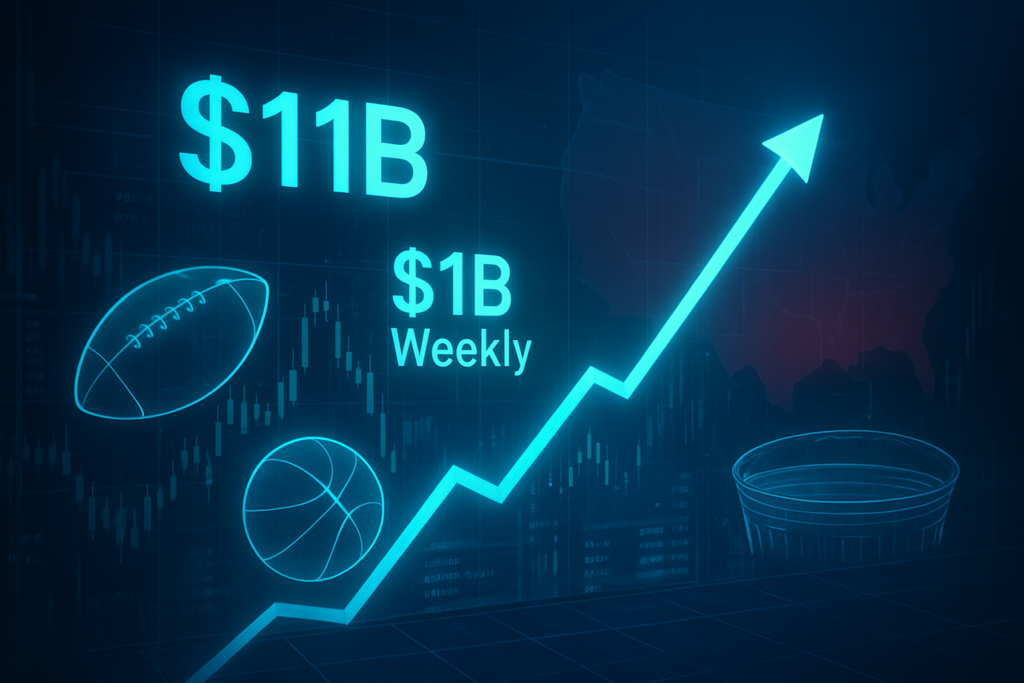
The rapid evolution of prediction markets has reached a fever pitch as Kalshi, the first federally regulated exchange for event contracts, officially reached "decacorn" status this month. With a fresh $11 billion valuation and weekly trading volumes consistently surpassing the $1 billion mark, the platform has transformed from a niche economic forecasting tool into a dominant force in the global wagering landscape. However, this meteoric rise has placed Kalshi directly in the crosshairs of state regulators, sparking a legal battle that could redefine the boundaries between financial commodities and sports gambling.
The surge in activity marks a significant shift in the prediction market ecosystem. While the 2024 U.S. elections served as the initial catalyst for mainstream adoption, Kalshi’s sustained growth into early 2026 is being driven by a strategic pivot into sports event contracts. Traders are no longer just betting on interest rate hikes or election outcomes; they are high-frequency trading the point spreads of NFL games and the over/under of NBA totals, all through a platform regulated by the Commodity Futures Trading Commission (CFTC).
The Market: Kalshi’s Explosive Growth and Dominance
In December 2025, Kalshi solidified its position as a market leader by closing a massive $1.1 billion Series E funding round. This capital injection, led by the crypto-focused venture firm Paradigm and supported by heavyweights like Sequoia Capital and Alphabet Inc. (NASDAQ: GOOGL) via its growth fund CapitalG, valued the exchange at a staggering $11 billion. Other participants included Andreessen Horowitz, ARK Invest (NYSE Arca: ARKK), and IVP, signaling broad institutional confidence in the "everything market" model.
The valuation is backed by eye-popping performance metrics. By the final week of December 2025, Kalshi reported a record-breaking $1.7 billion in notional trading volume. Daily volumes have also seen a dramatic uptick, with the platform recording approximately $291 million on January 1, 2026, alone. This represents an 1,100% year-over-year increase, largely fueled by the platform's expansion into sports. Unlike traditional sportsbooks, Kalshi’s contracts are structured as binary options, allowing for unique hedging strategies and price discovery that mimic traditional financial markets.
Why Traders Are Betting: The Retail Revolution
The primary driver behind Kalshi’s volume explosion is its aggressive integration with retail trading platforms and media giants. Kalshi has successfully moved beyond its own app by embedding its markets into the interfaces of Robinhood Markets, Inc. (NASDAQ: HOOD) and Coinbase Global, Inc. (NASDAQ: COIN). This "brokerage-as-a-service" model allows millions of retail investors to trade event contracts alongside their stocks and cryptocurrencies, lowering the barrier to entry for a new generation of traders.
Furthermore, Kalshi has effectively institutionalized prediction market data through exclusive partnerships with major news networks. Starting in January 2026, live market odds from Kalshi have become a staple on Warner Bros. Discovery (NASDAQ: WBD)'s CNN and Comcast Corporation (NASDAQ: CMCSA)'s CNBC. These integrations provide real-time, market-based sentiment on everything from corporate earnings to playoff outcomes, creating a self-reinforcing loop of visibility and trading activity. For many traders, the transparency of an order-book-based exchange offers a more "fair" alternative to the opaque "vig" of traditional sportsbooks.
Broader Context and Implications: The 38-State Legal Firestorm
Despite its commercial success, Kalshi is facing an existential legal challenge. A coalition of 38 states and the District of Columbia recently filed a joint amicus brief in the ongoing case of Maryland vs. Kalshi. The states argue that Kalshi’s sports contracts are "functionally indistinguishable" from sports wagering and should therefore fall under state-level gambling regulations rather than federal CFTC oversight. This coalition, which includes major markets like California and New York, contends that Kalshi is bypassing state taxes and consumer protection laws.
The tension reached a breaking point on January 20, 2026, when a Massachusetts judge granted a preliminary injunction against the exchange. The ruling effectively bans Kalshi from offering sports event contracts in the state starting January 23, 2026. This is the first major state-level ban to take effect, creating a fragmented legal landscape where Kalshi may be legal in New Jersey (where it recently won a stay against a cease-and-desist) but prohibited in neighboring states. The outcome of these battles will determine if prediction markets can coexist with the traditional gaming industry or if they will be relegated back to strictly economic and political events.
What to Watch Next
The coming months will be pivotal for Kalshi's $11 billion valuation. Investors and traders are closely watching the Maryland vs. Kalshi case, as a final ruling there could set a precedent for other states in the 38-member coalition. If Maryland successfully argues that state gaming laws supersede CFTC regulation for sports contracts, Kalshi could face a wave of "geofencing" requirements, significantly impacting its liquidity and volume.
Another key milestone is the potential for further integration with daily fantasy sports (DFS) platforms. Kalshi’s existing partnership with PrizePicks has already expanded its reach, and rumors of a deeper tie-up with other major DFS operators could further bolster volumes. However, these moves will likely attract even more scrutiny from powerful tribal gaming groups and established casino operators who view Kalshi’s growth as a direct threat to their regulated monopolies.
Bottom Line
Kalshi has successfully proven that there is a massive appetite for a "market for everything," bridging the gap between Wall Street and Main Street through the gamification of real-world outcomes. Reaching an $11 billion valuation and $1 billion in weekly volume is a testament to the platform's technical scale and the public's desire for transparent, high-liquidity prediction markets.
However, the "State vs. Federal" jurisdictional battle looms large. While Kalshi has the backing of Silicon Valley and the federal oversight of the CFTC, the combined weight of 38 state attorneys general and the established gaming lobby presents a formidable obstacle. For now, Kalshi remains the undisputed king of prediction markets, but its path to long-term stability depends on whether it can convince the legal system that its contracts are tools for risk management, not just another way to bet on the big game.
This article is for informational purposes only and does not constitute financial or betting advice. Prediction market participation may be subject to legal restrictions in your jurisdiction.
PredictStreet focuses on covering the latest developments in prediction markets.
Visit the PredictStreet website at https://www.predictstreet.ai/.