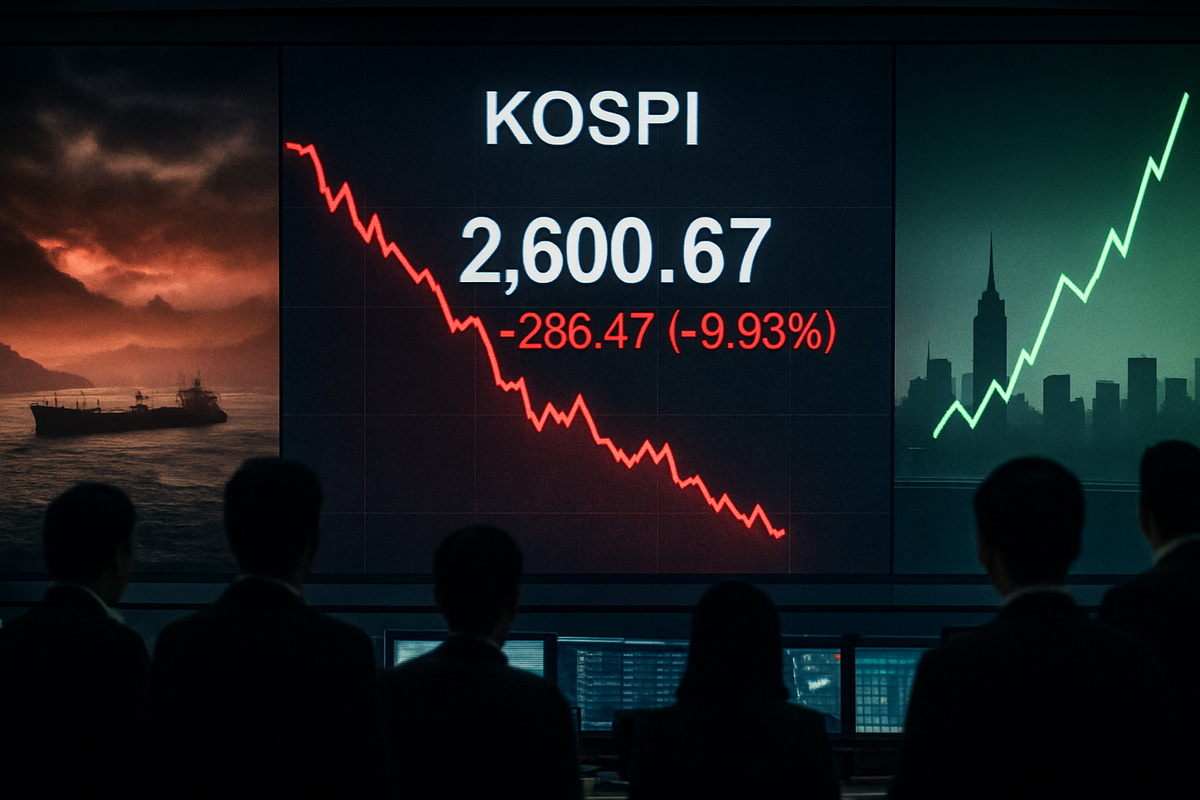
The global financial landscape was fractured on March 4, 2026, as South Korea’s benchmark KOSPI index suffered a cataclysmic 12.1% collapse, marking the single worst trading day in the nation’s history. The "Black Wednesday" rout was triggered by a rapid military escalation in the Middle East, culminating in the closure of the Strait of Hormuz—the world’s most vital energy artery. As the sun rose over Europe and North America, the shockwaves from Seoul initially ignited a "scary start" for global bourses, with investors fearing a repeat of the 1973 oil embargo or a systemic 2008-style meltdown.
However, the day took a defiant and unexpected turn as trading shifted to New York. Despite the chaos in Asia, U.S. markets staged a remarkable "V-shaped" recovery, decoupling from the carnage in the East. While the KOSPI’s double-digit dive signaled an existential threat to energy-dependent industrial economies, U.S. indices were bolstered by resilient labor data and the nation’s status as a net energy exporter. This divergence highlights a deepening rift in the global economy: the vulnerability of the Asian manufacturing hub versus the perceived "safe harbor" of American exceptionalism.
The Seoul Meltdown: A Timeline of the Collapse
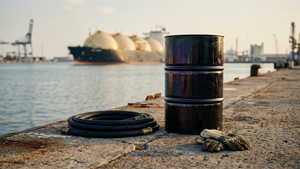
The historic 12.1% plunge in the KOSPI (KRX: 005930 - Samsung Electronics, the index bellwether) was the culmination of a week-long geopolitical nightmare. Tensions had reached a boiling point following a series of coordinated strikes by U.S. and Israeli forces against Iranian military infrastructure over the preceding weekend. By Monday, the Islamic Revolutionary Guard Corps (IRGC) retaliated by declaring the Strait of Hormuz closed, deploying naval mines and anti-ship missiles to block the 21-mile-wide passage. For South Korea, which relies on the Strait for nearly 70% of its crude oil and 30% of its natural gas, the blockade represented an immediate threat to national survival.
The market reaction on Wednesday was instantaneous and unrelenting. When the opening bell rang in Seoul, the KOSPI immediately gapped down 8%, triggering "Level 1" circuit breakers that halted trading for 20 minutes. When trading resumed, the selling intensified. The tech-heavy KOSDAQ index fared even worse, plummeting 14% as investors liquidated positions in high-growth semiconductor and battery firms. By the closing bell, the KOSPI had lost 698.37 points, finishing at 5,093.54. The South Korean Won also buckled, breaching the psychologically critical 1,500 level against the U.S. dollar for the first time in nearly two decades.
In response to the panic, the South Korean Financial Services Commission (FSC) and the Bank of Korea moved into emergency mode. FSC Chairman Lee Eog-weon announced the activation of a "100 Trillion Won + Alpha" Market Stabilization Program, including a massive bond market fund to prevent a credit crunch. Meanwhile, the Ministry of Economy and Finance reassured the public that the country maintains 208 days of strategic petroleum reserves, but the market remained unconvinced, focused instead on the long-term paralysis of the global supply chain.
Winners and Losers: A Market Divided
The carnage in Seoul was most visible among the "AI Kings" and industrial titans. Samsung Electronics (KRX: 005930) plummeted 11.7%, while its rival SK Hynix (KRX: 000660) fell 9.6%. Both companies are heavily reliant on stable, affordable energy for their power-hungry fabrication plants. Hyundai Motor (KRX: 005380) saw a staggering 16.1% loss, as investors priced in the combined impact of skyrocketing logistics costs and a potential halt in production due to energy rationing. In Europe, luxury and consumer goods were hit hard, with Adidas (ETR: ADS) dropping 7% on fears that rising energy costs would sap global consumer discretionary spending.
Conversely, the crisis created a surge in demand for defense and U.S.-based energy firms. Hanwha Aerospace (KRX: 012450) was a rare bright spot in Korea, surging 19.8% as the regional conflict signaled a massive uptick in defense spending. In the U.S., defense contractors like Northrop Grumman (NYSE: NOC) and RTX (NYSE: RTX) rose 5.9% and 4.7% respectively, as the market anticipated a prolonged period of military engagement in the Middle East. Marathon Petroleum (NYSE: MPC) gained 5.9%, benefiting from its domestic refining capacity and the U.S.’s relative insulation from the Hormuz blockade.
Big Tech also emerged as an unlikely "safe haven." After an initial dip in pre-market trading, Nvidia (NASDAQ: NVDA) finished the day up 2.9%, and Tesla (NASDAQ: TSLA) rose 1.5%. Investors pivoted away from the vulnerable manufacturing base of East Asia and into the cash-rich, high-margin software and AI sectors of the United States. This "capital flight to quality" was further fueled by ASML (NASDAQ: ASML), which rose 3.2% as investors bet that any disruption in Korean chip production would only increase the long-term value of the lithography equipment needed to build capacity elsewhere.
Geopolitical Realignment and Historical Precedents
The March 4 crash draws uncomfortable parallels to the 1973 Oil Crisis and the 2011 "Black Monday" following the U.S. credit rating downgrade. However, the current event is distinct because of its intersection with the AI revolution. Modern global economies are more dependent on the seamless flow of both energy and data. By blocking the Strait of Hormuz, Iran has not only threatened the physical movement of oil but has also threatened the digital economy by targeting the energy supplies that power the world's most advanced chip factories.
This event signals a definitive end to the era of hyper-globalization. The vulnerability of South Korea—a linchpin in the global electronics supply chain—highlights the dangers of "just-in-time" energy procurement. We are likely to see an acceleration of "friend-shoring," where Western nations and their allies move critical manufacturing to regions that are less geographically dependent on volatile chokepoints. Regulatory bodies are already shifting their focus; the U.S. Department of Energy and the EU Commission are expected to announce new mandates for increased strategic energy reserves for all member nations by the end of the quarter.
Furthermore, the "scary start" and subsequent U.S. rebound underscore the concept of "U.S. Exceptionalism." For the first time in a major global crisis, the U.S. market did not follow the rest of the world into a tailspin. This is largely due to the U.S. being the world's largest producer of oil and gas, providing a domestic floor for energy prices that nations like South Korea and Japan simply do not have.
The Road Ahead: Strategic Pivots and Market Risks
In the short term, all eyes remain on the Strait of Hormuz. While reports from the New York Times suggest that back-channel negotiations between Washington and Tehran are underway, the physical presence of naval mines and the threat of drone swarms mean that oil prices are likely to remain elevated above $110 per barrel for weeks, if not months. Investors should expect continued volatility in the transport and travel sectors; United Airlines (NASDAQ: UAL) and American Airlines (NASDAQ: AAL) will face significant headwinds as jet fuel costs eat into their Q1 margins.
Long-term, the KOSPI crash will likely trigger a massive strategic pivot within South Korea. Expect the South Korean government to fast-track nuclear energy projects and hydrogen infrastructure to reduce their 70% reliance on Middle Eastern oil. For global investors, the opportunity lies in the "re-shoring" trade. The premium once given to efficient Asian manufacturing hubs may permanently shift toward North American and European industrial firms that can guarantee energy security, even at a higher cost of production.
The most critical challenge emerging from this crisis is the potential for a "Two-Speed Global Economy." While the U.S. may continue to thrive, the persistent high energy costs for the rest of the world could lead to a prolonged period of stagflation in Asia and Europe. Market participants should watch for a widening gap between the S&P 500 and the rest of the world’s major indices as a barometer of this trend.
Conclusion: A Turning Point for Global Capital
The events of March 4, 2026, will be remembered as a watershed moment for the financial markets. The 12.1% KOSPI crash served as a brutal reminder that geopolitical risk can still paralyze the most advanced economies in the world. While the U.S. market’s resilience provided a temporary sigh of relief, the fundamental fracture in the global supply chain remains unhealed. The world has learned that the price of chips is inextricably linked to the price of oil, and the security of one cannot exist without the security of the other.
Moving forward, investors must prioritize energy independence and regional security in their portfolios. The "dip-buying" witnessed in New York suggests that there is still immense liquidity and confidence in the U.S. system, but this confidence is contingent on the conflict remaining contained. If the "tanker war" in the Strait of Hormuz escalates into a broader regional conflict, even the most resilient U.S. sectors will eventually feel the heat.
In the coming months, the key metrics to watch will be the "won-dollar" exchange rate and the weekly throughput reports of the Strait of Hormuz. These will be the ultimate indicators of whether "Black Wednesday" was a one-day panic or the beginning of a long-term recalibration of the global economic order. For now, the world watches the Middle East, hoping that diplomacy can clear the waters that fear has so thoroughly muddied.
This content is intended for informational purposes only and is not financial advice