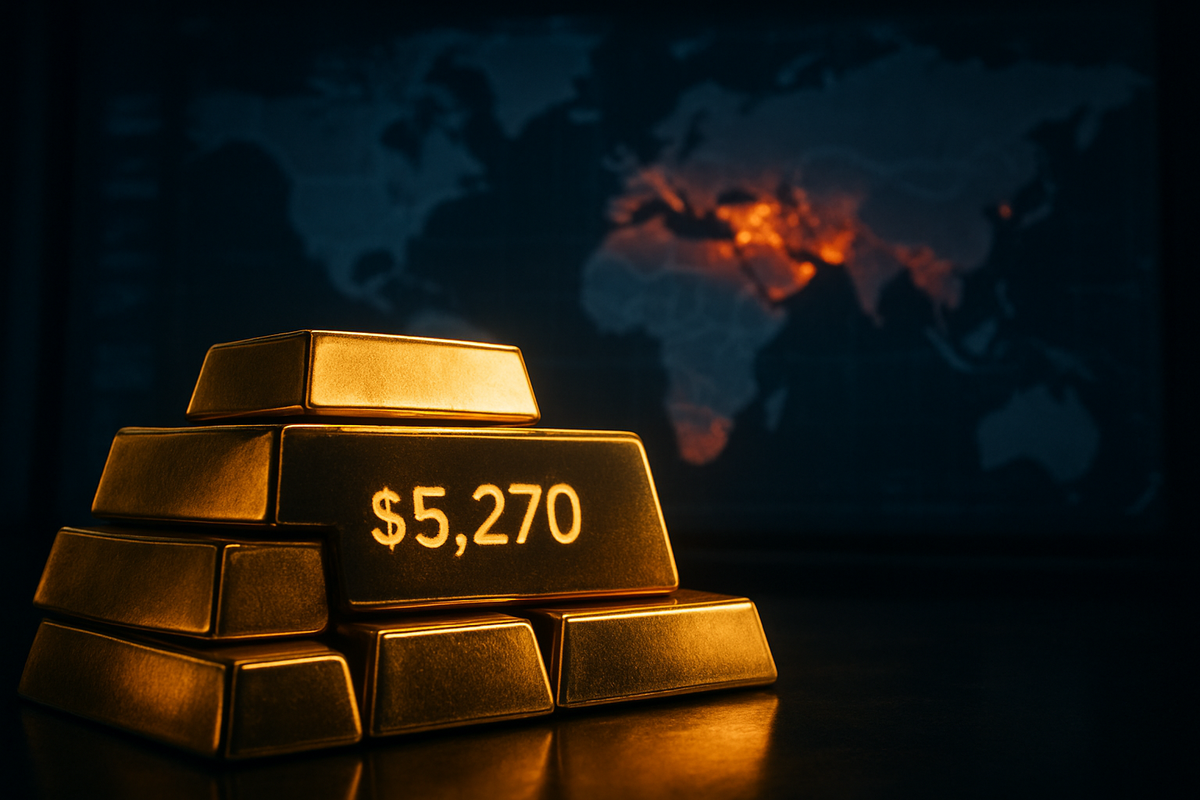
LONDON — In a historic trading session that has sent shockwaves through global financial hubs, gold prices surged to an unprecedented all-time high of $5,270 per ounce on the morning of March 3, 2026. The parabolic move comes in the immediate wake of coordinated military strikes by the United States and Israel against strategic targets in Iran, an escalation that has plunged the Middle East into its most precarious state in decades. As sirens blared in Tehran and military assets mobilized across the Persian Gulf, investors abandoned risk-heavy equities in a frantic "flight to quality," driving the yellow metal up more than 8% in a single day of trading.
The breach of the $5,200 barrier represents more than just a numerical milestone; it signifies a fundamental shift in the global perception of risk. With the Strait of Hormuz—a vital artery for 20% of the world’s oil supply—now under threat of closure, the specter of a dual energy and inflationary shock has rendered traditional fiat currencies and treasury bonds secondary to the perceived permanence of bullion. Analysts are describing the morning’s events as a "black swan" moment that has permanently reset the floor for precious metals in a fractured geopolitical landscape.
Geopolitical Ignition: The Road to $5,270
The dramatic ascent of gold began in the pre-dawn hours of March 3, following reports of "Operation Epic Fury," a joint tactical operation involving U.S. carrier-based aircraft and Israeli long-range precision strikes. The operation reportedly targeted Iranian drone manufacturing facilities and enriched uranium stockpiles, responding to what Western intelligence described as an "imminent and catastrophic" escalation in regional proxy warfare. Within minutes of the first explosions being confirmed by independent news agencies, the gold spot price leaped from its previous close of $4,850, bypassing several technical resistance levels with unprecedented velocity.
The timeline leading to this morning’s record high has been building for over 18 months. Throughout 2025, gold had already seen a steady 60% appreciation as central banks in China, India, and Turkey moved aggressively to diversify their reserves away from the U.S. dollar. This "de-dollarization" trend created a structural floor for gold, which was then tested by persistent domestic inflation in the United States and recurring skirmishes in the Levant. However, the direct involvement of U.S. assets against Iranian sovereign territory overnight acted as the final catalyst, triggering automated "buy" orders and margin calls across global commodities exchanges including the COMEX and the London Bullion Market Association (LBMA).
Initial market reactions were nothing short of chaotic. As gold futures spiked, the CBOE Volatility Index (VIX) surged by 40%, reflecting a widespread panic among equity holders. While the U.S. State Department has characterized the strikes as "defensive and limited," the Iranian Revolutionary Guard's vow of "harsh and multi-front retaliation" has kept the bid for safe-haven assets firmly in place. By mid-morning in New York, gold was trading at $5,270.40, a price point that most analysts just two years ago believed would take a decade to reach.
Market Bifurcation: The Winners and the Weighted
The surge in gold prices has created a stark divide in the corporate world, with a few sectors reaping the benefits of instability while the broader market reels. Leading the charge are the global mining titans, who are seeing their profit margins expand exponentially. Newmont Corporation (NYSE: NEM) and Barrick Gold (NYSE: GOLD) both saw their stock prices jump by double digits in early trading, as the value of their proven reserves skyrocketed in real-time. Agnico Eagle Mines (NYSE: AEM) also posted significant gains, as its focus on low-risk jurisdictions like Canada and Australia made it a favorite for investors seeking gold exposure without the added geopolitical risk of African or South American operations.
Simultaneously, the defense sector has seen a massive influx of capital. Lockheed Martin (NYSE: LMT) and RTX Corporation (NYSE: RTX)—formerly Raytheon—hit 52-week highs as the reality of a prolonged Middle Eastern conflict set in. The demand for missile defense systems, such as the Patriot and Iron Dome interceptors, is expected to surge as regional allies bolster their defenses against potential Iranian retaliatory strikes. For these companies, the conflict represents a surge in both immediate demand and long-term procurement contracts.
Conversely, the broader market indices, such as the S&P 500 (NYSEARCA: SPY), faced a sea of red. Consumer discretionary stocks and airlines, such as Delta Air Lines (NYSE: DAL), were hammered as the price of crude oil followed gold higher, raising fears of a return to the stagflationary environment of the 1970s. The "losers" in this scenario include any firm sensitive to energy costs or global trade disruptions, as the potential closure of the Strait of Hormuz threatens to choke off the supply of semiconductors and consumer goods moving between East and West.
A Structural Shift in the Global Order
The significance of gold hitting $5,270 extends far beyond the immediate profits of miners; it marks the "structural re-pricing" of gold as a geopolitical hedge. Historically, gold has served as the "ultimate insurance" because it carries no counterparty risk. Unlike a government bond, which is a promise to pay by a sovereign entity, gold is a physical asset that cannot be devalued by decree or frozen by sanctions. This characteristic has become paramount in 2026, as the weaponization of global finance has led many nations to conclude that physical gold is the only truly neutral reserve asset.
This event bears a striking resemblance to the gold rush of 1979-1980, which was similarly driven by the Iranian Revolution and a subsequent oil shock. However, the 2026 rally is amplified by a significantly more interconnected and fragile global economy. While the 1980 peak was eventually tamed by aggressive interest rate hikes from the Federal Reserve, the current U.S. debt load—now exceeding $38 trillion—makes such high interest rates nearly impossible to sustain without triggering a domestic fiscal crisis. Consequently, gold is no longer just a hedge against war; it is becoming a hedge against the very survival of the current fiat monetary system.
Furthermore, the "Hormuz Factor" adds a layer of complexity not seen in previous decades. If Iran follows through on threats to mine the Strait, the resulting spike in oil prices will act as a massive inflationary force. Historical data suggests that for every 1% gain in oil, gold often gains 0.20% to 0.35% due to its role as an inflation hedge. This feedback loop could potentially push gold prices toward the $6,000 mark by the end of the quarter, as the "cost of living" and the "cost of safety" merge into a single, upward-spiraling metric.
The Path Ahead: Volatility as the New Normal
Looking forward, the immediate question for the markets is whether this is a temporary spike or the beginning of a new, higher-priced plateau. In the short term, much depends on the nature of Iran’s retaliation. If the conflict remains localized, we may see a minor "cooling off" period where gold stabilizes around $5,000. However, if the conflict expands to include proxies in Lebanon, Yemen, and Iraq, or if global supply chains are physically severed, $5,270 may soon look like a bargain.
Central banks are likely to remain the most significant players in the coming months. If the Federal Reserve is forced to choose between fighting inflation (by raising rates) or preventing a recession (by cutting them), any sign of "pivoting" toward lower rates to support the economy would be like throwing gasoline on the gold fire. Strategic pivots are also expected from institutional fund managers, many of whom have been underweight in gold for years. We are likely to see a massive re-allocation of capital into physical gold ETFs, such as the SPDR Gold Shares (NYSEARCA: GLD), as "safety" becomes the primary objective over "growth."
The potential for a "diplomatic de-escalation" remains the primary downside risk for gold prices. Should a ceasefire be negotiated or a new security framework established, the speculative "war premium" could evaporate as quickly as it appeared. However, given the depth of the current animosity and the strategic importance of the targets hit, such an outcome appears increasingly unlikely in the near term.
Closing Thoughts: A New Era for Investors
The events of March 3, 2026, have permanently altered the investment landscape. Gold’s ascent to $5,270 per ounce is a clarion call that the era of relative geopolitical stability and low-cost energy has ended. For investors, the key takeaway is that gold has reclaimed its throne as the world’s premier safe-haven asset, performing exactly as intended during a period of maximum systemic stress.
Moving forward, the market will be characterized by extreme volatility and a high sensitivity to news from the Persian Gulf. Investors should keep a close watch on two primary indicators: the price of Brent Crude oil and the weekly statements from the world’s major central banks. If central banks continue to buy gold even at these record prices, it will serve as a definitive signal that the "new normal" for gold is here to stay.
While the human and geopolitical costs of the current conflict are still being tallied, the financial verdict is already in. In a world of increasing uncertainty, the timeless value of gold has never been more evident.
This content is intended for informational purposes only and is not financial advice.