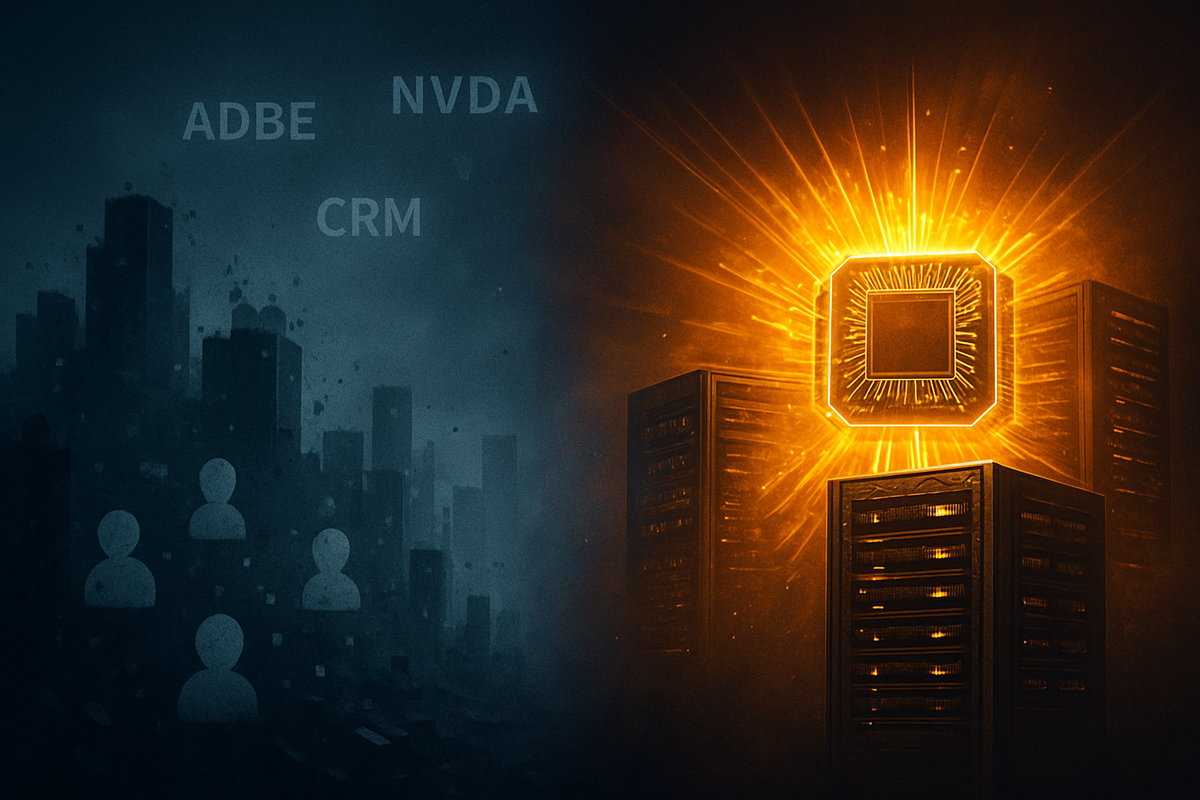
As of March 17, 2026, the once-unstoppable software-as-a-service (SaaS) sector is facing a reckoning. For nearly two decades, the industry thrived on a simple, lucrative formula: sell a license for every employee, every month. But as generative AI transitions from a futuristic novelty into a workforce utility, that "per-seat" model is collapsing. Wall Street, once content with promises of "AI-driven growth," has grown impatient, wiping over $1 trillion in market value from the sector in early 2026 as investors pivot toward hardware plays that offer more tangible returns.
The pressure is most visible among the industry’s titans—Adobe (NASDAQ: ADBE), Salesforce (NYSE: CRM), and ServiceNow (NYSE: NOW). While these companies have integrated AI deeply into their platforms, a chilling realization has gripped the market: if an AI agent can do the work of five humans, why would a company continue to pay for five software seats? This "displacement fear" has sparked a valuation crisis, leading to a massive rotation of capital away from application software and toward the "picks and shovels" of the AI era, like NVIDIA (NASDAQ: NVDA).
The Erosion of the Per-Seat Empire
The current crisis, frequently dubbed the "SaaSpocalypse" by market analysts, didn't happen overnight. The seeds were sown in mid-2024 when early AI adopters began reporting significant productivity gains that didn't require headcount growth. By early 2026, the trend turned into a structural shift. Recent data shows that purely per-seat pricing adoption plummeted from 21% to just 15% over the last twelve months, as 70% of enterprises now demand usage-based or outcome-based contracts.
The timeline reached a boiling point in the first quarter of 2026. Adobe (NASDAQ: ADBE) saw its stock tumble nearly 30% from its 52-week high, despite reporting revenue growth. Investors are increasingly spooked by the rise of specialized AI tools that threaten to commoditize Adobe’s core creative suite. Similarly, Salesforce (NYSE: CRM) suffered a 26% share price drop after its latest earnings call, where even record-breaking growth in its AI platforms couldn't mask concerns about a stagnating core CRM business. The market’s reaction has been swift and brutal: software is being judged not by its features, but by its ability to prove immediate return on investment (ROI) in a shrinking labor market.
Winners and Losers in the AI Pivot
The divide between the "AI Haves" and "AI Have-Nots" is widening. In the winner's circle, hardware remains king. NVIDIA (NASDAQ: NVDA) and Broadcom (NASDAQ: AVGO) continue to see their valuations swell, with NVIDIA’s "Vera Rubin" platform becoming the essential nucleus for enterprise AI agents. Broadcom recently reported that AI-related semiconductor revenue now accounts for a staggering 44% of its total intake, highlighting a clear preference among investors for the infrastructure that powers the AI, rather than the applications that use it.
Within the SaaS space, ServiceNow (NYSE: NOW) has emerged as a rare resilient player. Its "Now Assist" platform crossed $600 million in annual contract value (ACV) in late 2025 and is on track to hit $1 billion this year. By focusing on workflow automation rather than just "creative assistants," ServiceNow has managed to prove its value as an efficiency engine. Conversely, companies like Atlassian (NASDAQ: TEAM) and Workday (NASDAQ: WDAY) have been hit hard. Atlassian reported its first-ever decline in enterprise seat counts in early 2026, while Workday was forced to announce an 8.5% workforce reduction, citing AI-driven efficiency gains that paradoxically reduced the need for the very human roles its software serves.
A Fundamental Shift in the Industry Fabric
This event marks the end of the "Growth at All Costs" era for software and the beginning of a "Value Realization" phase. Historically, SaaS companies enjoyed high margins because their software was "sticky" and scaled with a company's headcount. However, the rise of GenAI has introduced the "Compute Tax." SaaS firms are now paying massive fees to hyperscalers like Microsoft Azure and AWS to run their AI features, eroding the 80%+ gross margins that once made the sector the darling of Wall Street.
Furthermore, the "SaaSpocalypse" is triggering a regulatory and operational headache known as "Shadow Code." Analysts have identified a growing risk where AI agents inside SaaS platforms generate unversioned, autonomous logic that creates security vulnerabilities and unpredictable costs. This has led many Fortune 500 CFOs to pull back on SaaS-embedded AI in favor of building internal control planes. Only 14% of CFOs surveyed in March 2026 reported a measurable ROI from their third-party AI investments, a statistic that underscores the current "show me the money" climate.
The Road Ahead: Adaptation or Obsolescence
In the short term, the software sector must undergo a painful transition. To survive, firms like Salesforce and Adobe are being forced to pivot their entire business models toward "outcome-based" pricing. Instead of charging per user, they are beginning to charge based on the success of an AI agent—for example, a fee for every customer service ticket resolved or every marketing campaign successfully launched. While this aligns the software’s cost with the value it provides, it is a high-risk gamble that requires a total overhaul of sales and accounting structures.
Long-term, we may see a massive consolidation in the SaaS market. Smaller players who cannot afford the high compute costs of AI will likely be swallowed by the giants who have the capital to weather the margin squeeze. The market is also watching for potential leadership changes; with legendary figures like Adobe’s Shantanu Narayen moving into board roles, a new generation of "AI-native" executives is expected to take the helm, focusing on lean operations and automated revenue streams.
Final Assessment: What Investors Should Watch
The events of early 2026 serve as a stark reminder that in the technology world, today’s moat can quickly become tomorrow’s drain. The "SaaSpocalypse" isn't necessarily a death knell for the industry, but it is a radical evolution. The era of easy growth through headcount expansion is over. Moving forward, the market will reward companies that can demonstrate "AI-native" efficiency and those that successfully transition to usage-based revenue models without sacrificing their margins.
Investors should closely monitor the Q2 and Q3 2026 earnings reports for any further declines in seat counts and the progress of usage-based revenue pilots. The key metric is no longer just "Total Addressable Market" (TAM), but "Total Attainable Value" (TAV). As the dust settles on this $1 trillion correction, the survivors will be those who proved that their AI wasn't just a replacement for their customers' employees, but a fundamental upgrade to the way business is done.
This content is intended for informational purposes only and is not financial advice.