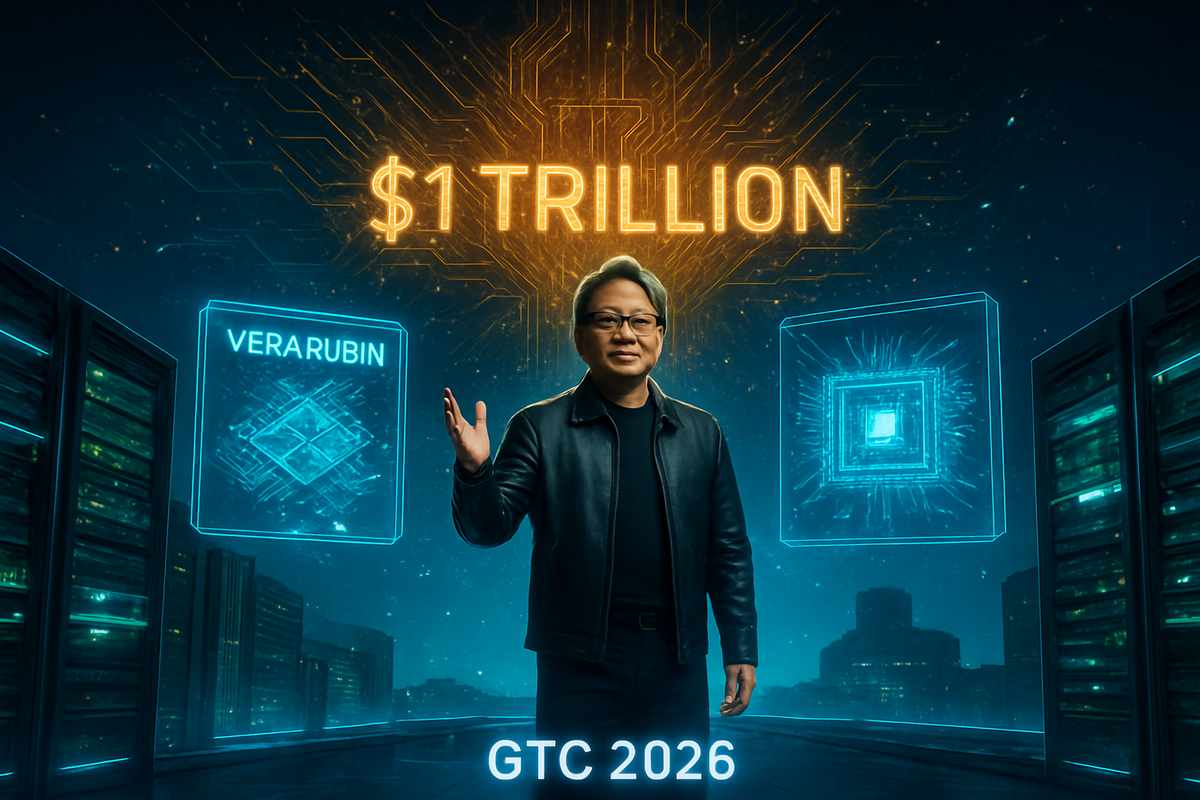
SAN JOSE, CA — In a move that has sent shockwaves through global financial markets, Jensen Huang, the CEO of NVIDIA (NASDAQ: NVDA), has officially projected that cumulative demand for artificial intelligence chips will reach a staggering $1 trillion by the end of 2027. Speaking yesterday, March 16, 2026, at the company’s annual GTC conference, Huang characterized the current market not merely as a growth cycle, but as a fundamental "re-architecting of the global computing stack."
The announcement has triggered a massive rally across the technology sector, reaffirming NVIDIA's position as the primary architect of the modern industrial revolution. As of mid-day trading on March 17, 2026, NVDA shares have surged, lifting the broader indices and quieting skeptics who had questioned whether the AI infrastructure build-out was reaching a plateau. Instead, Huang’s "Vera Rubin" architecture and the shift toward autonomous "Agentic AI" suggest that the era of hyper-scale growth is only just beginning.
The Dawn of the $1 Trillion Forecast
The centerpiece of the GTC 2026 keynote was the unveiling of the Vera Rubin platform, the successor to the highly successful Blackwell architecture. While technical specifications impressed the audience—boasting a 3.5x performance leap in training and a 5x increase in inference—it was the $1 trillion revenue forecast that captured the world's attention. This figure represents a doubling of NVIDIA’s previous long-term guidance issued in late 2025, signaling an "acceleration of the acceleration" in data center demand.
Huang’s timeline traces back to the 2023 pivot toward generative AI, but he noted that 2026 marks a definitive "inference inflection point." For the past three years, the industry was focused on the heavy lifting of training Large Language Models (LLMs). Now, the market has shifted toward the deployment of Agentic AI—autonomous systems capable of reasoning, coding, and executing multi-step tasks. These systems require continuous, high-speed inference power, creating a permanent and growing floor for chip demand that previously did not exist.
The event featured appearances from the CEOs of the "Big Five" hyperscalers, all of whom have committed to unprecedented capital expenditure levels for the coming year. This unified front of industry titans suggests that the $1 trillion figure is more than just a CEO's ambition; it is backed by the confirmed spending plans of the world’s largest corporations.
Winners and Losers in the Specialized Silicon Race
While NVIDIA (NASDAQ: NVDA) remains the undisputed leader with an estimated 80% share of the AI accelerator market, the $1 trillion pie is large enough to create new winners. Advanced Micro Devices (NASDAQ: AMD) has successfully carved out a double-digit market share for the first time in the AI era. Their MI350X series is being widely adopted by cloud providers seeking to diversify their supply chains and reduce their "NVIDIA tax." AMD’s stock saw a sympathetic 4.2% rise following Huang’s keynote, as investors recognized that a rising tide in AI infrastructure would inevitably lift the primary alternative provider.
Conversely, Intel (NASDAQ: INTC) continues to face a complex landscape. While it maintains a dominant 60% share of the data center CPU market, its Gaudi 4 AI accelerators have struggled to gain traction with frontier model developers. Intel is increasingly positioning itself as the "value" alternative for mid-market enterprises, but the $1 trillion forecast is largely driven by high-end, frontier-grade silicon where Intel currently lacks a competitive edge. Meanwhile, Taiwan Semiconductor Manufacturing Company (NYSE: TSM) stands as a silent but essential victor, as they remain the sole foundry capable of producing the complex 2-nanometer and 3-nanometer chips required for both NVIDIA and AMD’s next-gen architectures.
The "Hyperscalers"—including Microsoft (NASDAQ: MSFT), Alphabet (NASDAQ: GOOGL), Amazon (NASDAQ: AMZN), and Meta Platforms (NASDAQ: META)—are navigating a double-edged sword. While they are the primary beneficiaries of AI-driven productivity, their projected $700 billion in collective infrastructure spending for 2026 has put pressure on their margins. However, the market’s reaction suggests that investors currently value AI dominance over near-term profitability, as nearly all major tech stocks saw gains following the forecast.
The Significance of "AI Factories" and Sovereign AI
The wider significance of Huang’s forecast lies in the changing nature of data centers themselves. In 2026, the concept of a general-purpose data center is being replaced by the "AI Factory." These are massive, gigawatt-scale facilities designed solely for token generation. A critical driver of this demand is "Sovereign AI," a trend where national governments, such as those of Saudi Arabia, the UAE, and Japan, are investing tens of billions of dollars to build domestic compute clusters. These nations view AI sovereignty as essential to their national security and economic future, adding a layer of geopolitical demand that is independent of traditional corporate tech cycles.
Furthermore, the physical infrastructure requirements are creating massive ripple effects in the energy sector. NVIDIA’s Rubin-class racks now require liquid cooling as a mandatory standard, sparking a boom in thermal management companies. Perhaps more significantly, the extreme power demands of these $1 trillion worth of chips are driving a resurgence in nuclear energy. Strategic partnerships between big tech and nuclear power providers are becoming common, as the industry realizes that the bottleneck for Huang’s vision is no longer just silicon, but the electricity required to run it.
Historically, such massive infrastructure shifts—like the build-out of the internet in the 1990s or the railroad expansion in the 19th century—have led to periods of intense volatility. However, unlike the "dot-com" bubble, the current AI boom is underpinned by massive revenue generation from the very start, with NVIDIA’s fiscal year 2026 revenue reaching a record $215.9 billion.
Looking Ahead: The Road to 2027
As we look toward 2027, the primary challenge for the tech sector will be the transition from digital assistants to fully autonomous agents. This will require not just more chips, but a fundamentally different software layer. NVIDIA’s recent $20 billion integration of Groq’s inference technology suggests that the company is already preparing for a world where "speed-to-token" is the most valuable currency in the market.
In the short term, investors should watch for any signs of "digestion" in the market—periods where cloud providers pause spending to integrate the massive amounts of hardware they have already purchased. However, if Huang’s forecast holds true, any such pullbacks are likely to be temporary. The long-term challenge will be the "power wall"—the physical limit of how much electricity can be diverted to AI clusters before it impacts national grids.
A New Era for Investors
The key takeaway from Jensen Huang’s GTC 2026 address is that the AI revolution is moving into its most capital-intensive and transformative phase. The $1 trillion demand forecast serves as a roadmap for the next two years of global economic development. For the market, it validates the sky-high valuations of AI leaders and suggests that the "tech-led recovery" has significant room to run.
Moving forward, the focus will shift from who can build the best model to who has the infrastructure to run them at scale. Investors should keep a close eye on data center capex reports from the Big Five and the progress of the Vera Rubin rollout. While the numbers are astronomical, the reality is clear: in the race for digital intelligence, the world’s most powerful entities are betting their futures on the silicon coming out of Santa Clara.
This content is intended for informational purposes only and is not financial advice.