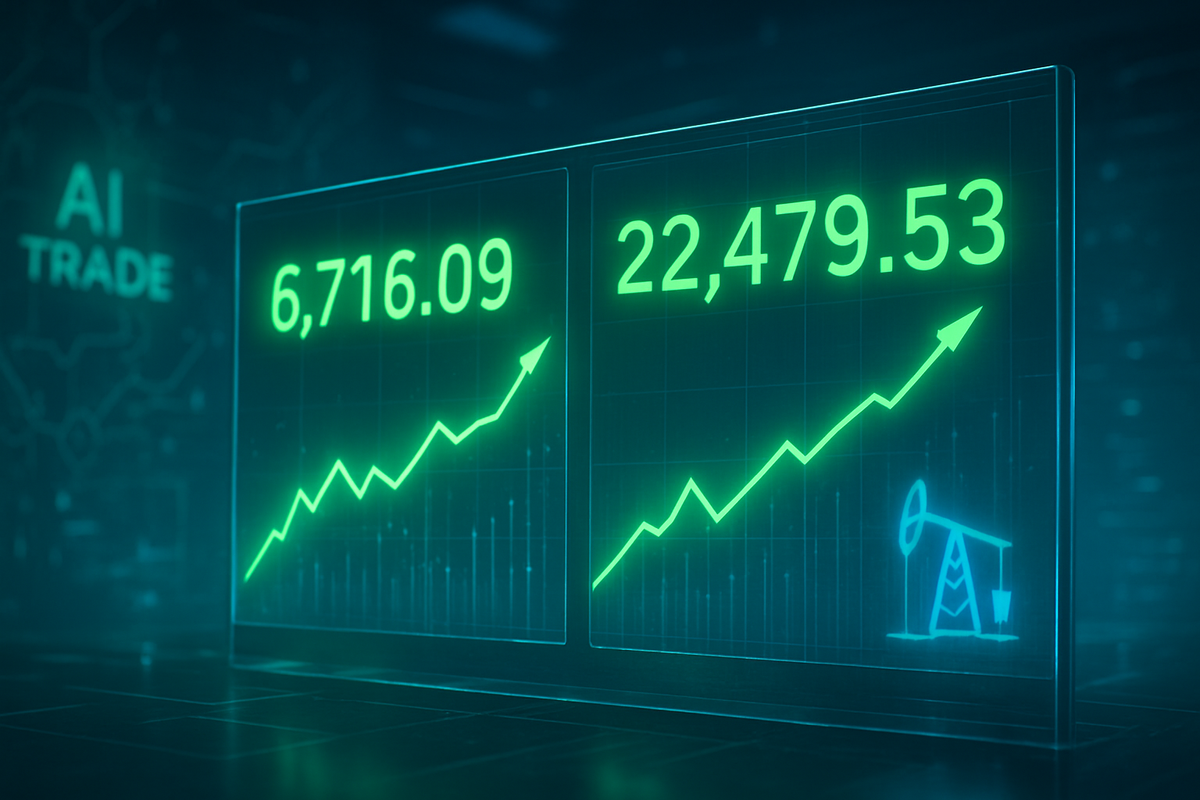
Wall Street found its footing on Tuesday, March 17, 2026, as the major indices staged a modest but critical recovery from recent 2026 lows. The S&P 500 (NYSE: SPY) edged up 0.2% to close at 6,716.09, while the tech-heavy Nasdaq Composite (NASDAQ: IXIC) led the charge with a 0.5% gain, finishing at 22,479.53. The rally marks a pivotal moment for investors who have spent the first ten weeks of the year grappling with persistent inflation concerns and a cooling enthusiasm for mega-cap technology valuations.
The day’s gains were primarily fueled by a renewed appetite for the "AI trade," which has shifted focus in 2026 from hardware infrastructure to the deployment of autonomous "Agentic AI" systems. Simultaneously, a slight easing of tensions in global energy corridors provided much-needed relief to a market that had been pricing in a significant supply shock. While the broader indices remain below their late-2025 peaks, the mid-March bounce suggests that the fundamental narrative of technology-driven productivity continues to provide a sturdy floor for the equities market.
A Turn in Sentiment: From Early-Year Slump to St. Patrick’s Day Green
The rebound on March 17 follows a turbulent start to 2026. After a banner year in 2025, the markets entered January under a cloud of uncertainty. Rising geopolitical friction in the Middle East and concerns over the closure of key shipping lanes had sent Brent crude prices surging toward the $100 mark, stoking fears of a second wave of inflation. This macro-economic pressure, combined with a "show me the money" attitude toward AI investments, had pushed both the S&P 500 and the Nasdaq to their lowest levels in over five months by early March.
However, the tide began to turn as fresh data suggested that global energy supply chains were more resilient than previously feared. As oil prices stabilized in the mid-$80s, the "fear trade" that had dominated the first quarter began to unwind. This opened the door for institutional buyers to rotate back into high-growth technology sectors, particularly those that had been oversold during the February dip. The session on Tuesday saw steady, incremental buying throughout the day, a stark contrast to the volatile "sell-the-rip" behavior seen in previous weeks.
Key stakeholders, including major hedge funds and institutional asset managers, appear to be shifting their strategy from defensive positioning back toward opportunistic growth. Market participants noted that the 22,000 level on the Nasdaq has become a psychological support zone, with algorithmic trading platforms triggering buy orders as the index approached that threshold last week. The stability in the bond market—with the 10-year Treasury yield holding steady near 4.2%—further supported the case for a renewed equities rally.
The Winners and Losers of the AI Pivot
In the 2026 market landscape, the "AI trade" is no longer a monolithic rise of all things silicon. The winners of the March 17 rally were led by companies successfully transitioning from AI training to AI inference and autonomous agents. NVIDIA Corporation (NASDAQ: NVDA), the perennial bellwether of the sector, saw its shares rise 1.8% as it unveiled new enterprise software partnerships aimed at the "Agentic AI" wave. Similarly, Microsoft Corporation (NASDAQ: MSFT) gained 1.4%, buoyed by reports of record adoption rates for its autonomous business process agents within its Azure cloud ecosystem.
The software-as-a-service (SaaS) sector also saw a significant boost. Palantir Technologies (NYSE: PLTR) jumped 3.2% after securing a major government contract focused on AI-driven logistics, reinforcing its position as a primary beneficiary of the "Second Wave" of AI integration. ServiceNow, Inc. (NYSE: NOW) also outperformed, rising 2.1% as investors favored companies that could demonstrate clear, bottom-line efficiency gains from their AI offerings.
On the losing side of the ledger, traditional energy giants felt the weight of easing oil fears. Exxon Mobil Corporation (NYSE: XOM) and Chevron Corporation (NYSE: CVX) both slipped roughly 1.1%, acting as a drag on the Dow Jones Industrial Average. The rotation out of energy and into tech suggests that the "inflation hedge" trade is losing momentum in favor of growth. Additionally, some legacy semiconductor firms that failed to pivot toward the custom silicon needs of 2026 found themselves left behind, illustrating a widening performance gap between specialized AI leaders and broad-market commodity chipmakers.
Wider Significance and the Shift Toward Inference
The performance on March 17 is more than just a single-day bounce; it reflects a maturing of the artificial intelligence investment cycle. In 2024 and 2025, the market was dominated by the "Build Phase," where the primary concern was who could manufacture the fastest GPUs and build the largest data centers. In early 2026, the market has entered the "Inference and Implementation Phase." This shift has profound implications for how public companies are valued, moving the goalposts from theoretical capacity to realized productivity and autonomous workflows.
Historically, this transition mirrors the mid-to-late 1990s internet boom, where the focus shifted from those building the fiber-optic cables to those building the applications that ran on them. The current trend toward "Agentic AI"—systems that can not only answer questions but execute complex business tasks without human intervention—is seen as the primary engine for GDP growth in the latter half of this decade. Regulators have also played a role, with the recent "AI Safety and Innovation Act of 2025" providing a clearer framework for enterprise deployment, which has reduced the "headline risk" for major tech firms.
Furthermore, the easing of oil fears suggests that the global economy may be better equipped to handle localized geopolitical shocks than it was in previous decades. The increased diversification of energy sources and the ongoing electrification of the global vehicle fleet are beginning to act as structural dampeners on oil price volatility. This "de-coupling" of tech performance from energy shocks is a significant development that could lead to a lower equity risk premium for the Nasdaq in the long term.
What Lies Ahead: FOMC and Earnings Season
Looking forward, the short-term trajectory of this rally will likely be determined by the Federal Reserve’s upcoming meeting and the start of the Q1 earnings season in April. Investors are closely watching for any signals that the Fed might consider a rate cut in the second half of 2026, a move that would provide a powerful tailwind for high-valuation tech stocks. Conversely, any indication that "sticky" service-sector inflation remains a concern could quickly snuff out the current momentum.
Strategic pivots will be required for companies that have relied solely on the "AI hype" without delivering tangible products. The market is increasingly demanding transparency regarding "AI ROI" (Return on Investment). Companies like Alphabet Inc. (NASDAQ: GOOGL) and Broadcom Inc. (NASDAQ: AVGO) are expected to face intense scrutiny in the coming weeks as they report their latest quarterly figures. The ability of these firms to prove that their 2025 capital expenditures are translating into 2026 revenue growth will be the ultimate test for the sustainability of the current rally.
Wrap-Up: A Market at a Crossroads
The March 17 rally provides a much-needed breath of fresh air for a market that has been under significant duress. The 0.2% gain in the S&P 500 and the 0.5% rise in the Nasdaq signal a stabilization of sentiment and a return to the fundamental drivers of the 2020s bull market: technology and innovation. By reclaiming ground from 2026 lows, the indices have shown that there is still significant institutional support for the "AI 2.0" narrative.
As we move forward, investors should keep a close eye on the performance of the "Second Wave" AI winners and the continued stabilization of the energy markets. While the immediate threat of an oil-induced recession seems to be receding, the path ahead remains narrow. The ability of the "AI trade" to move from hardware speculation to software execution will define the next phase of market leadership. For now, Wall Street appears content to ride the green wave of St. Patrick’s Day, hoping that the lows of early 2026 are firmly in the rearview mirror.
This content is intended for informational purposes only and is not financial advice.