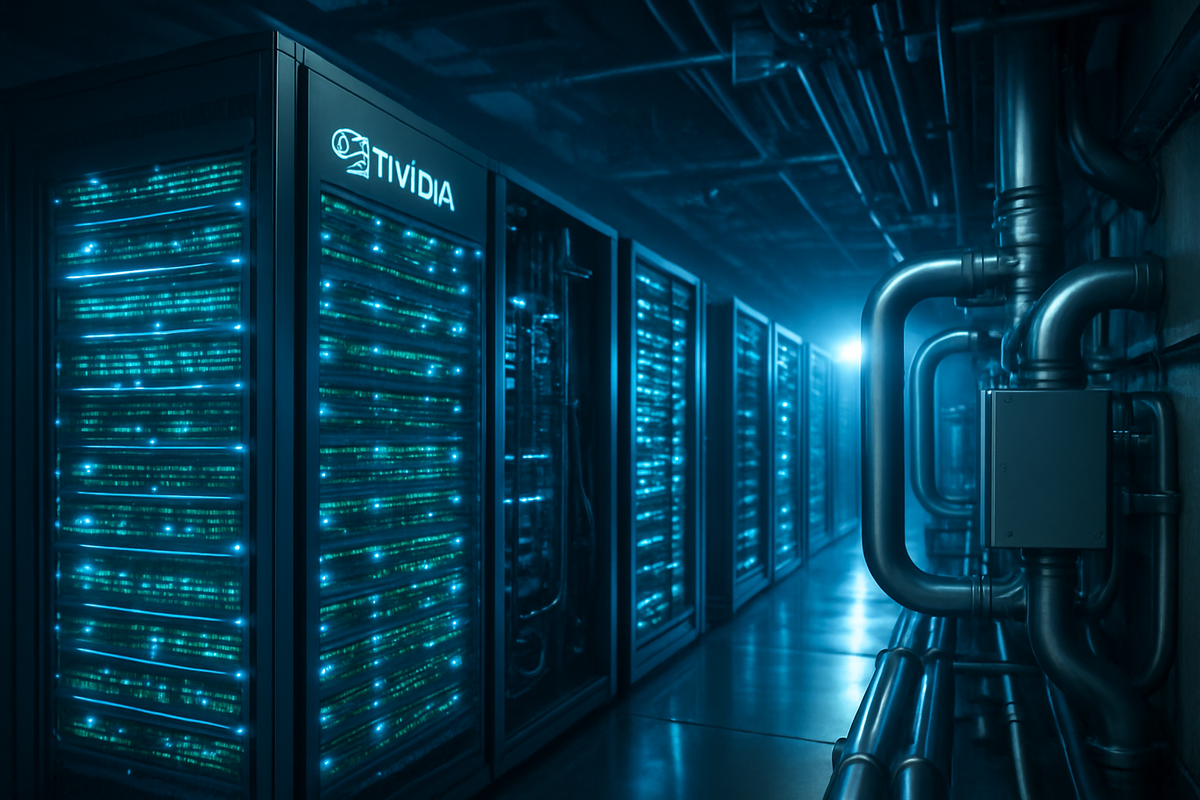
The narrative surrounding the world’s most valuable semiconductor company underwent a fundamental shift at the San Jose Convention Center for the 2026 GTC conference. NVIDIA Corporation (NASDAQ: NVDA) is no longer just selling chips; it is architecting the physical reality of the "AI Factory." Following a series of high-profile announcements by CEO Jensen Huang, the market has pivoted its focus toward the essential, heavy-duty infrastructure required to keep these silicon giants running.
The immediate implications of the GTC 2026 news center on the burgeoning partnership with power management titan Eaton (NYSE: ETN). As AI models grow in complexity, the electrical grid has become the ultimate bottleneck. By integrating Nvidia’s new "Vera Rubin" architecture directly with Eaton’s advanced power distribution and liquid cooling systems, the two companies are attempting to standardize the "grid-to-chip" pathway, potentially shaving years off the construction timelines for global data centers.
The Dawn of the Vera Rubin Era and the Eaton Alliance
The centerpiece of GTC 2026 was the official unveiling of the Vera Rubin architecture, the highly anticipated successor to the Blackwell line. Named after the pioneering astronomer who provided evidence for dark matter, the Rubin R100 GPU is built on Taiwan Semiconductor Manufacturing Co. (NYSE: TSM) 3-nanometer (N3P) process. Early benchmarks suggest a staggering 3x to 5x improvement in inference performance over its predecessors, fueled by the adoption of sixth-generation HBM4 memory. However, the sheer power density of these systems—now exceeding 130 kilowatts per rack—presented a physics problem that Nvidia could not solve with silicon alone.
Enter Eaton (NYSE: ETN). In a joint keynote segment on March 16, 2026, the companies introduced the "Beam Rubin DSX," a modular, pre-engineered data center platform designed specifically for Nvidia’s NVL72 racks. This is not merely a supply agreement; it is a co-design partnership where Eaton’s 800-volt Direct Current (VDC) infrastructure is baked into Nvidia’s reference designs. By moving to 800V DC, the partnership claims to eliminate multiple stages of energy conversion, reducing heat waste and allowing for megawatt-scale deployments that were previously deemed impossible due to thermal constraints.
The timeline leading to this moment has been one of increasing desperation for power. Throughout 2025, cloud service providers reported that "power availability" had overtaken "chip supply" as the primary constraint on AI expansion. The industry reaction has been one of relief and aggressive re-positioning. Eaton’s stock surged 1.59% to $361.04 on the news, as investors digested the company’s record $12 billion electrical sector backlog. Nvidia shares followed suit, rising 1.65% to $183.22, as the market rewarded the company for addressing the physical limits of its own growth.
Winners and Losers in the Industrial AI Shift
The primary winner in this new landscape is undoubtedly Eaton, which has secured its position as the "indispensable partner" for high-density AI. By aligning its hardware so closely with Nvidia’s roadmap, Eaton has created a "moat" around the electrical "grey space" of the data center. Similarly, Vertiv Holdings Co (NYSE: VRT), a leader in thermal management, stands to benefit as liquid cooling becomes a mandatory requirement for the Rubin architecture, though they now face heightened competition from Eaton’s integrated DSX platform.
Conversely, legacy data center providers who have been slow to upgrade to liquid-cooled, high-voltage architectures may find themselves holding "stranded assets." Companies like Digital Realty Trust (NYSE: DLR) and Equinix (NASDAQ: EQIX) are under pressure to rapidly retrofit existing facilities or risk losing the most lucrative AI workloads to purpose-built "AI Factories." On the semiconductor side, competitors such as Advanced Micro Devices (NASDAQ: AMD) and Intel Corporation (NASDAQ: INTC) face a daunting challenge: they must not only match Nvidia’s compute performance but also replicate the massive infrastructure ecosystem Nvidia has built with industrial partners.
Furthermore, the secondary market for power components—transformers, switchgear, and high-capacity breakers—is expected to see a prolonged "supercycle." This bodes well for companies like Schneider Electric (OTC:SBGSY) and ABB Ltd (NYSE: ABB), though Eaton’s first-mover advantage with the Vera Rubin reference design gives it a significant edge in the immediate near-term.
Scaling the Unscalable: A Paradigm Shift in Infrastructure
The significance of the Nvidia-Eaton partnership extends far beyond a single product launch; it represents the industrialization of artificial intelligence. In years past, AI was a software problem solved with specialized hardware. In 2026, AI is a utility problem. By treating the data center as a single, holistic machine—from the utility substation to the individual HBM4 memory stack—Nvidia is effectively creating a proprietary "Infrastructure Operating System."
This shift mirrors the historical development of the electric grid itself. Just as Thomas Edison had to build the entire distribution system to make the lightbulb viable, Jensen Huang is building the "AI Factory" to make the Rubin chip viable. This event fits into a broader trend of "vertical integration of the physical layer," where tech companies are no longer content to let third-party contractors handle the power and cooling of their chips.
There are also significant regulatory and policy implications. As AI data centers consume a larger share of the national power grid, the ability of companies like Eaton to turn Uninterruptible Power Supplies (UPS) into "energy buffers"—capable of feeding power back to the grid during peak demand—could prove vital. This "Grid-to-Chip" strategy may be the only way for the industry to navigate the tightening carbon emissions and energy usage regulations being implemented across the EU and North America.
What Comes Next: The Road to Feynman
Looking ahead, the "Beam Rubin DSX" platform is only the first step. During the GTC keynote, Nvidia teased its 2028 "Feynman" architecture, which is expected to utilize 1.6-nanometer process technology and silicon photonics. This will require a total abandonment of electrical data transmission in favor of optical signals, a transition that will likely require another round of massive infrastructure overhauls.
In the short term, the market will be watching the "NemoClaw" platform, Nvidia’s new framework for autonomous enterprise AI agents. If these agents can begin optimizing data center operations in real-time—adjusting power loads and cooling flows based on predictive workloads—the efficiency gains could extend the life of existing power grids. However, the strategic pivot required for the rest of the industry is immense. Competitors must now think like civil engineers as much as electrical engineers.
Potential challenges include the supply chain for high-voltage components, which is currently even more constrained than the supply chain for advanced semiconductors. If Eaton cannot scale the production of the DSX platform to meet the demand for Rubin chips, the entire AI rollout could stall, creating a new form of "chokepoint" in the global economy.
A New Benchmark for the AI Economy
The GTC 2026 conference will likely be remembered as the moment the "AI Bubble" concerns were replaced by "AI Infrastructure" realities. Nvidia has successfully pivoted the conversation away from the speculative value of software and toward the tangible value of the physical infrastructure required to run it. The partnership with Eaton serves as a blueprint for how the next decade of computing will be built: not in isolation, but in deep collaboration with the heavy industries that power our world.
For investors, the key takeaways are clear. The "AI trade" is no longer just about who has the best algorithm; it is about who has the power, the cooling, and the physical space to deploy that algorithm at scale. Moving forward, the market will likely reward companies that can provide integrated, turnkey solutions rather than fragmented hardware components.
In the coming months, watch for the "backlog conversion" rates of companies like Eaton and Vertiv. These will be the true leading indicators of AI growth, even more so than GPU delivery times. As the Vera Rubin architecture begins shipping in late 2026, the success of the Eaton partnership will determine whether the AI revolution can keep the lights on—both literally and figuratively.
This content is intended for informational purposes only and is not financial advice