The United States economy has reached a precarious crossroads this March 2026, as the latest batch of economic data confirms the emergence of a "stagflation" scenario—a rare and punishing combination of stagnant economic growth and persistent inflation. On March 13, the Bureau of Economic Analysis (BEA) delivered a sobering blow, revising fourth-quarter 2025 GDP growth down to a meager 0.7% annualized rate. Simultaneously, the Federal Reserve’s preferred inflation metric, the Core Personal Consumption Expenditures (PCE) price index, remains stubbornly high at 3.1% year-over-year, significantly above the central bank’s 2% target.
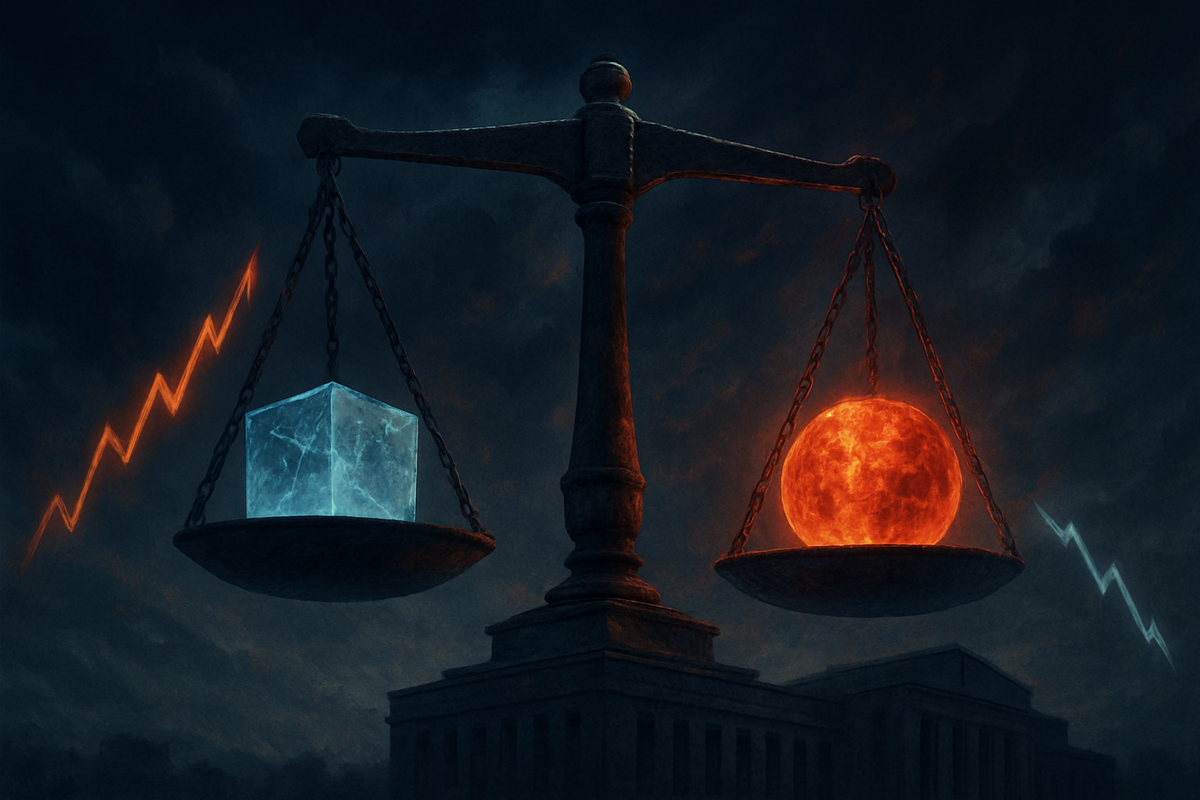
This divergence has created what economists are calling the "Stagflation Riddle," a policy pincer that leaves the Federal Reserve with no easy exits. As of March 16, 2026, the market is grappling with the reality that the aggressive rate hikes of the previous years have cooled the economy to the point of a near-stall, yet supply-side shocks—most notably a spike in crude oil prices to the $150 range—continue to keep consumer prices uncomfortably high. With the "Sahm Rule" recession indicator triggered by a February jump in unemployment to 4.4%, the pressure on policymakers has reached a fever pitch.
A Perfect Storm: From Shutdowns to Supply Shocks
The current economic malaise is the result of a compounding series of crises that began in late 2025. A 43-day partial government shutdown during the final months of last year severely disrupted federal spending and consumer confidence, leading to the dramatic downward revision of GDP from an initial 1.4% estimate to the current 0.7%. While the government has since reopened, the "fiscal cliff" created by the disruption has left a lasting scar on domestic productivity and retail activity.
Compounding the domestic slowdown is a volatile geopolitical landscape. The ongoing Iran-Israel conflict and the subsequent blockade of the Strait of Hormuz have sent energy markets into a tailspin. With oil prices fluctuating between $100 and $150 per barrel, the "inflationary floor" has been raised, preventing the Fed from seeing the price cooling they expected. This supply-side shock mirrors the 1970s energy crises, where external factors dictated domestic price levels regardless of interest rate policy.
The Federal Reserve, led by Chair Jerome Powell, find themselves in a state of strategic paralysis. Powell’s term is set to expire in May 2026, and the central bank is currently divided. Fed Governor Christopher Waller recently described the decision to maintain the current "Hawkish Hold" (rates at 3.50%–3.75%) as a "coin toss," while other officials, such as Governor Stephen Miran, have begun advocating for rate cuts to prevent a deeper contraction in the labor market, which saw a loss of 92,000 jobs in February alone.
Market Fallout: Winners in the Vise and Losers in the Lag
The transition into a stagflationary environment has triggered a massive rotation across Wall Street, with growth-oriented technology giants bearing the brunt of the volatility. Microsoft Corporation (NASDAQ: MSFT) and Amazon.com, Inc. (NASDAQ: AMZN) have seen their shares slide 15% and 7% respectively as investors grow weary of massive capital expenditures in Artificial Intelligence (AI) against a backdrop of slowing enterprise spending. Similarly, Meta Platforms, Inc. (NASDAQ: META) dropped nearly 4% following reports that it would delay its newest AI models due to resource constraints and high operational costs.
Software and discretionary retail have been hit even harder. Adobe Inc. (NASDAQ: ADBE) saw its shares plunge over 7% following concerns regarding its AI strategy and the departure of key leadership. In the retail space, Ulta Beauty, Inc. (NASDAQ: ULTA) plummeted 14% after slashing its guidance, a clear signal that middle-income consumers are finally pulling back on discretionary purchases as their real wages are eroded by 3.1% Core PCE inflation.
Conversely, "real economy" sectors and high-yield dividend stocks are emerging as havens. Energy companies have been the primary beneficiaries of the oil price surge, while utilities have outperformed the broader market by over 10% this month. Defensive plays like PepsiCo, Inc. (NASDAQ: PEP) and Target Corporation (NYSE: TGT) are being watched closely; while they offer stability, analysts warn that even these giants are reaching the limit of their pricing power. Meanwhile, income-seeking investors have flocked to "Safe Dividend Kings" like Altria Group, Inc. (NYSE: MO) and United Bankshares, Inc. (NASDAQ: UBSI) to lock in yields as traditional growth prospects dim.
The Return of the 1970s: Historical Parallels and Policy Risks
The wider significance of this "riddle" lies in its historical precedent. Economists at Yardeni Research have warned that the U.S. risks returning to the "stop-go" monetary policy of the 1970s. During that era, the Fed repeatedly oscillated between raising rates to fight inflation and cutting them to combat unemployment, ultimately failing to solve either problem and allowing inflation expectations to become "unanchored." With current inflation expectations drifting toward 4.5%, the risk of a similar loss of credibility is high.
This event also highlights the limitations of monetary policy in the face of supply-side disruptions. Traditional interest rate hikes are designed to cool demand, but they do little to clear a blockaded shipping lane or lower the cost of fuel. Furthermore, the massive federal deficits incurred over the last three years have limited the government's ability to use fiscal stimulus to jumpstart growth, leaving the economy in a state of "fiscal exhaustion."
The ripple effects are extending beyond the U.S. borders. As the dollar remains strong due to relatively high U.S. rates, emerging markets are struggling with their own debt burdens, further dampening global demand for American exports. This feedback loop threatens to turn a domestic slowdown into a synchronized global stagnation, a scenario not seen in decades.
Navigating the Fog: What Lies Ahead for Investors
In the short term, the market will be laser-focused on the Federal Reserve’s May meeting. If the Fed chooses to prioritize growth by cutting rates, they may satisfy the labor market but risk a secondary surge in inflation that could necessitate even more drastic hikes later in 2026. If they remain on hold, the risk of the 0.7% GDP growth turning into a full-scale contraction increases. Many analysts believe a "strategic pivot" toward protecting employment is inevitable as political pressure mounts in an election cycle.
Strategic adaptations are already underway in the corporate world. Companies are shifting from "growth at all costs" to "margin preservation." We should expect to see a wave of cost-cutting measures, including further layoffs in the tech sector and a reduction in capital intensive R&D projects. Market opportunities may emerge in commodities and infrastructure, which tend to hold value during periods of currency debasement and supply constraints.
A Season of Uncertainty
The "Stagflation Riddle of 2026" serves as a stark reminder that the post-pandemic recovery was more fragile than many anticipated. The convergence of a 0.7% GDP growth rate and 3.1% Core PCE has effectively trapped the Federal Reserve, forcing a choice between two equally unpalatable outcomes: a deeper recession or a prolonged inflationary spiral.
For investors, the coming months will require a defensive posture. Key indicators to watch include the monthly PCE updates, the trajectory of crude oil prices in the Middle East, and the Sahm Rule’s progression. As the era of "easy money" and predictable growth fades into the rearview mirror, the market’s ability to navigate this stagflationary fog will determine the financial winners and losers of the late 2020s.
This content is intended for informational purposes only and is not financial advice.