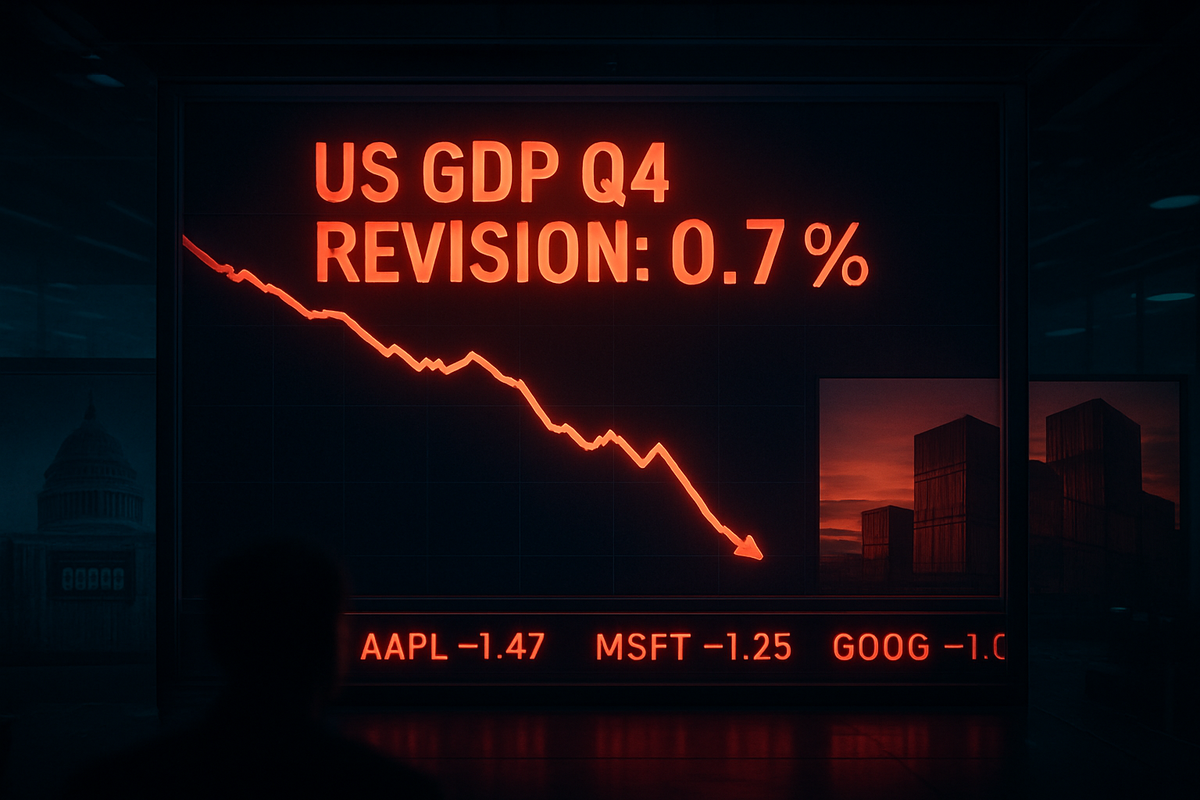
The U.S. economy hit a significant speed bump in the final months of 2025, with the Bureau of Economic Analysis (BEA) revising the fourth-quarter Real Gross Domestic Product (GDP) growth down to a meager 0.7% annualized rate. This update, released on March 13, 2026, represents a sharp halving of the "advance" estimate of 1.4% and signals a much more pronounced cooling of the domestic economy than analysts had initially feared. The revision paints a picture of an economy struggling under the weight of a historic federal government shutdown, dwindling consumer momentum, and escalating trade tensions.
The immediate implications for the market are a renewed focus on "stagflation"—the dreaded combination of stagnant growth and sticky inflation. With oil prices surging past $100 a barrel simultaneously, the 0.7% GDP print suggests that the Federal Reserve's "soft landing" may be turning into a "bumpy taxiing." Investors are now reassessing the health of the American consumer and the viability of aggressive growth forecasts for 2026, as the tailwinds of the mid-2025 AI-driven surge seem to have dissipated in the face of fiscal and geopolitical headwinds.
A Perfect Storm of Fiscal and Commercial Drag
The downward revision to 0.7% was not the result of a single failure, but rather a convergence of several negative factors that finalized in the BEA's second estimate. The primary culprit was the 43-day federal government shutdown that paralyzed Washington in October and November 2025. This historic shutdown alone subtracted roughly 1.2 percentage points from the quarterly growth rate, as federal spending plummeted by 16.7%. Beyond the direct loss of government services and payrolls, the shutdown caused a ripple effect of uncertainty that delayed investment decisions across the private sector.
Leading up to this moment, 2025 had been a year of extreme volatility. The economy began with a -0.6% contraction in Q1, only to roar back with a 4.4% expansion in Q3, fueled by massive investment in artificial intelligence and a resilient labor market. However, the momentum broke in Q4 as the shutdown coincided with a moderation in consumer spending—the bedrock of the U.S. economy. Personal consumption expenditures were revised down to 2.0% from 2.4%, with a notable decline in goods purchases. Furthermore, nonresidential fixed investment saw a significant haircut, falling from an estimated 3.7% growth to just 2.3%, as businesses grew cautious about a new wave of tariffs and global trade disruptions.
The market reaction on the day of the release was swift and tilted toward safety. While the S&P 500 Index (SPX) dropped 0.6% to close at 6,632.19, the tech-heavy Nasdaq Composite Index (IXIC) was the hardest hit, falling 0.9%. The data confirmed that the "V-shaped" recovery seen in the summer of 2025 had flattened out completely by year-end, leaving the full-year growth for 2025 at a modest 2.1%, down from 2.8% in 2024.
Winners and Losers in a Cooling Climate
The revision triggered a "K-shaped" response in the equity markets, where defensive havens and energy giants emerged as winners, while high-growth tech and cyclical retail names suffered. Walmart Inc. (NYSE: WMT) saw its shares rise 0.95% to $126.52, as investors sought refuge in a company perceived as a "staple" that can weather a consumer slowdown. Similarly, the energy sector provided a rare bright spot; Exxon Mobil Corp. (NYSE: XOM) and Chevron Corp. (NYSE: CVX) both saw gains as Brent crude oil spiked to over $103 per barrel. The oil surge, driven by geopolitical tensions in the Strait of Hormuz, acted as a double-edged sword: boosting energy stocks while threatening to further dampen overall economic growth through higher input costs.
On the losing side, "Big Tech" faced a reckoning as the narrative shifted from AI-driven expansion to macroeconomic contraction. Apple Inc. (NASDAQ: AAPL) shares slid 2.21% to $250.12, and Meta Platforms Inc. (NASDAQ: META) tumbled 3.83% following reports of delays in its latest AI initiatives. The high valuations of these tech giants are difficult to justify when the underlying economy is growing at less than 1%. Even more dramatic was the plunge in the discretionary sector, where Ulta Beauty Inc. (NASDAQ: ULTA) fell 14.2% after providing soft forward guidance that mirrored the BEA's data on cooling consumer appetites.
The banking sector also felt the squeeze. Regional lenders like Zions Bancorporation (NASDAQ: ZION) and Comerica Inc. (NYSE: CMA) saw their stock prices pressured as the low-growth environment raised concerns about loan demand and potential credit quality issues. Conversely, some niche players found favor; Micron Technology Inc. (NASDAQ: MU) jumped over 5% on optimistic forward-looking analyst commentary, suggesting that while the macro picture is bleak, specific sub-sectors like semiconductors may still have idiosyncratic growth stories to tell.
Wider Significance and Historical Context
The 0.7% growth rate is more than just a number; it represents a significant shift in the post-pandemic economic narrative. For much of 2024 and early 2025, the U.S. economy was characterized by "American Exceptionalism," outperforming its global peers. This revision suggests that the U.S. is finally succumbing to the same gravity affecting Europe and China. The event fits into a broader trend of "policy-induced volatility," where government shutdowns and aggressive trade maneuvers (such as the tariffs imposed in early 2025) are increasingly becoming the primary drivers of economic cycles, rather than traditional business cycles.
Comparisons are already being drawn to the stagnation seen in the late 1970s. While inflation has cooled from its 2022 peaks, the current "sticky" level of 2.8% combined with 0.7% growth has brought the word "stagflation" back into the vocabulary of Wall Street strategists. Historically, periods of sub-1% growth following a period of high interest rates often precede a formal recession. However, the BEA noted that "Real Final Sales to Private Domestic Purchasers"—a metric that excludes volatile trade and inventory data—remained at 1.9%, suggesting that while the headline figure is weak, the underlying private economy is not yet in a freefall.
The regulatory and policy implications of this GDP print are profound. With the 2026 mid-term elections approaching, the Biden administration and Congress will likely face immense pressure to provide fiscal stimulus or reach a more permanent resolution on trade and budget issues to avoid another shutdown. The Federal Reserve, meanwhile, finds itself in a "policy vice," unable to easily cut rates to stimulate growth due to the lingering 2.8% inflation and the recent oil shock.
Looking Toward 2026: Pivot or Peril?
As we move further into 2026, the market is bracing for a period of strategic adaptation. Investment banks remain divided on the path forward. Goldman Sachs Group Inc. (NYSE: GS) has maintained a relatively bullish full-year 2026 growth forecast of 2.8%, betting that business tax cuts and the "One Big Beautiful Bill Act" (OBBBA) will reinvigorate investment in the second half of the year. In contrast, Morgan Stanley (NYSE: MS) has adopted a more cautious 2.4% forecast, warning that the closure of the Strait of Hormuz and $100+ oil could act as a permanent tax on the consumer.
In the short term, companies will likely pivot toward cost-cutting and efficiency rather than aggressive expansion. We have already seen this with the leadership change at Adobe Inc. (NASDAQ: ADBE), where the departure of long-time CEO Shantanu Narayen coincided with a 7.5% stock drop as investors questioned the company's future growth trajectory in a low-GDP environment. The market opportunity in 2026 may lie in "defensive growth"—companies that can provide essential services or technological efficiencies that reduce costs for other businesses.
The long-term scenario hinges on whether the Q4 2025 slump was a temporary "shutdown hangover" or the start of a structural slowdown. If the geopolitical situation stabilizes and oil prices retreat, the U.S. could see a re-acceleration. However, if energy prices remain high and trade tensions escalate, the 0.7% growth rate might be remembered as the moment the U.S. economy finally "hit the wall."
Summary of Key Takeaways
The BEA's revision of Q4 2025 GDP to 0.7% marks a critical turning point for the U.S. economy, highlighting the severe impact of fiscal instability and cooling demand. Investors should walk away with three key insights: first, the "government shutdown" drag was much deeper than anticipated; second, the "soft landing" narrative is under extreme pressure from stagflationary risks; and third, the market is aggressively rotating out of growth and into defensive and energy-related assets.
Moving forward, the market will likely remain in a state of high sensitivity to any data regarding consumer health and energy prices. Investors should closely watch for the first-quarter 2026 "advance" estimate in April to see if the economy has bounced back from the shutdown or if the malaise is persistent. The ability of the Federal Reserve to navigate this low-growth, mid-inflation environment without triggering a full-blown recession will be the defining story of 2026. For now, the watchword for the market is "caution," as the economic engine of the world's largest economy appears to be running on fumes.
This content is intended for informational purposes only and is not financial advice